



 Chat with AI
Exam 58: A Changing Biosphere

Exam 1: Studying Life246 Questions
Exam 2: Small Molecules and the Chemistry of Life246 Questions
Exam 3: Proteins, Carbohydrates, and Lipids246 Questions
Exam 4: Nucleic Acids and the Origin of Life246 Questions
Exam 5: Cells: the Working Units of Life248 Questions
Exam 6: Cell Membranes246 Questions
Exam 7: Cell Communication and Multicellularity246 Questions
Exam 8: Energy, Enzymes, and Metabolism246 Questions
Exam 9: Pathways That Harvest Chemical Energy246 Questions
Exam 10: Photosynthesis: Energy From Sunlight242 Questions
Exam 11: The Cell Cycle and Cell Division260 Questions
Exam 12: Inheritance, Genes, and Chromosomes250 Questions
Exam 13: Dna and Its Role in Heredity257 Questions
Exam 14: From Dna to Protein: Gene Expression252 Questions
Exam 15: Gene Mutation and Molecular Medicine251 Questions
Exam 16: Regulation of Gene Expression245 Questions
Exam 17: Genomes249 Questions
Exam 18: Recombinant Dna and Biotechnology243 Questions
Exam 20: Mechanisms of Evolution243 Questions
Exam 21: Reconstructing and Using Phylogenies246 Questions
Exam 22: Speciation247 Questions
Exam 23: Evolution of Genes and Genomes252 Questions
Exam 24: The History of Life on Earth246 Questions
Exam 25: Bacteria, Archaea, and Viruses262 Questions
Exam 26: The Origin and Diversification of Eukaryotes252 Questions
Exam 27: Plants Without Seeds: From Water to Land251 Questions
Exam 28: The Evolution of Seed Plants259 Questions
Exam 29: The Evolution and Diversity of Fungi261 Questions
Exam 30: Animal Origins and the Evolution of Body Plans248 Questions
Exam 31: Protostome Animals244 Questions
Exam 32: Deuterostome Animals246 Questions
Exam 33: The Plant Body243 Questions
Exam 34: Transport in Plants248 Questions
Exam 35: Plant Nutrition247 Questions
Exam 36: Regulation of Plant Growth246 Questions
Exam 37: Reproduction in Flowering Plants247 Questions
Exam 38: Plant Responses to Environmental Challenges246 Questions
Exam 39: Physiology, Homeostasis, and Temperature Regulation258 Questions
Exam 40: Animal Hormones249 Questions
Exam 41: Immunology: Animal Defense Systems265 Questions
Exam 42: Animal Reproduction261 Questions
Exam 43: Animal Development261 Questions
Exam 44: Neurons, Glia, and Nervous Systems250 Questions
Exam 45: Sensory Systems249 Questions
Exam 46: The Mammalian Nervous System: Structure and Higher Functions254 Questions
Exam 47: Musculoskeletal Systems259 Questions
Exam 48: Gas Exchange247 Questions
Exam 49: Circulatory Systems252 Questions
Exam 50: Nutrition, Digestion, and Absorption259 Questions
Exam 51: Salt and Water Balance and Nitrogen Excretion251 Questions
Exam 52: Animal Behavior249 Questions
Exam 53: The Physical Environment and Biogeography of Life248 Questions
Exam 54: Populations259 Questions
Exam 55: Species Interactions254 Questions
Exam 56: Communities247 Questions
Exam 57: Ecosystems238 Questions
Exam 58: A Changing Biosphere222 Questions
Select questions type


A species of bird is critically endangered, and its habitat is rapidly disappearing.A conservationist committed to preventing the extinction of this species would be most likely to undertake which type of program in the short term?
(Multiple Choice)
4.9/5  (79)
(79) Each country that participates in CITES issues a permit for the sale of all legal wildlife or plant species.Species listed by CITES are not permitted.At trade sites, merchandise is counted and checked to ensure its legality.In this way, the CITES agreement helps limit illegal trade in endangered species.What recent factor in elephant conservation has made enforcement of the CITES agreement less useful?
(Multiple Choice)
4.8/5 (76)
(76) When it was established, the U.S.Forest Service instituted a "no fire" policy; they attempted to prevent forest fires and to quickly and completely suppress fires if they started.Their stated purpose was to protect the nation's timber supply.In the 1970s, they reversed this policy and now let some fires burn, especially those that start naturally.In some cases, they even start fires, a process called "controlled burning." What factor caused the Forest Service's reversal of policy on fires?
(Multiple Choice)
4.9/5 (82)
(82) Extinctions, such as the extinction of the heath hen on Martha's Vineyard, Massachusetts, occur at the population or species level.But factors at other levels can be instrumental in causing an extinction.Which factor in the heath hens' extinction operated at the community level of diversity rather than the population level?
(Multiple Choice)
4.7/5 (88)
(88) Plume hunting in the late 1800s to supply feather decorations for hats and clothing was responsible for the depletion and even extinction of many types of birds in the United States.This activity was an example of loss of biodiversity due to
(Multiple Choice)
4.9/5 (71)
(71) Many native pollinators in Hawaii were driven extinct by non-native species.Now, many beautiful native Hawaiian flowers are pollinated by the Japanese white-eye bird.At first, Japanese white-eyes coexisted with native birds, but recently their numbers have increased in old-growth forests, leaving native birds too little to eat and threatening their survival.Today, the Japanese white-eye could best be classified as
(Multiple Choice)
5.0/5 (68)
(68) Refer to the figure. 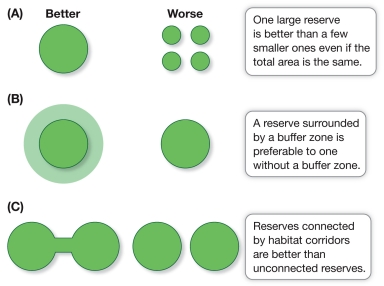 The figure illustrates three ecological principles considered in the establishment of protected areas.Briefly explain why the characteristics in the "better" column (larger reserves, buffer zones, and habitat corridors) are considered superior to their opposites in terms of supporting viable populations and ecosystem services.
 (Essay)
4.8/5 (82)
(82) In the eastern United States, 28 species of migratory birds are nesting earlier in the spring than they did several decades ago, and northeastern birds that winter in the southern United States are returning north 13 days earlier than they did a century ago.These changes are most likely due to
(Multiple Choice)
4.8/5 (81)
(81) Wild orca populations face many threats from humans.Sea World bred captive orcas from the 1980s until 2016.In captivity, orcas had their first calves much younger (8 years old) than wild orcas (14.9 years old).Captives were highly inbred and had a high number of stillbirths.Calves were later bred by artificial insemination.Suppose, in the future, orcas become endangered and the species must be saved through captive breeding and release.Based on this information, what factor or factors might limit the success of such a program?
(Essay)
4.9/5 (77)
(77) Which situation would be considered an example of habitat degradation, as opposed to habitat loss or destruction?
(Multiple Choice)
4.8/5 (69)
(69) A conservation group is debating the benefits of working specifically on the protection of an endangered species versus establishing a protected area that encompasses the habitat of that species.Which benefit would be provided only by the protected area option?
(Multiple Choice)
4.9/5 (69)
(69) Introduced from Asia more than 5,000 years ago, dingoes (wild dogs) are now considered an "honorary native species" in Australia.They are the largest predators in the country.Like wolves, they hunt in packs and can bring down prey the size of buffaloes.Where dingoes are scarce, foxes and cats have caused the extinction of 20 mammals and threaten many more.Where more dingoes are present, fox and cat numbers are low, and mammal populations are protected.But farmers want to eradicate dingoes, which sometimes prey on sheep.Which would likely happen to the ecosystem if dingoes were removed?
(Multiple Choice)
4.9/5 (70)
(70) Edge effects are often damaging to the biodiversity of the original habitat because they
(Multiple Choice)
4.7/5 (81)
(81) Genetic drift, leading to inbreeding depression, combined with demographic stochasticity can threaten biodiversity because it results in a smaller _______.
(Short Answer)
4.8/5 (96)
(96) One way ecologists try to estimate the effect of habitat loss on the rate of extinctions is by applying a concept from island biogeography known as the _______ relationship.
(Short Answer)
4.9/5 (69)
(69) Refer to the figure. 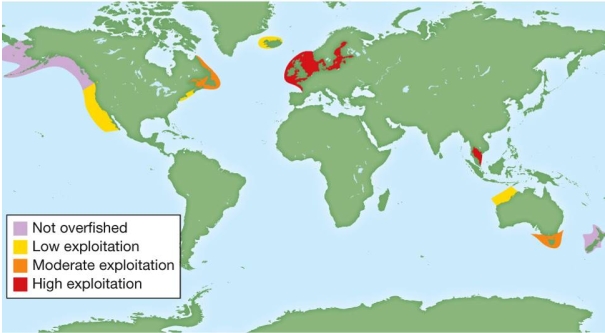 From the map, determine the locations in the world where overfishing is the most serious problem.Which continents or regions show high, moderate, and low exploitation? Why are the exploited areas close to continents?
 (Essay)
4.8/5 (66)
(66) Michigan scientists are trying to save the endangered Kirtland's warbler, a small songbird that breeds only in even-aged stands of jack pine.They have replanted stands of jack pine and used prescribed burning to develop stands of the middle-aged trees the warblers prefer.Which ecological concept is being used to aid this restoration ecology project?
(Multiple Choice)
4.8/5 (68)
(68) In the past 20 to 50 years, many plants have reacted to rising temperatures by blooming earlier in the spring.Early flowering is particularly associated with insect-pollinated plants.Which would be the most likely result if insect pollinators did not also emerge earlier, or if their emergence did not coincide with flowering?
(Multiple Choice)
4.7/5 (78)
(78) Deaths of individuals in a population could lead to genetic drift, inbreeding, and demographic stochasticity.This in turn reduces genetic diversity and fitness, which results in a smaller effective population size.This leads to a spiraling population decline known as a(n) _______.
(Short Answer)
4.8/5 (87)
(87) Developers are building ten new homes on a parcel of land of one habitat type.Local zoning regulations require that they leave some of the land in its natural condition to conserve native species.They can set aside either one large plot or five small separated plots.The total amount of conserved area is the same in either case.Which choice, if either, would be best for maintaining biodiversity, and why?
(Multiple Choice)
4.9/5 (77)
(77) 
Filters
- Essay(0)
- Multiple Choice(0)
- Short Answer(0)
- True False(0)
- Matching(0)