



 Chat with AI
Exam 58: A Changing Biosphere

Exam 1: Studying Life246 Questions
Exam 2: Small Molecules and the Chemistry of Life246 Questions
Exam 3: Proteins, Carbohydrates, and Lipids246 Questions
Exam 4: Nucleic Acids and the Origin of Life246 Questions
Exam 5: Cells: the Working Units of Life248 Questions
Exam 6: Cell Membranes246 Questions
Exam 7: Cell Communication and Multicellularity246 Questions
Exam 8: Energy, Enzymes, and Metabolism246 Questions
Exam 9: Pathways That Harvest Chemical Energy246 Questions
Exam 10: Photosynthesis: Energy From Sunlight242 Questions
Exam 11: The Cell Cycle and Cell Division260 Questions
Exam 12: Inheritance, Genes, and Chromosomes250 Questions
Exam 13: Dna and Its Role in Heredity257 Questions
Exam 14: From Dna to Protein: Gene Expression252 Questions
Exam 15: Gene Mutation and Molecular Medicine251 Questions
Exam 16: Regulation of Gene Expression245 Questions
Exam 17: Genomes249 Questions
Exam 18: Recombinant Dna and Biotechnology243 Questions
Exam 20: Mechanisms of Evolution243 Questions
Exam 21: Reconstructing and Using Phylogenies246 Questions
Exam 22: Speciation247 Questions
Exam 23: Evolution of Genes and Genomes252 Questions
Exam 24: The History of Life on Earth246 Questions
Exam 25: Bacteria, Archaea, and Viruses262 Questions
Exam 26: The Origin and Diversification of Eukaryotes252 Questions
Exam 27: Plants Without Seeds: From Water to Land251 Questions
Exam 28: The Evolution of Seed Plants259 Questions
Exam 29: The Evolution and Diversity of Fungi261 Questions
Exam 30: Animal Origins and the Evolution of Body Plans248 Questions
Exam 31: Protostome Animals244 Questions
Exam 32: Deuterostome Animals246 Questions
Exam 33: The Plant Body243 Questions
Exam 34: Transport in Plants248 Questions
Exam 35: Plant Nutrition247 Questions
Exam 36: Regulation of Plant Growth246 Questions
Exam 37: Reproduction in Flowering Plants247 Questions
Exam 38: Plant Responses to Environmental Challenges246 Questions
Exam 39: Physiology, Homeostasis, and Temperature Regulation258 Questions
Exam 40: Animal Hormones249 Questions
Exam 41: Immunology: Animal Defense Systems265 Questions
Exam 42: Animal Reproduction261 Questions
Exam 43: Animal Development261 Questions
Exam 44: Neurons, Glia, and Nervous Systems250 Questions
Exam 45: Sensory Systems249 Questions
Exam 46: The Mammalian Nervous System: Structure and Higher Functions254 Questions
Exam 47: Musculoskeletal Systems259 Questions
Exam 48: Gas Exchange247 Questions
Exam 49: Circulatory Systems252 Questions
Exam 50: Nutrition, Digestion, and Absorption259 Questions
Exam 51: Salt and Water Balance and Nitrogen Excretion251 Questions
Exam 52: Animal Behavior249 Questions
Exam 53: The Physical Environment and Biogeography of Life248 Questions
Exam 54: Populations259 Questions
Exam 55: Species Interactions254 Questions
Exam 56: Communities247 Questions
Exam 57: Ecosystems238 Questions
Exam 58: A Changing Biosphere222 Questions
Select questions type


Which of these activities, occurring in marine environments, would be considered an example of habitat degradation?
(Multiple Choice)
4.9/5  (77)
(77) The predicted increases in world temperatures, sea level, storms, and ocean acidification are all aspects of _______.
(Short Answer)
4.8/5 (80)
(80) Ninety percent of a forest is cut down and removed.This results in a loss of all members of several tree species in a region.The immediate loss of trees is an example of which factor important to biodiversity decline?
(Multiple Choice)
4.8/5 (75)
(75) Polar bears hunt seals by traveling over sea ice to areas where seals hunt in the ocean.Seals rarely come to land but use the sea ice to rest, give birth, and raise their pups.Which can be expected to happen to polar bears and seals as the climate warms and the sea ice melts more and more rapidly?
(Multiple Choice)
4.9/5 (80)
(80) All members of a rare cycad (ancient tree) species have been illegally removed from wild ecosystems in Africa.They exist today only in botanical parks and private collections.The cause of this type of species extinction is termed _______.
(Short Answer)
4.8/5 (73)
(73) Decades ago, a coastal wetland was drained, filled, and built upon as a city expanded outward.The wetland's permanent community of plants and animals was destroyed.In addition, people lost the wetland's aesthetic, recreational, and flood-control benefits.The city council recently voted to restore a part of the original wetland.The restoration process is least likely to involve which action?
(Multiple Choice)
4.8/5 (87)
(87) An industry releases toxic chemicals into a river.An oil spill occurs off the Gulf Coast, polluting local beaches and fishery areas.A cruise boat in the Pacific releases its trash, most of it plastic, into the open ocean.All of these are examples of
(Multiple Choice)
4.7/5 (72)
(72) Refer to the graph. 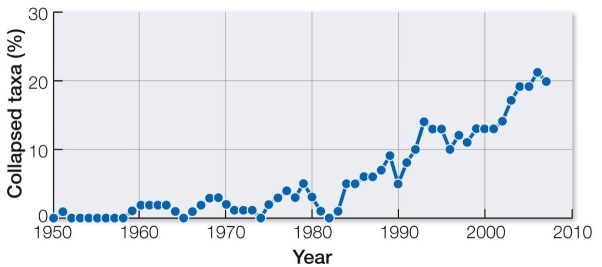 Ocean fisheries began collapsing in the twentieth century because of increased demand and better technologies.According to the graph, what is the best conclusion that can be drawn about the status of these fisheries between 1950 and 2010?
 (Multiple Choice)
4.9/5 (92)
(92) What can conservation biologists say with certainty about the causes of the extinction of species?
(Multiple Choice)
4.9/5 (78)
(78) An invasive species might have any of the following effects except
(Multiple Choice)
4.9/5 (75)
(75) Climate researchers have found that biomes are shifting toward the poles.This is particularly evident in temperate grasslands and boreal forests.It is expected that by 2100, nearly 40 percent of land-based ecosystems will have changed to different community types.This suggests that, in the near future, some
(Multiple Choice)
4.8/5 (72)
(72) Burmese pythons are among the world's largest snake species.Pet owners released a number of them into the Florida Everglades, where they have been breeding and spreading rapidly.Originally from Southeast Asia, the introduced pythons now prey on many kinds of Florida mammals and birds and even occasionally on alligators.
How is the proliferation of this top predator likely to affect the Everglades ecosystem?
(Essay)
4.9/5 (63)
(63) Human intervention to restore degraded ecosystems is primarily useful because it
(Multiple Choice)
4.8/5 (77)
(77) Scientists describe the recent decline in global biodiversity as Earth's sixth mass extinction.They are having difficulty determining exactly how rapidly species are disappearing, but most scientists fear they are underestimating the rate and number of species being lost.This underestimation would most likely occur because
(Multiple Choice)
4.8/5 (72)
(72) What are the most obvious effects of climate change now occurring on land, and what major changes are occurring in species or ecosystems as a result of these effects?
(Essay)
4.9/5 (76)
(76) A new fungal pathogen that affects certain oak trees is introduced into a forest.Why might this introduced pathogen be more damaging to forest species than an already present native pathogen?
(Multiple Choice)
4.8/5 (84)
(84) Ecotourism may be an important means of preserving endangered species, such as African wild dogs, for all of these reasons except that it
(Multiple Choice)
4.9/5 (82)
(82) Today, Earth is said to be undergoing a sixth mass extinction event, the first (and only) one caused by humans.This mass extinction event can best be distinguished from Earth's background extinction rate by considering the
(Multiple Choice)
4.9/5 (78)
(78) Why are coupled human-natural systems, in addition to protected areas, necessary to stem the loss of biodiversity?
(Multiple Choice)
4.9/5 (79)
(79) Climate changes are already beginning to cause species to change their life history and be at risk of extinction as a result of all of the following factors except
(Multiple Choice)
4.8/5 (90)
(90) 
Filters
- Essay(0)
- Multiple Choice(0)
- Short Answer(0)
- True False(0)
- Matching(0)