



 Chat with AI
Exam 58: A Changing Biosphere

Exam 1: Studying Life246 Questions
Exam 2: Small Molecules and the Chemistry of Life246 Questions
Exam 3: Proteins, Carbohydrates, and Lipids246 Questions
Exam 4: Nucleic Acids and the Origin of Life246 Questions
Exam 5: Cells: the Working Units of Life248 Questions
Exam 6: Cell Membranes246 Questions
Exam 7: Cell Communication and Multicellularity246 Questions
Exam 8: Energy, Enzymes, and Metabolism246 Questions
Exam 9: Pathways That Harvest Chemical Energy246 Questions
Exam 10: Photosynthesis: Energy From Sunlight242 Questions
Exam 11: The Cell Cycle and Cell Division260 Questions
Exam 12: Inheritance, Genes, and Chromosomes250 Questions
Exam 13: Dna and Its Role in Heredity257 Questions
Exam 14: From Dna to Protein: Gene Expression252 Questions
Exam 15: Gene Mutation and Molecular Medicine251 Questions
Exam 16: Regulation of Gene Expression245 Questions
Exam 17: Genomes249 Questions
Exam 18: Recombinant Dna and Biotechnology243 Questions
Exam 20: Mechanisms of Evolution243 Questions
Exam 21: Reconstructing and Using Phylogenies246 Questions
Exam 22: Speciation247 Questions
Exam 23: Evolution of Genes and Genomes252 Questions
Exam 24: The History of Life on Earth246 Questions
Exam 25: Bacteria, Archaea, and Viruses262 Questions
Exam 26: The Origin and Diversification of Eukaryotes252 Questions
Exam 27: Plants Without Seeds: From Water to Land251 Questions
Exam 28: The Evolution of Seed Plants259 Questions
Exam 29: The Evolution and Diversity of Fungi261 Questions
Exam 30: Animal Origins and the Evolution of Body Plans248 Questions
Exam 31: Protostome Animals244 Questions
Exam 32: Deuterostome Animals246 Questions
Exam 33: The Plant Body243 Questions
Exam 34: Transport in Plants248 Questions
Exam 35: Plant Nutrition247 Questions
Exam 36: Regulation of Plant Growth246 Questions
Exam 37: Reproduction in Flowering Plants247 Questions
Exam 38: Plant Responses to Environmental Challenges246 Questions
Exam 39: Physiology, Homeostasis, and Temperature Regulation258 Questions
Exam 40: Animal Hormones249 Questions
Exam 41: Immunology: Animal Defense Systems265 Questions
Exam 42: Animal Reproduction261 Questions
Exam 43: Animal Development261 Questions
Exam 44: Neurons, Glia, and Nervous Systems250 Questions
Exam 45: Sensory Systems249 Questions
Exam 46: The Mammalian Nervous System: Structure and Higher Functions254 Questions
Exam 47: Musculoskeletal Systems259 Questions
Exam 48: Gas Exchange247 Questions
Exam 49: Circulatory Systems252 Questions
Exam 50: Nutrition, Digestion, and Absorption259 Questions
Exam 51: Salt and Water Balance and Nitrogen Excretion251 Questions
Exam 52: Animal Behavior249 Questions
Exam 53: The Physical Environment and Biogeography of Life248 Questions
Exam 54: Populations259 Questions
Exam 55: Species Interactions254 Questions
Exam 56: Communities247 Questions
Exam 57: Ecosystems238 Questions
Exam 58: A Changing Biosphere222 Questions
Select questions type


An invasive, as opposed to an introduced, species is usually characterized by
(Multiple Choice)
4.9/5  (81)
(81) Which initiative would not be included in modern conservation biology's efforts to preserve biodiversity?
(Multiple Choice)
4.9/5 (81)
(81) Which of these is not currently a factor important to biodiversity decline?
(Multiple Choice)
4.8/5 (85)
(85) Fragmenting of habitats, as is done in tropical rainforests, intensifies stress on organisms more and more as the habitats become smaller.This occurs as a result of _______.
(Short Answer)
4.7/5 (71)
(71) Tropical rainforests are being destroyed in South America, Africa, and Southeast Asia.Every year, an area of rainforest the size of the country of Panama is destroyed.Much of this destruction is done by either clear cutting or burning, both of which leave the land completely barren.This loss of rainforest will likely have a negative impact on all of the following environmental factors except the
(Multiple Choice)
4.8/5 (69)
(69) The exotic pet trade, in addition to further depleting rare and endangered species, is damaging to species biodiversity because it also may
(Multiple Choice)
4.8/5 (81)
(81) Every year, billions of pounds of plastic (from plastic bags to drink bottles to fishing nets) enter the world's oceans.Plastics do not break down chemically but are constantly eroded by wind and water.Fish, sea turtles, seabirds, and marine mammals ingest plastics or become entangled in large pieces and die.Even zooplankton take in tiny pieces when filter feeding.Categorize the type of biodiversity threat posed by ocean plastic, and hypothesize its likely effects on the ocean food web.
(Essay)
4.8/5 (87)
(87) Natural populations are losing individuals for many reasons, including loss or degradation of habitat, overharvesting, species invasion, or disease.This loss of individuals most likely results in which change to the overall populations?
(Multiple Choice)
4.8/5 (88)
(88) The agreement known as CITES would be involved in protection of endangered species through which of these activities?
(Multiple Choice)
4.7/5 (89)
(89) The use of CITES to protect an endangered species would be most appropriate under circumstances in which a species is threatened by
(Multiple Choice)
4.9/5 (77)
(77) As temperatures increase and spring arrives earlier, it is likely that more and more animals and plants will start to reproduce _______ in the season.
(Short Answer)
4.7/5 (74)
(74) Some endangered species are currently being kept alive through breeding programs in zoos, aquariums, and botanical gardens.However, these programs are only temporary, because
(Multiple Choice)
4.8/5 (78)
(78) Refer to the figure. 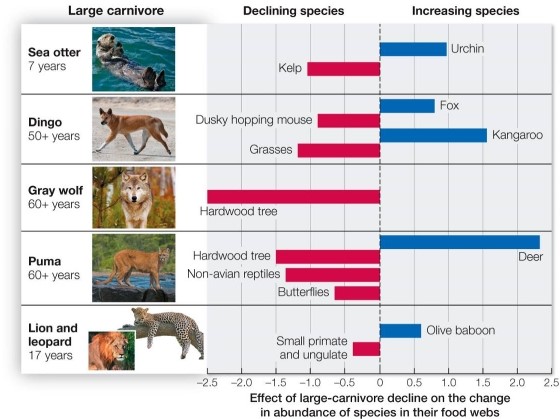 Based on information in the figure, the best conclusion that can be drawn about the effect of removing a top predator from an ecosystem is that the removal will cause
 (Multiple Choice)
4.9/5 (67)
(67) A conservation biologist is promoting the preservation of a wilderness site that includes a stand of old-growth forest.She emphasizes the age of the trees and the importance of preserving this ancient ecosystem for future generations.She states that "it is the right thing to do." This scientist is arguing that biodiversity (as exemplified by this ancient forest) is important because
(Multiple Choice)
4.9/5 (88)
(88) In some parts of the Midwest, prairie restoration programs have required replacement of introduced agricultural grasses, such as bluegrasses, with the native prairie grasses that once thrived there.Prairie restoration proved difficult until scientists discovered that native prairie grasses were adapted to survive periodic wildfires, while introduced grasses were not.They changed their method to include prescribed burns.In this case, the restoration ecology project benefited from the use of which ecological concept?
(Multiple Choice)
5.0/5 (87)
(87) Until a few years ago, ivory-billed woodpeckers had not been seen since the 1940s.The species was widely assumed to be extinct.Its habitat in the lowland forests of the southeastern United States had been destroyed by clear cutting.Then, in 2004, two ornithologists thought they spotted an ivory-bill in an Arkansas swamp.These and other ornithologists immediately began a massive search.Several more sightings and a few audio recordings were made, and ornithologists hoped the species was recovering now that forests are regrowing.But skeptics challenged both the sightings and the recordings.No reliable sightings have been made since 2005.Given this information, what conclusion can be drawn about the extinction of the ivory-billed woodpecker?
(Multiple Choice)
4.9/5 (82)
(82) A species has a very small population size but has been maintaining a stable population.During one year, the few breeding females produce many more males than females.The next year, the population is much smaller.This is an example of the population characteristic called _______.
(Short Answer)
4.8/5 (92)
(92) Assume a potentially invasive species is about to be accidentally introduced into the United States via ship ballast water.The best way to control this species is to
(Multiple Choice)
4.9/5 (79)
(79) Human-caused changes such as habitat loss, overharvesting, and climate change often lead to lowered effective population sizes, which in turn lead to a loss of ecosystem _______.
(Short Answer)
4.8/5 (90)
(90) Some invasive species carry pathogens or parasites with them.Scientists think this might be one reason why some introduced species become invasive.Carrying pathogens or parasites might make an invading species more successful if the invading pathogen or parasite
(Multiple Choice)
5.0/5 (86)
(86) 
Filters
- Essay(0)
- Multiple Choice(0)
- Short Answer(0)
- True False(0)
- Matching(0)