



 Chat with AI
Exam 58: A Changing Biosphere

Exam 1: Studying Life246 Questions
Exam 2: Small Molecules and the Chemistry of Life246 Questions
Exam 3: Proteins, Carbohydrates, and Lipids246 Questions
Exam 4: Nucleic Acids and the Origin of Life246 Questions
Exam 5: Cells: the Working Units of Life248 Questions
Exam 6: Cell Membranes246 Questions
Exam 7: Cell Communication and Multicellularity246 Questions
Exam 8: Energy, Enzymes, and Metabolism246 Questions
Exam 9: Pathways That Harvest Chemical Energy246 Questions
Exam 10: Photosynthesis: Energy From Sunlight242 Questions
Exam 11: The Cell Cycle and Cell Division260 Questions
Exam 12: Inheritance, Genes, and Chromosomes250 Questions
Exam 13: Dna and Its Role in Heredity257 Questions
Exam 14: From Dna to Protein: Gene Expression252 Questions
Exam 15: Gene Mutation and Molecular Medicine251 Questions
Exam 16: Regulation of Gene Expression245 Questions
Exam 17: Genomes249 Questions
Exam 18: Recombinant Dna and Biotechnology243 Questions
Exam 20: Mechanisms of Evolution243 Questions
Exam 21: Reconstructing and Using Phylogenies246 Questions
Exam 22: Speciation247 Questions
Exam 23: Evolution of Genes and Genomes252 Questions
Exam 24: The History of Life on Earth246 Questions
Exam 25: Bacteria, Archaea, and Viruses262 Questions
Exam 26: The Origin and Diversification of Eukaryotes252 Questions
Exam 27: Plants Without Seeds: From Water to Land251 Questions
Exam 28: The Evolution of Seed Plants259 Questions
Exam 29: The Evolution and Diversity of Fungi261 Questions
Exam 30: Animal Origins and the Evolution of Body Plans248 Questions
Exam 31: Protostome Animals244 Questions
Exam 32: Deuterostome Animals246 Questions
Exam 33: The Plant Body243 Questions
Exam 34: Transport in Plants248 Questions
Exam 35: Plant Nutrition247 Questions
Exam 36: Regulation of Plant Growth246 Questions
Exam 37: Reproduction in Flowering Plants247 Questions
Exam 38: Plant Responses to Environmental Challenges246 Questions
Exam 39: Physiology, Homeostasis, and Temperature Regulation258 Questions
Exam 40: Animal Hormones249 Questions
Exam 41: Immunology: Animal Defense Systems265 Questions
Exam 42: Animal Reproduction261 Questions
Exam 43: Animal Development261 Questions
Exam 44: Neurons, Glia, and Nervous Systems250 Questions
Exam 45: Sensory Systems249 Questions
Exam 46: The Mammalian Nervous System: Structure and Higher Functions254 Questions
Exam 47: Musculoskeletal Systems259 Questions
Exam 48: Gas Exchange247 Questions
Exam 49: Circulatory Systems252 Questions
Exam 50: Nutrition, Digestion, and Absorption259 Questions
Exam 51: Salt and Water Balance and Nitrogen Excretion251 Questions
Exam 52: Animal Behavior249 Questions
Exam 53: The Physical Environment and Biogeography of Life248 Questions
Exam 54: Populations259 Questions
Exam 55: Species Interactions254 Questions
Exam 56: Communities247 Questions
Exam 57: Ecosystems238 Questions
Exam 58: A Changing Biosphere222 Questions
Select questions type


Which is the best example of a coupled human-natural system?
(Multiple Choice)
4.8/5  (83)
(83) A program in which the National Wildlife Federation certifies individuals' backyards as wildlife-friendly habitats can be considered a _______ system.
(Short Answer)
4.8/5 (84)
(84) Scientists consider amphibians, which die or show signs of stress in degraded environmental conditions, to be biological indicators for all of the following reasons except that they
(Multiple Choice)
4.8/5 (67)
(67) Refer to the graphs. 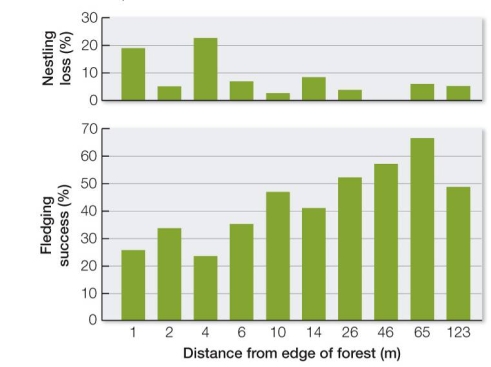 According to the graphs, the fledging success of a nesting forest bird will be less than 50 percent unless the bird is at least _______ meters from the forest edge.
 (Multiple Choice)
4.9/5 (76)
(76) All of these factors have been specifically implicated in the worldwide decline of amphibians except
(Multiple Choice)
4.8/5 (77)
(77) An area that restricts or prohibits habitat loss and degradation and that is designed to conserve and manage biodiversity and to replenish populations that might otherwise become extinct is known as a(n)
(Multiple Choice)
4.9/5 (100)
(100) When ocean fisheries began, the most sought-after species were top predators such as bluefin tuna, orange roughy, and Chilean sea bass.These fisheries have now collapsed, and fishermen have responded by "fishing down the food chain," that is, taking smaller species from lower levels.If the trend of overharvesting continues at these lower trophic levels, what will the likely effect on ocean food webs be?
(Multiple Choice)
4.7/5 (72)
(72) Can captive breeding of the California condor be considered a success?
(Multiple Choice)
4.8/5 (90)
(90) The Amur leopard now lives only in remote northern forests of Russia; the last census showed only 14-20 adults and 5-6 cubs surviving.The leopard no longer occurs in Korea or northern China.The Amur tiger had approximately the same range; in the 1940s, only 40 tigers remained in the Russian Far East.Russia gave government protection to the tiger, and the population has now increased to about 540 individuals.The IUCN classifies these two animals into different categories.Based on their current populations, one would expect the leopard to be classified as
(Multiple Choice)
5.0/5 (89)
(89) The flightless dodo bird lived on the island of Mauritius in the Indian Ocean.It was the largest animal on the island and had no predators.When Portuguese ships landed in 1505, the dodo was easy prey for sailors wanting a new food source.It was trapped on the island and unable to fly, so it could not get away.Sailors also introduced rats, pigs, and monkeys, which ate the dodos' eggs.The dodo was extinct by 1681.Which factors were important in its extinction?
(Multiple Choice)
4.9/5 (79)
(79) Conservation biologists in the past have concentrated on preserving ecosystems high in biodiversity.However, there has been a continued loss of biodiversity due to habitat loss, climate change, and other factors.The emphasis on preserving ecosystems is thus evolving to place a greater emphasis on rebuilding degraded ecosystems, a process known as _______.
(Short Answer)
4.8/5 (75)
(75) The Miami blue butterfly was thought extinct since the 1980s, due to habitat loss and fragmentation, but two small isolated populations were recently found in the Florida Keys.There is no migration between the two populations, and effective population size is described as "critically low." Population fluctuations have been seen in recent generations, but there has been no drastic decline in population size.In the near future, the persistence of Miami blue butterfly populations will likely be threatened by all of the following factors except
(Multiple Choice)
4.9/5 (73)
(73) Refer to the graphs. 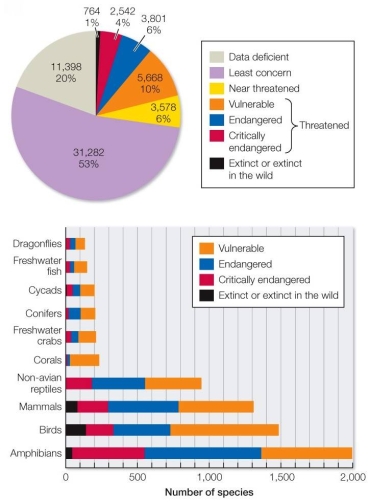 Based on the graphs, which conclusion can reasonably be drawn about future extinctions?
 (Multiple Choice)
4.8/5 (83)
(83) An imported plant escapes from a greenhouse and begins to grow outdoors.Unnoticed at first, it proliferates and its seeds begin to spread.After several years, it occurs in the wild in several states.The plant grows faster than many native species and is difficult to eradicate.Which is the most likely result of this plant's introduction into the ecosystem?
(Multiple Choice)
5.0/5 (81)
(81) Tropical evergreen forests might be especially vulnerable to extinction because the trees
(Multiple Choice)
4.9/5 (79)
(79) Up to the present, the factor responsible for most of Earth's loss of biodiversity has been
(Multiple Choice)
4.8/5 (83)
(83) In the Hawaiian Islands, non-native mosquitoes introduced the blood disease malaria, which has wiped out nearly all low-elevation native birds.This species of mosquito was introduced, and because of its effect on native populations, it can now be considered _______.
(Short Answer)
4.7/5 (77)
(77) Conservationists undertaking a restoration ecology project would most likely be seeking which outcome?
(Multiple Choice)
4.8/5 (90)
(90) One way to determine whether a population is being overharvested is to determine when it is no longer sustainable-that is, when the population is being harvested faster than it can be replaced by its natural rate of reproduction.In the case of an exploited ocean fishery, an observer would first become aware that the fishery is being overharvested when fish biomass
(Multiple Choice)
4.9/5 (74)
(74) 
Filters
- Essay(0)
- Multiple Choice(0)
- Short Answer(0)
- True False(0)
- Matching(0)