



 Chat with AI
Exam 58: A Changing Biosphere

Exam 1: Studying Life246 Questions
Exam 2: Small Molecules and the Chemistry of Life246 Questions
Exam 3: Proteins, Carbohydrates, and Lipids246 Questions
Exam 4: Nucleic Acids and the Origin of Life246 Questions
Exam 5: Cells: the Working Units of Life248 Questions
Exam 6: Cell Membranes246 Questions
Exam 7: Cell Communication and Multicellularity246 Questions
Exam 8: Energy, Enzymes, and Metabolism246 Questions
Exam 9: Pathways That Harvest Chemical Energy246 Questions
Exam 10: Photosynthesis: Energy From Sunlight242 Questions
Exam 11: The Cell Cycle and Cell Division260 Questions
Exam 12: Inheritance, Genes, and Chromosomes250 Questions
Exam 13: Dna and Its Role in Heredity257 Questions
Exam 14: From Dna to Protein: Gene Expression252 Questions
Exam 15: Gene Mutation and Molecular Medicine251 Questions
Exam 16: Regulation of Gene Expression245 Questions
Exam 17: Genomes249 Questions
Exam 18: Recombinant Dna and Biotechnology243 Questions
Exam 20: Mechanisms of Evolution243 Questions
Exam 21: Reconstructing and Using Phylogenies246 Questions
Exam 22: Speciation247 Questions
Exam 23: Evolution of Genes and Genomes252 Questions
Exam 24: The History of Life on Earth246 Questions
Exam 25: Bacteria, Archaea, and Viruses262 Questions
Exam 26: The Origin and Diversification of Eukaryotes252 Questions
Exam 27: Plants Without Seeds: From Water to Land251 Questions
Exam 28: The Evolution of Seed Plants259 Questions
Exam 29: The Evolution and Diversity of Fungi261 Questions
Exam 30: Animal Origins and the Evolution of Body Plans248 Questions
Exam 31: Protostome Animals244 Questions
Exam 32: Deuterostome Animals246 Questions
Exam 33: The Plant Body243 Questions
Exam 34: Transport in Plants248 Questions
Exam 35: Plant Nutrition247 Questions
Exam 36: Regulation of Plant Growth246 Questions
Exam 37: Reproduction in Flowering Plants247 Questions
Exam 38: Plant Responses to Environmental Challenges246 Questions
Exam 39: Physiology, Homeostasis, and Temperature Regulation258 Questions
Exam 40: Animal Hormones249 Questions
Exam 41: Immunology: Animal Defense Systems265 Questions
Exam 42: Animal Reproduction261 Questions
Exam 43: Animal Development261 Questions
Exam 44: Neurons, Glia, and Nervous Systems250 Questions
Exam 45: Sensory Systems249 Questions
Exam 46: The Mammalian Nervous System: Structure and Higher Functions254 Questions
Exam 47: Musculoskeletal Systems259 Questions
Exam 48: Gas Exchange247 Questions
Exam 49: Circulatory Systems252 Questions
Exam 50: Nutrition, Digestion, and Absorption259 Questions
Exam 51: Salt and Water Balance and Nitrogen Excretion251 Questions
Exam 52: Animal Behavior249 Questions
Exam 53: The Physical Environment and Biogeography of Life248 Questions
Exam 54: Populations259 Questions
Exam 55: Species Interactions254 Questions
Exam 56: Communities247 Questions
Exam 57: Ecosystems238 Questions
Exam 58: A Changing Biosphere222 Questions
Select questions type


Ocean fisheries have been a major source of human food for centuries.But with the rapid rise of human populations and the development of high-tech fishing gear, extreme overharvesting of many species has occurred in the last century.This harvesting for food contrasts with harvesting by people who obtain and sell aquarium fish from coral reefs.Compare and contrast these two types of overharvesting.How does overharvesting affect the ecosystem in each case?
(Essay)
4.9/5  (80)
(80) A fern lives in the tropical rainforest and depends on the dense shade of the forest to survive.Then the rainforest where the fern lives is cut down and replaced with open pastureland, which is warmer and drier.The fern goes extinct.This is an example of biodiversity loss due to
(Multiple Choice)
4.7/5 (90)
(90) In Southern California, scientists watched 15 culverts and underpasses and found that various carnivores, mule deer, small mammals, and reptiles traveled through them to other parts of the area.Although not designed for that purpose, the culverts and underpasses served as
(Multiple Choice)
4.7/5 (68)
(68) Arctic ice algae grow in nutrient-rich pockets in and under sea ice.The algae are food for zooplankton, which are eaten by Arctic cod.The cod are eaten by marine mammals such as seals, which in turn are eaten by polar bears.As Arctic temperatures warm and sea ice melts, there is less and less habitat for ice algae.How will this change affect this Arctic food web?
(Multiple Choice)
4.8/5 (76)
(76) The recent rediscovery of the pygmy tarsier, thought to be extinct for the previous 85 years, suggests that
(Multiple Choice)
4.7/5 (85)
(85) Major causes of the global decrease in biodiversity include all of the following except
(Multiple Choice)
4.8/5 (77)
(77) Refer to the figure. 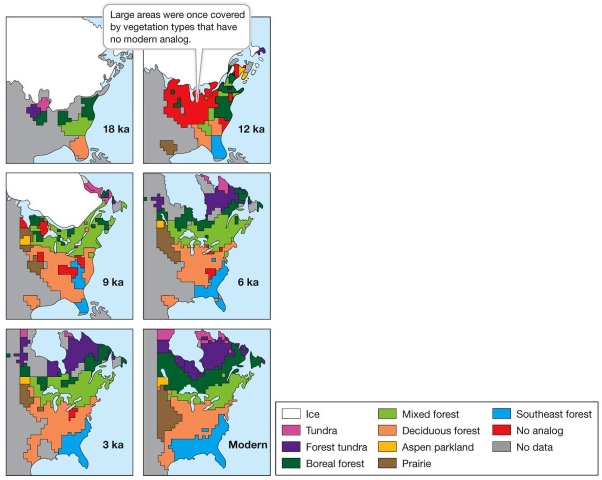 Study the maps showing changes in vegetation in the eastern United States since the last ice age, 18,000 years ago (18 ka).Describe the change in patterns for mixed forest, deciduous forest, and southeast forest.What general conclusions can you draw about the movement of vegetation as ice melted and receded to the north? How does this pattern relate to changes occurring today?
 (Essay)
5.0/5 (69)
(69) For more than 200 years, sea otters were exploited for their beautiful pelts.When otter populations declined, populations of their main food source, sea urchins, exploded.Urchins then overharvested kelp, their primary food source, leaving areas barren of kelp and depriving many other species of habitat.This description suggests that the species in this ocean ecosystem that were harmed by sea otter overharvesting included
(Multiple Choice)
4.7/5 (75)
(75) The cane toad is native to Central and South America and can grow to be a foot long.It was introduced into Hawaii, the Philippines, and the Caribbean to control pests in sugarcane fields.It quickly became a serious pest itself because it eats anything it can fit into its mouth.It also secretes a powerful toxin.The cane toad can best be described as a(n) _______.
(Short Answer)
4.8/5 (73)
(73) Overharvesting would most likely result in extinction for a species that is
(Multiple Choice)
4.9/5 (83)
(83) Winter moth, a species of moth that was introduced to the United States from Europe, has spread widely and become a threat to many trees.Winter moth would be classified as a(n) _______ species.
(Short Answer)
4.8/5 (82)
(82) Controlling the spread of invasive species around the world is especially difficult because of the
(Multiple Choice)
4.8/5 (72)
(72) The extinction of heath hens, a subspecies of prairie chickens (in the grouse family), on Martha's Vineyard, Massachusetts, was the result of
(Multiple Choice)
4.8/5 (86)
(86) What major factor prevents the use of captive breeding programs as a solution for saving endangered species?
(Multiple Choice)
4.9/5 (88)
(88) A national park in Bolivia was designed with three distinct areas.Area A is a large central area designated "no extraction"; no resources of any kind can be removed from it.Area B is a large surrounding area populated by indigenous peoples and designated to allow them to continue to farm and hunt there.Outside both areas, area C is zoned for "extractive" uses (for example, livestock raising and a gas pipeline).What terms would best describe areas A and B, respectively?
(Multiple Choice)
4.8/5 (68)
(68) The fungal pathogen Batrachochytrium dendrobatidis, or Bd, has been strongly implicated in the decline of amphibians around the world.Researchers are currently debating whether Bd is a novel pathogen, recently introduced into wild populations (the "novel pathogen hypothesis"), or whether it existed before the declines and emerged because of human-caused environmental changes (the "emerging endemic hypothesis").Based on what you know about this disease and its spread, which hypothesis seems more likely? Justify your choice.
(Essay)
4.8/5 (83)
(83) Refer to the graph. 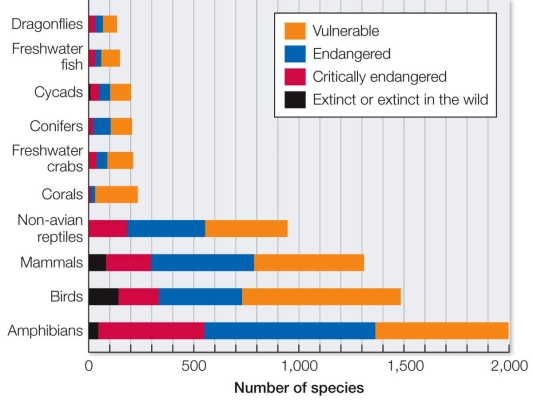 So far, the IUCN has assessed more than 76,000 species, but there are at least 8.7 million species on Earth (probably more), and most of them are invertebrates.Few plants and invertebrates have been assessed.Their list of at-risk organisms is heavily skewed toward vertebrates, which are larger and easier to measure.Given this knowledge, what is the most reasonable conclusion that can be drawn regarding the at-risk groups shown on the graph?
 (Multiple Choice)
4.7/5 (83)
(83) To accommodate the needs of various local groups, park managers in the Philippines maintained the outer boundaries of a national park but adjusted the internal boundaries.They defined a core area where biodiversity was completely protected, and they assigned several outer multiple-use zones.These multiple-use zones might also be called _______.
(Short Answer)
4.8/5 (79)
(79) The government must assess a species' extinction risk and decide that it is endangered before it can be placed on the U.S.endangered species list.This usually happens in response to a petition from an environmental group or other agency.Which factor is most likely to cause the government to reject the species (that is, decide not to place it on the endangered list)?
(Multiple Choice)
4.9/5 (78)
(78) Leatherback turtles occur in the Atlantic, Pacific, and Indian oceans and migrate among all three oceans.In 1980, there were 115,000 nesting females globally; by 2015, that number had dropped to between 26,000 and 43,000.This decline resulted from poaching for eggs and meat, destruction of nesting sites, accidental catches by fishermen, disorientation of nestlings due to artificial lighting from coastal developments, and more.What does this information suggest about the future of leatherback turtles?
(Multiple Choice)
4.9/5 (75)
(75) 
Filters
- Essay(0)
- Multiple Choice(0)
- Short Answer(0)
- True False(0)
- Matching(0)