Multiple Choice
Refer to the graph. 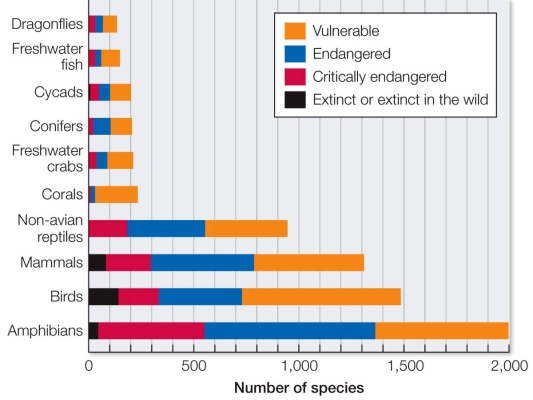 So far, the IUCN has assessed more than 76,000 species, but there are at least 8.7 million species on Earth (probably more) , and most of them are invertebrates.Few plants and invertebrates have been assessed.Their list of at-risk organisms is heavily skewed toward vertebrates, which are larger and easier to measure.Given this knowledge, what is the most reasonable conclusion that can be drawn regarding the at-risk groups shown on the graph?
A) Of the species assessed, amphibians have by far the most species at risk.
B) Of the species assessed, most are likely to go extinct eventually.
C) Most dragonfly and other insect species are not at risk.
D) Vertebrates are most at risk because they are the most important organisms.
E) Even after new species are assessed, few plant species will be at risk.
Correct Answer:

Verified
Correct Answer:
Verified
Q172: Controlling the spread of invasive species around
Q173: The extinction of heath hens, a subspecies
Q174: What major factor prevents the use of
Q175: A national park in Bolivia was designed
Q176: The fungal pathogen Batrachochytrium dendrobatidis, or Bd,
Q178: To accommodate the needs of various local
Q179: The government must assess a species' extinction
Q180: Leatherback turtles occur in the Atlantic, Pacific,
Q181: Which is the best example of a
Q182: A program in which the National Wildlife