



 Chat with AI
Exam 58: A Changing Biosphere

Exam 1: Studying Life246 Questions
Exam 2: Small Molecules and the Chemistry of Life246 Questions
Exam 3: Proteins, Carbohydrates, and Lipids246 Questions
Exam 4: Nucleic Acids and the Origin of Life246 Questions
Exam 5: Cells: the Working Units of Life248 Questions
Exam 6: Cell Membranes246 Questions
Exam 7: Cell Communication and Multicellularity246 Questions
Exam 8: Energy, Enzymes, and Metabolism246 Questions
Exam 9: Pathways That Harvest Chemical Energy246 Questions
Exam 10: Photosynthesis: Energy From Sunlight242 Questions
Exam 11: The Cell Cycle and Cell Division260 Questions
Exam 12: Inheritance, Genes, and Chromosomes250 Questions
Exam 13: Dna and Its Role in Heredity257 Questions
Exam 14: From Dna to Protein: Gene Expression252 Questions
Exam 15: Gene Mutation and Molecular Medicine251 Questions
Exam 16: Regulation of Gene Expression245 Questions
Exam 17: Genomes249 Questions
Exam 18: Recombinant Dna and Biotechnology243 Questions
Exam 20: Mechanisms of Evolution243 Questions
Exam 21: Reconstructing and Using Phylogenies246 Questions
Exam 22: Speciation247 Questions
Exam 23: Evolution of Genes and Genomes252 Questions
Exam 24: The History of Life on Earth246 Questions
Exam 25: Bacteria, Archaea, and Viruses262 Questions
Exam 26: The Origin and Diversification of Eukaryotes252 Questions
Exam 27: Plants Without Seeds: From Water to Land251 Questions
Exam 28: The Evolution of Seed Plants259 Questions
Exam 29: The Evolution and Diversity of Fungi261 Questions
Exam 30: Animal Origins and the Evolution of Body Plans248 Questions
Exam 31: Protostome Animals244 Questions
Exam 32: Deuterostome Animals246 Questions
Exam 33: The Plant Body243 Questions
Exam 34: Transport in Plants248 Questions
Exam 35: Plant Nutrition247 Questions
Exam 36: Regulation of Plant Growth246 Questions
Exam 37: Reproduction in Flowering Plants247 Questions
Exam 38: Plant Responses to Environmental Challenges246 Questions
Exam 39: Physiology, Homeostasis, and Temperature Regulation258 Questions
Exam 40: Animal Hormones249 Questions
Exam 41: Immunology: Animal Defense Systems265 Questions
Exam 42: Animal Reproduction261 Questions
Exam 43: Animal Development261 Questions
Exam 44: Neurons, Glia, and Nervous Systems250 Questions
Exam 45: Sensory Systems249 Questions
Exam 46: The Mammalian Nervous System: Structure and Higher Functions254 Questions
Exam 47: Musculoskeletal Systems259 Questions
Exam 48: Gas Exchange247 Questions
Exam 49: Circulatory Systems252 Questions
Exam 50: Nutrition, Digestion, and Absorption259 Questions
Exam 51: Salt and Water Balance and Nitrogen Excretion251 Questions
Exam 52: Animal Behavior249 Questions
Exam 53: The Physical Environment and Biogeography of Life248 Questions
Exam 54: Populations259 Questions
Exam 55: Species Interactions254 Questions
Exam 56: Communities247 Questions
Exam 57: Ecosystems238 Questions
Exam 58: A Changing Biosphere222 Questions
Select questions type


Determining the extinction of a species is difficult for a number of reasons, including lack of knowledge of their habitats, life cycles, and distributions.Given such difficulties, which of these animals would be most likely to be declared extinct?
(Multiple Choice)
4.9/5  (98)
(98) The Arctic Ocean is experiencing some climate-related changes.Some waters have recently become ice-free because of rising temperatures.These waters are now too deep for some commercially important species such as Arctic cod.As ocean acidification increases, it will reduce the productivity of shelled organisms, including mollusks and some plankton.Also, stratification will likely become more intense.Warmer water will float on a layer of colder, denser, nutrient-rich water, preventing nutrients from reaching the surface.What will these changes most likely mean for Arctic fish populations?
(Multiple Choice)
4.8/5 (66)
(66) The major causes of habitat loss and degradation, and subsequent biodiversity loss, are timber harvesting, livestock grazing, and _______.
(Short Answer)
4.8/5 (75)
(75) Scientists are particularly concerned about the decline of amphibian species and numbers because
(Multiple Choice)
4.8/5 (79)
(79) A small invasive fish called the stone moroko was introduced into Europe from China.The fish carries an intracellular parasite that does not harm the moroko but is a generalist parasite.It attacks various other species of fish, causing higher mortality and inability to spawn.It is implicated in the rapid decline of the now-endangered European sunbleak (a member of the carp family).Which is the most likely result of the introduction of the intracellular parasite into European fresh water?
(Multiple Choice)
4.7/5 (80)
(80) Refer to the figure. 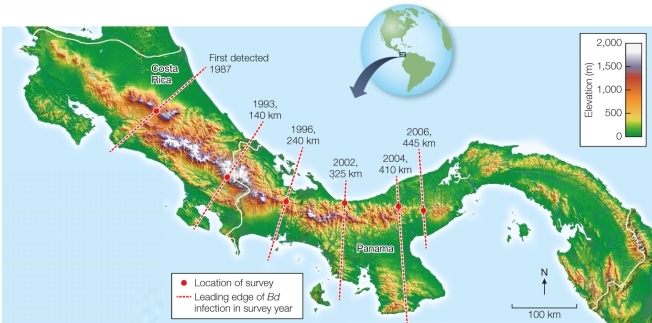 The map shows the movement of the fungal pathogen Batrachochytrium dendrobatidis, or Bd, through the countries of Costa Rica and Panama between 1987 and 2006.According to the map, which is the best description of the movement of Bd during this time?
 (Multiple Choice)
4.9/5 (83)
(83) Bluefin tuna are ocean predators that feed on a variety of smaller fish, including herring, anchovies, sardines, bluefish, and mackerel.They maintain balance in these populations.Tuna are preyed on by some toothed whales and sharks, and their meat is prized by the Japanese as a source for sushi.Since World War II, human harvesting has depleted species numbers, leaving bluefins endangered.Conservationists say ecological extinction of bluefin tuna would have serious and unpredictable consequences.The most likely consequence is that loss of tuna would
(Multiple Choice)
4.7/5 (85)
(85) Nonmarket services related to biodiversity are often difficult to estimate because they
(Multiple Choice)
4.9/5 (94)
(94) Habitat corridors would be least effective in facilitating movement between natural areas for which of these species?
(Multiple Choice)
4.9/5 (90)
(90) Which situation best represents the benefits of nonmarket values inherent in the protection of ecosystem biodiversity?
(Multiple Choice)
4.7/5 (90)
(90) In their study of pollination on coffee plantations in Costa Rica, Stanford University scientists were able to show
(Multiple Choice)
4.8/5 (90)
(90) Refer to the figure. 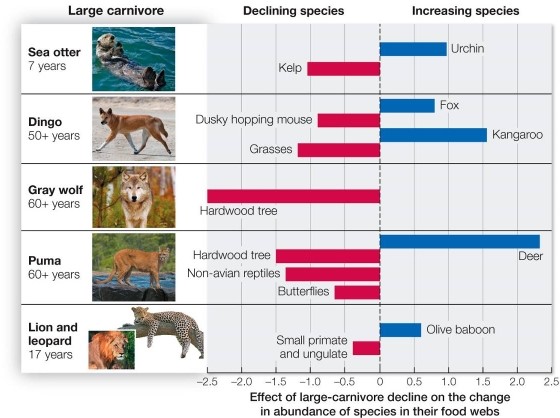 The diagram shows the effects of large carnivore declines on other species in their food webs.Blue bars represent direct effects of carnivore declines, and red bars represent indirect effects.The data suggest that species such as deer increased when the carnivore left, and then caused the secondary decline of other species, such as hardwood trees.This means that the large carnivore served as a(n)
 (Multiple Choice)
4.9/5 (76)
(76) Australian pygmy bluetongue lizards were not seen for 33 years.They were thought to be extinct until one was discovered inside a snake in 1992.Prior to that time, only 19 individuals were known from anywhere in the world.The species inhabits a restricted geographic area and uses the burrows of spiders for refuge, the only lizard known to do so.Biologists did not observe bluetongue lizards because they did not look inside spider burrows.It has likely been difficult to determine the status of this lizard for all of the following reasons except that
(Multiple Choice)
4.9/5 (79)
(79) Refer to the graph. 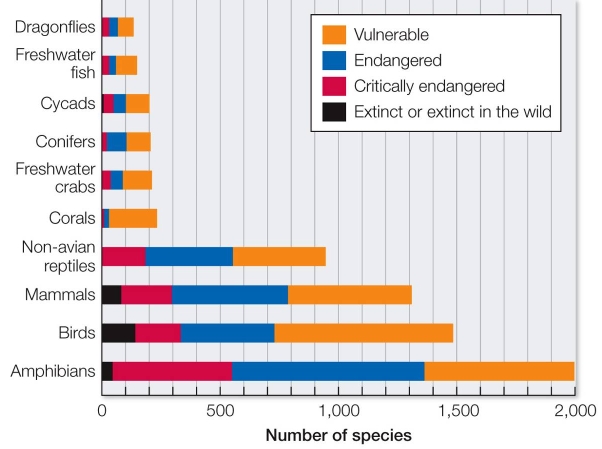 The IUCN has so far assessed 53,033 species, of the approximately 8.7 million thought to exist on Earth.The graph shows the number of species in each extinction risk category that so far have been assessed.This suggests that, especially in nonvertebrate categories, such as corals, the numbers shown on the graph are likely to be
 (Multiple Choice)
4.8/5 (86)
(86) Which is the least likely way in which an aquatic species might be accidentally introduced into U.S.waters?
(Multiple Choice)
4.8/5 (92)
(92) Most wildlife trade is legal.It includes trade in both plants and animals; thus, exotic flowers, pets, wood used for furniture, and "wild" ingredients used in food and medicines are all included.Conservationists consider wildlife trade a problem when it is illegal and involves endangered species.This is most likely because endangered species
(Multiple Choice)
4.9/5 (86)
(86) In recent years, deadly coral bleaching events have increased on reefs around the world.This increase is strongly correlated with rising reef temperatures.The worst bleaching events occur in years when an El Niño weather event occurs, causing even higher spikes in reef temperatures.Based on this evidence, one can conclude that El Niño weather events likely
(Multiple Choice)
5.0/5 (67)
(67) The wood thrush is a forest interior species, which reproduces most successfully in areas deep inside the forest.The cowbird is a grassland and forest edge species that has flourished as humans have cut forests and built towns.Cowbirds lay eggs in other birds' nests, and the host birds often raise the larger cowbird nestlings.As cowbird population size and geographic range have expanded, wood thrush populations have declined.Which factor is likely most responsible for the declining wood thrush population?
(Multiple Choice)
4.9/5 (86)
(86) The vaquita is a very small porpoise that lives in the Gulf of California.Its total population dropped from 60 to 30 total individuals between 2016 and 2017.It occurs with the totoaba fish, which is prized in Asia and illegally traded from Mexico to China.The vaquita is caught and drowned in fishing nets meant to catch the totoaba.The Clymene dolphin occurs in small groups of 60 to 80 individuals, with same sexes grouping together.It lives in the Atlantic Ocean and sometimes schools with common dolphins and spinner dolphins.The Clymene dolphin's world population is about 15,000.It is believed to be naturally rare.Which of these small cetaceans seems more likely to go extinct in the near future?
(Multiple Choice)
4.7/5 (71)
(71) A predatory invasive species enters an ecosystem that has an endangered species that serves as one possible type of prey.Which is the most likely outcome of the species interaction?
(Multiple Choice)
4.9/5 (71)
(71) 
Filters
- Essay(0)
- Multiple Choice(0)
- Short Answer(0)
- True False(0)
- Matching(0)