



 Chat with AI
Exam 58: A Changing Biosphere

Exam 1: Studying Life246 Questions
Exam 2: Small Molecules and the Chemistry of Life246 Questions
Exam 3: Proteins, Carbohydrates, and Lipids246 Questions
Exam 4: Nucleic Acids and the Origin of Life246 Questions
Exam 5: Cells: the Working Units of Life248 Questions
Exam 6: Cell Membranes246 Questions
Exam 7: Cell Communication and Multicellularity246 Questions
Exam 8: Energy, Enzymes, and Metabolism246 Questions
Exam 9: Pathways That Harvest Chemical Energy246 Questions
Exam 10: Photosynthesis: Energy From Sunlight242 Questions
Exam 11: The Cell Cycle and Cell Division260 Questions
Exam 12: Inheritance, Genes, and Chromosomes250 Questions
Exam 13: Dna and Its Role in Heredity257 Questions
Exam 14: From Dna to Protein: Gene Expression252 Questions
Exam 15: Gene Mutation and Molecular Medicine251 Questions
Exam 16: Regulation of Gene Expression245 Questions
Exam 17: Genomes249 Questions
Exam 18: Recombinant Dna and Biotechnology243 Questions
Exam 20: Mechanisms of Evolution243 Questions
Exam 21: Reconstructing and Using Phylogenies246 Questions
Exam 22: Speciation247 Questions
Exam 23: Evolution of Genes and Genomes252 Questions
Exam 24: The History of Life on Earth246 Questions
Exam 25: Bacteria, Archaea, and Viruses262 Questions
Exam 26: The Origin and Diversification of Eukaryotes252 Questions
Exam 27: Plants Without Seeds: From Water to Land251 Questions
Exam 28: The Evolution of Seed Plants259 Questions
Exam 29: The Evolution and Diversity of Fungi261 Questions
Exam 30: Animal Origins and the Evolution of Body Plans248 Questions
Exam 31: Protostome Animals244 Questions
Exam 32: Deuterostome Animals246 Questions
Exam 33: The Plant Body243 Questions
Exam 34: Transport in Plants248 Questions
Exam 35: Plant Nutrition247 Questions
Exam 36: Regulation of Plant Growth246 Questions
Exam 37: Reproduction in Flowering Plants247 Questions
Exam 38: Plant Responses to Environmental Challenges246 Questions
Exam 39: Physiology, Homeostasis, and Temperature Regulation258 Questions
Exam 40: Animal Hormones249 Questions
Exam 41: Immunology: Animal Defense Systems265 Questions
Exam 42: Animal Reproduction261 Questions
Exam 43: Animal Development261 Questions
Exam 44: Neurons, Glia, and Nervous Systems250 Questions
Exam 45: Sensory Systems249 Questions
Exam 46: The Mammalian Nervous System: Structure and Higher Functions254 Questions
Exam 47: Musculoskeletal Systems259 Questions
Exam 48: Gas Exchange247 Questions
Exam 49: Circulatory Systems252 Questions
Exam 50: Nutrition, Digestion, and Absorption259 Questions
Exam 51: Salt and Water Balance and Nitrogen Excretion251 Questions
Exam 52: Animal Behavior249 Questions
Exam 53: The Physical Environment and Biogeography of Life248 Questions
Exam 54: Populations259 Questions
Exam 55: Species Interactions254 Questions
Exam 56: Communities247 Questions
Exam 57: Ecosystems238 Questions
Exam 58: A Changing Biosphere222 Questions
Select questions type


In 1900, there were about 100,000 cheetahs living in the wild, across Africa and Asia.Today, there are only 9,000 to 12,000 cheetahs remaining.These survivors are restricted to parts of eastern, central, and southwestern Africa, with a small portion (less than 200) in Iran.These changes suggest that the effective population size of cheetahs is currently
(Multiple Choice)
4.8/5  (93)
(93) Throughout the Northern Hemisphere, plant species are blooming several weeks earlier than they did 50 years ago.Also, their insect pollinators are emerging and reproducing earlier, so they require earlier-blooming flowers to provide pollen and nectar.These changes in timing are most likely caused by
(Multiple Choice)
4.9/5 (94)
(94) All species are affected by climate change, and some of them respond by moving their ranges poleward.Of the insects, birds, and trees contained in a given ecosystem, the _______ would likely be the slowest to move their ranges.
(Short Answer)
5.0/5 (64)
(64) Groupers are large fish that act as top predators and keystone species in their coral reef habitats.They are preferentially harvested by fishermen.If overharvested, their decline would likely result in changes to the reef ecosystem and
(Multiple Choice)
4.7/5 (79)
(79) Approximately 50 percent of current medicines either come from or are based on natural substances.Researchers also depend on natural biodiversity as a source of future medicines, foods, and energy.This potential use of biodiversity most directly relates to which aspect or value of biodiversity?
(Multiple Choice)
4.9/5 (80)
(80) Suppose a highly virulent virus is found in chickens and several wild birds in the United States.It is new to the United States but has been seen a few times in isolated cases in African birds.Scientists think it might have arrived in the United States in a shipment of parrots, at least one of which was infected.In the United States, this virus would represent a(n)
(Multiple Choice)
4.9/5 (86)
(86) A type of green seaweed known as "killer algae" was once native to the Indian and Pacific oceans but has escaped from aquariums in California, Japan, Australia, and Monaco.In the Mediterranean, it is replacing native algae and depriving native marine life of food and habitat.California eradicated the algae by using costly toxic chemicals.Would killer algae be considered invasive, or merely introduced? Why?
(Multiple Choice)
4.8/5 (72)
(72) A city planning agency wants to restore an abandoned industrial area to its original natural state, including restoration of its original biodiversity.Based on methods typically used in restoration ecology, they would likely carry out all the following activities except
(Multiple Choice)
4.7/5 (71)
(71) Which effort to preserve biodiversity would be classified as restoration ecology?
(Multiple Choice)
4.8/5 (71)
(71) A landowner wants to control an invasive plant species.He analyzes the spread of the plant and realizes that the plant infestation has three areas: a highly infested core area, a middle area or "advancing front" that has fewer plants but is expanding, and an outlier area that has the lowest plant density.The landowner decides to focus his first control efforts on the outlier area.What is his likely rationale for this choice?
(Multiple Choice)
4.8/5 (76)
(76) Kemp's ridley sea turtles nest along a single stretch of the Mexican coast in the Gulf of Mexico.In the 1940s, more than 100,000 turtles came ashore to nest in a single day.In the 1980s, only a few hundred were left, and now they are critically endangered.Initially, Kemp's ridleys were hunted for meat and particularly for their eggs, almost all of which were taken.Today, survivors are caught in fishing nets and threatened by pollution.This suggests that the major reason the Kemp's ridley sea turtle is critically endangered is
(Multiple Choice)
4.8/5 (77)
(77) In 1989, CITES instituted a ban on trade in African elephant ivory but reversed the ban in several African countries in 2008.The main reason for reversing the ban was that
(Multiple Choice)
4.9/5 (62)
(62) Scientists at the Woods Hole Oceanographic Institute tested marine organisms under different levels of atmospheric CO2, which dissolves in the ocean to form carbonic acid.They tested organisms at today's level (400 ppm) and several higher CO2 levels.At very high levels, the shells of clams, oysters, and some snails and urchins partially dissolved.However, crustaceans, including lobsters, crabs, and prawns, appeared to build more resilient skeletons.Which of the following do these results suggest about future marine ecosystems under higher CO2 levels (more acidic oceans)?
(Multiple Choice)
4.8/5 (80)
(80) Which is a major reason scientists are alarmed by the rapid and massive loss of amphibians?
(Multiple Choice)
4.9/5 (77)
(77) Converting private agricultural land in northeastern Montana to a native prairie landscape is an example of _______.
(Short Answer)
5.0/5 (83)
(83) Which of these actions is an example of ecological restoration?
(Multiple Choice)
4.8/5 (81)
(81) The fungal pathogen Batrachochytrium dendrobatidis, or Bd, appears to be partly responsible for the worldwide decline in _______.
(Short Answer)
4.8/5 (78)
(78) Ecologists often focus on protecting keystone species as a way of preserving endangered ecosystems.This is most likely because keystone species are the
(Multiple Choice)
4.7/5 (62)
(62) The population of the California red-legged frog has been severely affected as its habitat has been drained, filled, and covered with housing developments, parking lots, and other urban structures.The best description of the type of pressure exerted on the frogs in this situation is
(Multiple Choice)
4.9/5 (75)
(75) Refer to the map. 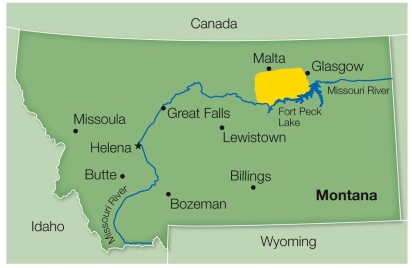 The map shows the area of a large prairie restoration project currently underway in Montana.What ecological features does this location have that make it suitable for prairie restoration, as discussed in the text? What practical (as opposed to ecological) factors make this a feasible location?
 (Essay)
4.9/5 (93)
(93) 
Filters
- Essay(0)
- Multiple Choice(0)
- Short Answer(0)
- True False(0)
- Matching(0)