



 Chat with AI
Exam 38: Plant Responses to Environmental Challenges

Exam 1: Studying Life246 Questions
Exam 2: Small Molecules and the Chemistry of Life246 Questions
Exam 3: Proteins, Carbohydrates, and Lipids246 Questions
Exam 4: Nucleic Acids and the Origin of Life246 Questions
Exam 5: Cells: the Working Units of Life248 Questions
Exam 6: Cell Membranes246 Questions
Exam 7: Cell Communication and Multicellularity246 Questions
Exam 8: Energy, Enzymes, and Metabolism246 Questions
Exam 9: Pathways That Harvest Chemical Energy246 Questions
Exam 10: Photosynthesis: Energy From Sunlight242 Questions
Exam 11: The Cell Cycle and Cell Division260 Questions
Exam 12: Inheritance, Genes, and Chromosomes250 Questions
Exam 13: Dna and Its Role in Heredity257 Questions
Exam 14: From Dna to Protein: Gene Expression252 Questions
Exam 15: Gene Mutation and Molecular Medicine251 Questions
Exam 16: Regulation of Gene Expression245 Questions
Exam 17: Genomes249 Questions
Exam 18: Recombinant Dna and Biotechnology243 Questions
Exam 20: Mechanisms of Evolution243 Questions
Exam 21: Reconstructing and Using Phylogenies246 Questions
Exam 22: Speciation247 Questions
Exam 23: Evolution of Genes and Genomes252 Questions
Exam 24: The History of Life on Earth246 Questions
Exam 25: Bacteria, Archaea, and Viruses262 Questions
Exam 26: The Origin and Diversification of Eukaryotes252 Questions
Exam 27: Plants Without Seeds: From Water to Land251 Questions
Exam 28: The Evolution of Seed Plants259 Questions
Exam 29: The Evolution and Diversity of Fungi261 Questions
Exam 30: Animal Origins and the Evolution of Body Plans248 Questions
Exam 31: Protostome Animals244 Questions
Exam 32: Deuterostome Animals246 Questions
Exam 33: The Plant Body243 Questions
Exam 34: Transport in Plants248 Questions
Exam 35: Plant Nutrition247 Questions
Exam 36: Regulation of Plant Growth246 Questions
Exam 37: Reproduction in Flowering Plants247 Questions
Exam 38: Plant Responses to Environmental Challenges246 Questions
Exam 39: Physiology, Homeostasis, and Temperature Regulation258 Questions
Exam 40: Animal Hormones249 Questions
Exam 41: Immunology: Animal Defense Systems265 Questions
Exam 42: Animal Reproduction261 Questions
Exam 43: Animal Development261 Questions
Exam 44: Neurons, Glia, and Nervous Systems250 Questions
Exam 45: Sensory Systems249 Questions
Exam 46: The Mammalian Nervous System: Structure and Higher Functions254 Questions
Exam 47: Musculoskeletal Systems259 Questions
Exam 48: Gas Exchange247 Questions
Exam 49: Circulatory Systems252 Questions
Exam 50: Nutrition, Digestion, and Absorption259 Questions
Exam 51: Salt and Water Balance and Nitrogen Excretion251 Questions
Exam 52: Animal Behavior249 Questions
Exam 53: The Physical Environment and Biogeography of Life248 Questions
Exam 54: Populations259 Questions
Exam 55: Species Interactions254 Questions
Exam 56: Communities247 Questions
Exam 57: Ecosystems238 Questions
Exam 58: A Changing Biosphere222 Questions
Select questions type


In a lab test, when leaves of an infected plant are placed in a culture plate adjacent to pathogenic bacteria, the bacteria die.This provides evidence that the plant is likely producing
(Multiple Choice)
4.9/5  (85)
(85) Which character is not a plant adaptation to a dry environment?
(Multiple Choice)
4.8/5 (75)
(75) Which substances are usually produced within hours of infection and are toxic to many bacteria and fungi?
(Multiple Choice)
4.8/5 (78)
(78) What type of signaling is involved when a plant perceives and responds to pathogens?
(Multiple Choice)
4.9/5 (78)
(78) Plants with long dormant periods interrupted by short periods of rapid growth and reproduction typically live in _______ environments.
(Short Answer)
4.9/5 (92)
(92) Refer to the figure. 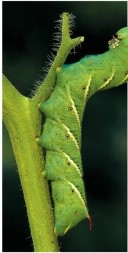 This hornworm is engaged in an evolutionary arms race with the tobacco plant.Which statement about the plant's response to this herbivore is false?
 (Multiple Choice)
4.9/5 (67)
(67) Nicotine helps to defend plants against herbivores by acting as a(n)
(Multiple Choice)
4.7/5 (79)
(79) Defensive water-soluble secondary compounds formed by plants are most commonly stored in the
(Multiple Choice)
4.8/5 (70)
(70) If a leaf on a plant is eaten by herbivores, the plant increases the concentration of alkaloids in the sharp trichomes on leaves that are produced subsequently.This increased production of alkaloids is an example of a(n)
(Multiple Choice)
4.9/5 (93)
(93) In the gene-for-gene resistance mechanism, if a plant has a resistance gene and a pathogen has the matching Avr gene, the
(Multiple Choice)
4.9/5 (86)
(86) Glucosinolates help to protect plants against herbivores by
(Multiple Choice)
4.9/5 (85)
(85) A newly discovered relative of the rubber tree most likely uses _______ as its main and most effective defense against herbivores.
(Multiple Choice)
4.8/5 (71)
(71) Plants sometimes protect themselves from their own toxic secondary metabolites by
(Multiple Choice)
5.0/5 (86)
(86) Which quality best characterizes systemic acquired resistance?
(Multiple Choice)
4.9/5 (82)
(82) There is currently an urgent need for the development of _______ strains that are resistant to a fungal infection called rust.
(Short Answer)
4.8/5 (87)
(87) Because wet soils are often deficient in _______, submerged root systems often grow _______.
(Multiple Choice)
4.9/5 (70)
(70) 
Filters
- Essay(0)
- Multiple Choice(0)
- Short Answer(0)
- True False(0)
- Matching(0)