



 Chat with AI
Exam 38: Plant Responses to Environmental Challenges

Exam 1: Studying Life246 Questions
Exam 2: Small Molecules and the Chemistry of Life246 Questions
Exam 3: Proteins, Carbohydrates, and Lipids246 Questions
Exam 4: Nucleic Acids and the Origin of Life246 Questions
Exam 5: Cells: the Working Units of Life248 Questions
Exam 6: Cell Membranes246 Questions
Exam 7: Cell Communication and Multicellularity246 Questions
Exam 8: Energy, Enzymes, and Metabolism246 Questions
Exam 9: Pathways That Harvest Chemical Energy246 Questions
Exam 10: Photosynthesis: Energy From Sunlight242 Questions
Exam 11: The Cell Cycle and Cell Division260 Questions
Exam 12: Inheritance, Genes, and Chromosomes250 Questions
Exam 13: Dna and Its Role in Heredity257 Questions
Exam 14: From Dna to Protein: Gene Expression252 Questions
Exam 15: Gene Mutation and Molecular Medicine251 Questions
Exam 16: Regulation of Gene Expression245 Questions
Exam 17: Genomes249 Questions
Exam 18: Recombinant Dna and Biotechnology243 Questions
Exam 20: Mechanisms of Evolution243 Questions
Exam 21: Reconstructing and Using Phylogenies246 Questions
Exam 22: Speciation247 Questions
Exam 23: Evolution of Genes and Genomes252 Questions
Exam 24: The History of Life on Earth246 Questions
Exam 25: Bacteria, Archaea, and Viruses262 Questions
Exam 26: The Origin and Diversification of Eukaryotes252 Questions
Exam 27: Plants Without Seeds: From Water to Land251 Questions
Exam 28: The Evolution of Seed Plants259 Questions
Exam 29: The Evolution and Diversity of Fungi261 Questions
Exam 30: Animal Origins and the Evolution of Body Plans248 Questions
Exam 31: Protostome Animals244 Questions
Exam 32: Deuterostome Animals246 Questions
Exam 33: The Plant Body243 Questions
Exam 34: Transport in Plants248 Questions
Exam 35: Plant Nutrition247 Questions
Exam 36: Regulation of Plant Growth246 Questions
Exam 37: Reproduction in Flowering Plants247 Questions
Exam 38: Plant Responses to Environmental Challenges246 Questions
Exam 39: Physiology, Homeostasis, and Temperature Regulation258 Questions
Exam 40: Animal Hormones249 Questions
Exam 41: Immunology: Animal Defense Systems265 Questions
Exam 42: Animal Reproduction261 Questions
Exam 43: Animal Development261 Questions
Exam 44: Neurons, Glia, and Nervous Systems250 Questions
Exam 45: Sensory Systems249 Questions
Exam 46: The Mammalian Nervous System: Structure and Higher Functions254 Questions
Exam 47: Musculoskeletal Systems259 Questions
Exam 48: Gas Exchange247 Questions
Exam 49: Circulatory Systems252 Questions
Exam 50: Nutrition, Digestion, and Absorption259 Questions
Exam 51: Salt and Water Balance and Nitrogen Excretion251 Questions
Exam 52: Animal Behavior249 Questions
Exam 53: The Physical Environment and Biogeography of Life248 Questions
Exam 54: Populations259 Questions
Exam 55: Species Interactions254 Questions
Exam 56: Communities247 Questions
Exam 57: Ecosystems238 Questions
Exam 58: A Changing Biosphere222 Questions
Select questions type


Increased tolerance of a plant to an environmental stress that results from prior exposure is most likely an example of
(Multiple Choice)
4.8/5  (76)
(76) In some swamp plants, root extensions called _______ grow into the air and deliver oxygen to the rest of the root system.
(Short Answer)
4.7/5 (81)
(81) Refer to the figure. 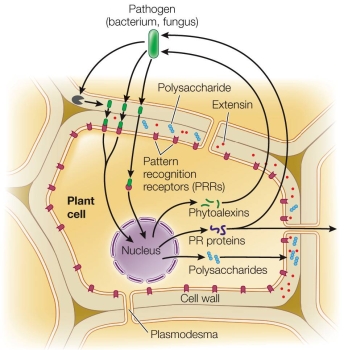 Which statement best describes the role of pathogen associated molecular patterns (PAMPs) in this signal transduction pathway?
 (Multiple Choice)
4.7/5 (88)
(88) A newly discovered gene in a petunia plant produces an integral membrane protein that helps the petunia resist pathogens.This gene probably codes for a
(Multiple Choice)
4.8/5 (95)
(95) Which statement about the general immunity response of a plant to a pathogen is false?
(Multiple Choice)
4.7/5 (72)
(72) How might the adaptations of herbivores affect plant evolution? How might plant adaptations affect the evolution of herbivores?
(Essay)
4.9/5 (82)
(82) When an herbivore chews on plant tissue, molecules called _______ are formed.These molecules bind to a _______ in the plasma membrane of a _______ cell and initiate the formation of jasmonates.
(Multiple Choice)
4.8/5 (90)
(90) A plant that produces tannins in response to attack by an herbivore is trying to
(Multiple Choice)
5.0/5 (85)
(85) Refer to the figure. 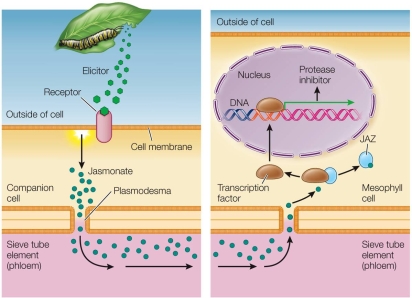 Insects raised on a diet of plant materials grow more slowly than those grown on a nonplant nutrient medium in the lab.This implies that the gene shown in the right panel of the figure is important for producing which defense compounds?
 (Multiple Choice)
4.9/5 (67)
(67) Compared to plants native to moist forests, annual plants in the deserts of the southwestern United States are more likely to
(Multiple Choice)
4.9/5 (81)
(81) Pyrethrin is an example of a defensive secondary metabolite called a(n)
(Multiple Choice)
4.7/5 (75)
(75) The tobacco hornworm (Manduca sexta) is adapted to feeding on nicotine-producing plants.Using genetically modified tobacco plants that do not produce nicotine, how might you test the hypothesis that dietary nicotine protects the tobacco hornworm against its parasite Cotesia congregata?
(Essay)
5.0/5 (85)
(85) Which of the following is an example of gene-for-gene resistance in a plant?
(Multiple Choice)
4.8/5 (85)
(85) Leaves adapted to a dry environment are least likely to exhibit
(Multiple Choice)
4.8/5 (89)
(89) A gardener is wondering where to plant a newly acquired unlabeled plant.You notice the plant has pneumatophores, so you advise the gardener plant it in
(Multiple Choice)
4.8/5 (77)
(77) Refer to the figure. 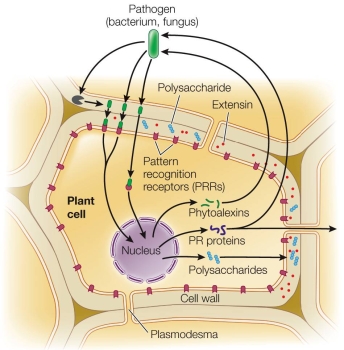 Which statement best describes the role of extensin in this signal transduction pathway?
 (Multiple Choice)
4.7/5 (77)
(77) 
Filters
- Essay(0)
- Multiple Choice(0)
- Short Answer(0)
- True False(0)
- Matching(0)