



 Chat with AI
Exam 38: Plant Responses to Environmental Challenges

Exam 1: Studying Life246 Questions
Exam 2: Small Molecules and the Chemistry of Life246 Questions
Exam 3: Proteins, Carbohydrates, and Lipids246 Questions
Exam 4: Nucleic Acids and the Origin of Life246 Questions
Exam 5: Cells: the Working Units of Life248 Questions
Exam 6: Cell Membranes246 Questions
Exam 7: Cell Communication and Multicellularity246 Questions
Exam 8: Energy, Enzymes, and Metabolism246 Questions
Exam 9: Pathways That Harvest Chemical Energy246 Questions
Exam 10: Photosynthesis: Energy From Sunlight242 Questions
Exam 11: The Cell Cycle and Cell Division260 Questions
Exam 12: Inheritance, Genes, and Chromosomes250 Questions
Exam 13: Dna and Its Role in Heredity257 Questions
Exam 14: From Dna to Protein: Gene Expression252 Questions
Exam 15: Gene Mutation and Molecular Medicine251 Questions
Exam 16: Regulation of Gene Expression245 Questions
Exam 17: Genomes249 Questions
Exam 18: Recombinant Dna and Biotechnology243 Questions
Exam 20: Mechanisms of Evolution243 Questions
Exam 21: Reconstructing and Using Phylogenies246 Questions
Exam 22: Speciation247 Questions
Exam 23: Evolution of Genes and Genomes252 Questions
Exam 24: The History of Life on Earth246 Questions
Exam 25: Bacteria, Archaea, and Viruses262 Questions
Exam 26: The Origin and Diversification of Eukaryotes252 Questions
Exam 27: Plants Without Seeds: From Water to Land251 Questions
Exam 28: The Evolution of Seed Plants259 Questions
Exam 29: The Evolution and Diversity of Fungi261 Questions
Exam 30: Animal Origins and the Evolution of Body Plans248 Questions
Exam 31: Protostome Animals244 Questions
Exam 32: Deuterostome Animals246 Questions
Exam 33: The Plant Body243 Questions
Exam 34: Transport in Plants248 Questions
Exam 35: Plant Nutrition247 Questions
Exam 36: Regulation of Plant Growth246 Questions
Exam 37: Reproduction in Flowering Plants247 Questions
Exam 38: Plant Responses to Environmental Challenges246 Questions
Exam 39: Physiology, Homeostasis, and Temperature Regulation258 Questions
Exam 40: Animal Hormones249 Questions
Exam 41: Immunology: Animal Defense Systems265 Questions
Exam 42: Animal Reproduction261 Questions
Exam 43: Animal Development261 Questions
Exam 44: Neurons, Glia, and Nervous Systems250 Questions
Exam 45: Sensory Systems249 Questions
Exam 46: The Mammalian Nervous System: Structure and Higher Functions254 Questions
Exam 47: Musculoskeletal Systems259 Questions
Exam 48: Gas Exchange247 Questions
Exam 49: Circulatory Systems252 Questions
Exam 50: Nutrition, Digestion, and Absorption259 Questions
Exam 51: Salt and Water Balance and Nitrogen Excretion251 Questions
Exam 52: Animal Behavior249 Questions
Exam 53: The Physical Environment and Biogeography of Life248 Questions
Exam 54: Populations259 Questions
Exam 55: Species Interactions254 Questions
Exam 56: Communities247 Questions
Exam 57: Ecosystems238 Questions
Exam 58: A Changing Biosphere222 Questions
Select questions type


Pathogens can be walled off during the hypersensitive response by the process of
(Multiple Choice)
4.7/5  (86)
(86) When a plant responds to a pathogen by turning on the hypersensitive response, what is the most likely result?
(Multiple Choice)
4.8/5 (78)
(78) Which statement about compounds that plants make to ward off predators and infection is true?
(Multiple Choice)
4.7/5 (69)
(69) Xerophyte plants with fleshy, water-storing leaves are called _______.
(Short Answer)
4.9/5 (75)
(75) Refer to the figure, showing a micrograph of a stomatal crypt. 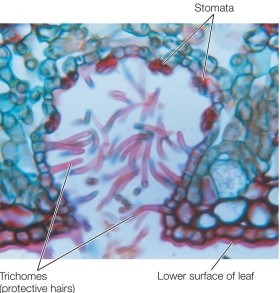 Trichomes are small hairs lining the stomata of some plants, such as this one.Which description does not reflect a possible role of trichomes?
 (Multiple Choice)
4.9/5 (93)
(93) Pathogens employ _______ genes that code for molecules called elicitors.
(Multiple Choice)
4.9/5 (81)
(81) Chaperonins are especially important in plants subjected to
(Multiple Choice)
4.8/5 (84)
(84) Which stressor causes high concentrations of abscisic acid to travel from the roots to the shoot?
(Multiple Choice)
4.8/5 (72)
(72) Some plants survive desert conditions by carrying out their entire life cycle in the days that follow a rare rainfall that soaks the soil.They are collectively referred to as _______.
(Short Answer)
5.0/5 (68)
(68) Wheat rust is a virulent fungal pathogen that threatens the food supply in many parts of the world.How might scientists combat this fungus?
(Essay)
4.8/5 (65)
(65) Endogenous alkaloids have long been thought to be deterrents to herbivores.Which statement about nicotine provides direct support for this conclusion?
(Multiple Choice)
4.9/5 (72)
(72) The roots of plants growing in water-logged soils often become _______ because oxygen _______ in water-saturated soils.
(Multiple Choice)
4.8/5 (72)
(72) In some aquatic plants, _______ tissue allows oxygen to reach submerged tissues.
(Short Answer)
5.0/5 (73)
(73) The major stress encountered by plants living in waterlogged soil is lack of _______.
(Short Answer)
4.8/5 (87)
(87) Which strategy is not used by plants to protect themselves from the toxic compounds they produce?
(Multiple Choice)
4.9/5 (89)
(89) Which of the following is not a plant adaptation to a saline environment?
(Multiple Choice)
4.7/5 (88)
(88) Which environmental stress in plants is most likely to lead to changes in membrane fluidity?
(Multiple Choice)
4.8/5 (70)
(70) 
Filters
- Essay(0)
- Multiple Choice(0)
- Short Answer(0)
- True False(0)
- Matching(0)