



 Chat with AI
Exam 7: Cell Communication and Multicellularity

Exam 1: Studying Life246 Questions
Exam 2: Small Molecules and the Chemistry of Life246 Questions
Exam 3: Proteins, Carbohydrates, and Lipids246 Questions
Exam 4: Nucleic Acids and the Origin of Life246 Questions
Exam 5: Cells: the Working Units of Life248 Questions
Exam 6: Cell Membranes246 Questions
Exam 7: Cell Communication and Multicellularity246 Questions
Exam 8: Energy, Enzymes, and Metabolism246 Questions
Exam 9: Pathways That Harvest Chemical Energy246 Questions
Exam 10: Photosynthesis: Energy From Sunlight242 Questions
Exam 11: The Cell Cycle and Cell Division260 Questions
Exam 12: Inheritance, Genes, and Chromosomes250 Questions
Exam 13: Dna and Its Role in Heredity257 Questions
Exam 14: From Dna to Protein: Gene Expression252 Questions
Exam 15: Gene Mutation and Molecular Medicine251 Questions
Exam 16: Regulation of Gene Expression245 Questions
Exam 17: Genomes249 Questions
Exam 18: Recombinant Dna and Biotechnology243 Questions
Exam 20: Mechanisms of Evolution243 Questions
Exam 21: Reconstructing and Using Phylogenies246 Questions
Exam 22: Speciation247 Questions
Exam 23: Evolution of Genes and Genomes252 Questions
Exam 24: The History of Life on Earth246 Questions
Exam 25: Bacteria, Archaea, and Viruses262 Questions
Exam 26: The Origin and Diversification of Eukaryotes252 Questions
Exam 27: Plants Without Seeds: From Water to Land251 Questions
Exam 28: The Evolution of Seed Plants259 Questions
Exam 29: The Evolution and Diversity of Fungi261 Questions
Exam 30: Animal Origins and the Evolution of Body Plans248 Questions
Exam 31: Protostome Animals244 Questions
Exam 32: Deuterostome Animals246 Questions
Exam 33: The Plant Body243 Questions
Exam 34: Transport in Plants248 Questions
Exam 35: Plant Nutrition247 Questions
Exam 36: Regulation of Plant Growth246 Questions
Exam 37: Reproduction in Flowering Plants247 Questions
Exam 38: Plant Responses to Environmental Challenges246 Questions
Exam 39: Physiology, Homeostasis, and Temperature Regulation258 Questions
Exam 40: Animal Hormones249 Questions
Exam 41: Immunology: Animal Defense Systems265 Questions
Exam 42: Animal Reproduction261 Questions
Exam 43: Animal Development261 Questions
Exam 44: Neurons, Glia, and Nervous Systems250 Questions
Exam 45: Sensory Systems249 Questions
Exam 46: The Mammalian Nervous System: Structure and Higher Functions254 Questions
Exam 47: Musculoskeletal Systems259 Questions
Exam 48: Gas Exchange247 Questions
Exam 49: Circulatory Systems252 Questions
Exam 50: Nutrition, Digestion, and Absorption259 Questions
Exam 51: Salt and Water Balance and Nitrogen Excretion251 Questions
Exam 52: Animal Behavior249 Questions
Exam 53: The Physical Environment and Biogeography of Life248 Questions
Exam 54: Populations259 Questions
Exam 55: Species Interactions254 Questions
Exam 56: Communities247 Questions
Exam 57: Ecosystems238 Questions
Exam 58: A Changing Biosphere222 Questions
Select questions type


Refer to the graph below. 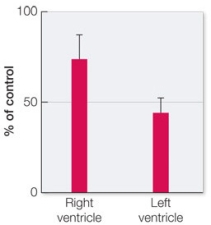 The graph shows data for the amount of connexin protein present in cells of the right ventricle and cells of the left ventricle isolated from patients who experienced heart failure due to arrhythmia.The quantities are expressed as percentage of the amount of connexin protein present in controls, determined using heart cells from individuals without heart failure.Which hypothesis is supported by these data?
 (Multiple Choice)
4.9/5  (76)
(76) Refer to the table below. 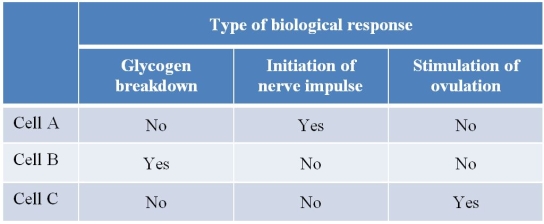 The table lists three different biological responses that result from cAMP-mediated signal transduction pathways.The "yes" and "no" references indicate which cells are capable of displaying the three biological responses.This information provides evidence in support of which statement about signal transduction pathways?
 (Multiple Choice)
4.8/5 (73)
(73) Refer to the figure below, which shows the signal transduction pathway initiated by the binding of an odorant molecule to an olfactory receptor of an olfactory neuron. 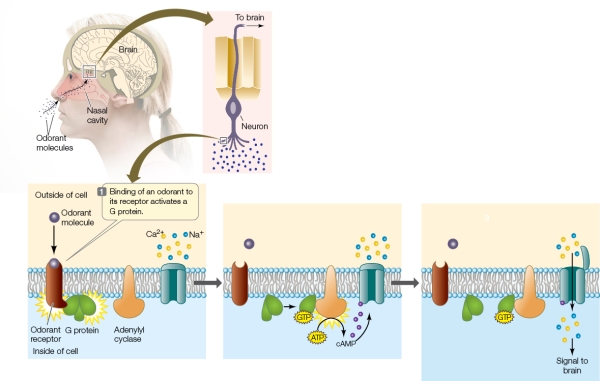 Information will be sent to the brain because of changes in ion concentrations within the neuron.What specific event is most directly responsible for the change in intracellular ion concentrations?
 (Multiple Choice)
4.8/5 (76)
(76) Refer to the table below. 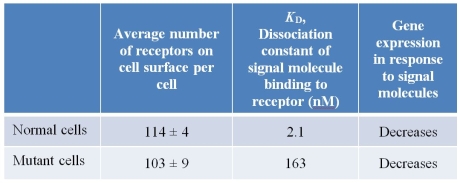 The table shows data collected from studies comparing normal and mutant cells.Mutant cells differ from normal cells in having a mutation in the gene encoding a receptor protein.The mutation results in a single amino acid change from a glutamic acid to a lysine.Which is a possible effect of the mutation?
 (Multiple Choice)
5.0/5 (78)
(78) The basic elements necessary for a signal transduction pathway within a cell are
(Multiple Choice)
4.8/5 (73)
(73) Refer to the figure below showing a transmembrane protein that functions in a signal transduction pathway. 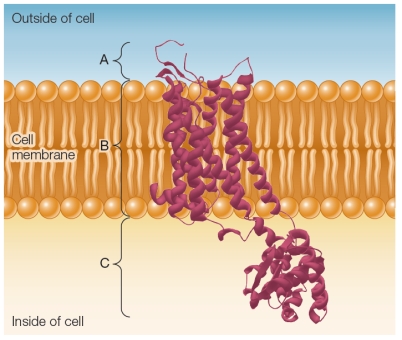 In which order are the parts of the protein affected during a single event of signal transduction?
 (Multiple Choice)
4.8/5 (76)
(76) When activated, some receptor proteins catalyze the transfer of a phosphate group from ATP to another protein.Such receptor proteins are known as protein _______.
(Short Answer)
4.7/5 (87)
(87) Chemical signals called paracrine signals are transported from the secreting cell to a target cell by
(Multiple Choice)
4.7/5 (90)
(90) Refer to the figure below. 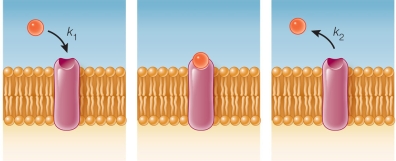 Which equation represents the equilibrium condition? In all equations shown, "R" represents a receptor with no ligand bound, "L" represents a free ligand in solution, and "RL" represents a receptor bound to a ligand.
 (Multiple Choice)
4.9/5 (77)
(77) Which is the correct order of the steps in a generalized signal transduction pathway?
(Multiple Choice)
4.8/5 (78)
(78) Refer to the figure below. 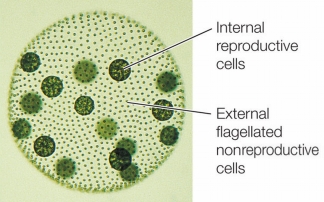 Which property of Volvox internal reproductive cells and external nonreproductive cells can be used as evidence to support current theory about how multicellularity evolved?
 (Multiple Choice)
4.9/5 (77)
(77) A benefit of the many steps involved in a protein kinase cascade is that they involve
(Multiple Choice)
4.8/5 (82)
(82) In the mammalian eye, the lens is composed of a large number of cells called lens cells.Only lens cells along the edges are close to a blood supply where they exchange nutrients and waste molecules.Lens cells in the middle of the lens are connected via gap junctions.Cataracts appear as a cloudiness that develops in the lenses of the eye, often with age.Biologists have suspected that cataracts result from a disruption in intercellular communication between lens cells through gap junctions.Which type of investigation would best provide more information about whether gap junctions are involved in cataract formation?
(Multiple Choice)
5.0/5 (78)
(78) Refer to the table below. 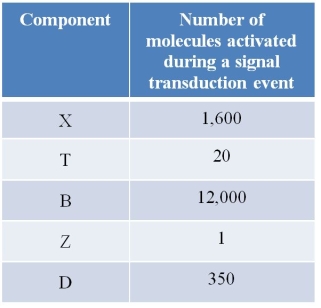 The components listed in the table are molecules that participate in a signal transduction pathway.A researcher measured the number of molecules of each component that were activated during one signal transduction event and summarized them as shown.From this information, a sketch could be made to show the sequential order of the components in the pathway.From first to last, they would be _______.
 (Short Answer)
4.9/5 (79)
(79) Refer to the table below, which lists three biological responses that result from cAMP-mediated signal transduction pathways.The "yes" and "no" references in the table indicate which cells are capable of displaying the three biological responses. 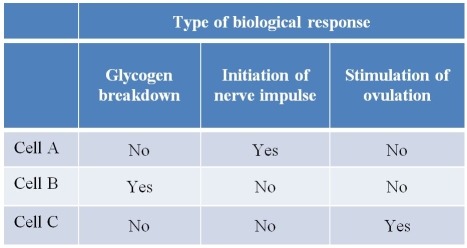 Which statement explains how the same second-messenger molecule, cAMP, can be involved in all of these different pathways?
 (Multiple Choice)
4.8/5 (80)
(80) Receptors bind to their ligands noncovalently, according to chemistry's law of mass action.This means that
(Multiple Choice)
4.8/5 (79)
(79) Protein kinase receptors phosphorylate themselves and/or other proteins when activated, resulting in a(n)
(Multiple Choice)
4.9/5 (60)
(60) The second messenger cAMP can be effective in many different signal transduction pathways because it is a small molecule, which enables its target proteins to have specific sites that bind the cAMP molecule.When this happens, the target proteins undergo a change in _______ with a concomitant change in their biological activity.
(Short Answer)
4.9/5 (72)
(72) Refer to the table below, which shows results from investigations of four mouse lineages. 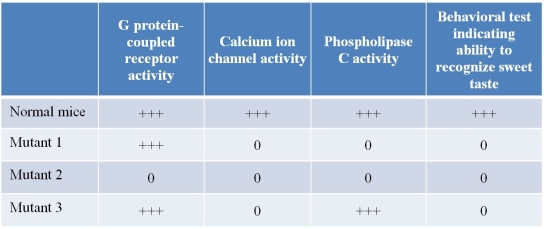 Three of these lineages have different mutations that disrupt the signal transduction pathway that allows mice to recognize sweet taste in response to sugar.For each mouse group, each component of the signal transduction pathway was tested in terms of its response to sugar, which was provided as a stimulus of the pathway.In the table, "+++" refers to high levels of activity in the response to sugar, and "0" refers to no activity in the response to sugar.These results provide evidence for which role of calcium ion channels in this signal transduction pathway?
 (Multiple Choice)
4.8/5 (76)
(76) Refer to the figure below. 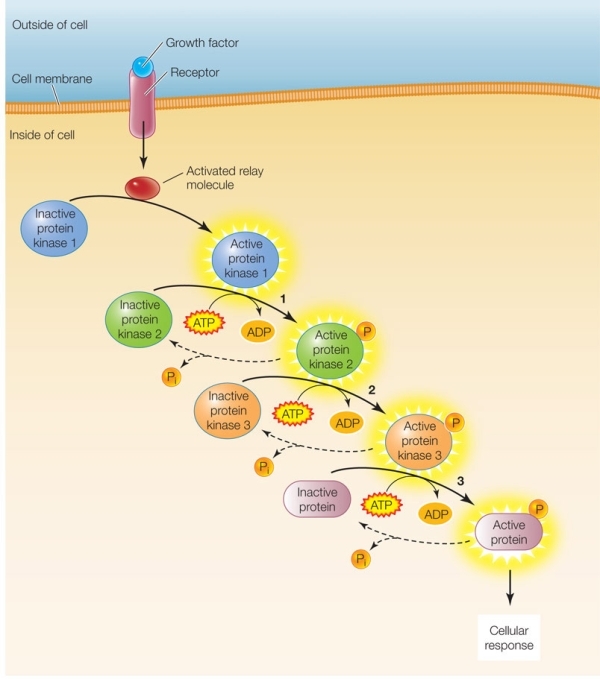 How is it a benefit to the cell to have so many protein kinase molecules participating in the signal transduction pathway shown?
 (Essay)
4.9/5 (98)
(98) 
Filters
- Essay(0)
- Multiple Choice(0)
- Short Answer(0)
- True False(0)
- Matching(0)