



 Chat with AI
Exam 7: Cell Communication and Multicellularity

Exam 1: Studying Life246 Questions
Exam 2: Small Molecules and the Chemistry of Life246 Questions
Exam 3: Proteins, Carbohydrates, and Lipids246 Questions
Exam 4: Nucleic Acids and the Origin of Life246 Questions
Exam 5: Cells: the Working Units of Life248 Questions
Exam 6: Cell Membranes246 Questions
Exam 7: Cell Communication and Multicellularity246 Questions
Exam 8: Energy, Enzymes, and Metabolism246 Questions
Exam 9: Pathways That Harvest Chemical Energy246 Questions
Exam 10: Photosynthesis: Energy From Sunlight242 Questions
Exam 11: The Cell Cycle and Cell Division260 Questions
Exam 12: Inheritance, Genes, and Chromosomes250 Questions
Exam 13: Dna and Its Role in Heredity257 Questions
Exam 14: From Dna to Protein: Gene Expression252 Questions
Exam 15: Gene Mutation and Molecular Medicine251 Questions
Exam 16: Regulation of Gene Expression245 Questions
Exam 17: Genomes249 Questions
Exam 18: Recombinant Dna and Biotechnology243 Questions
Exam 20: Mechanisms of Evolution243 Questions
Exam 21: Reconstructing and Using Phylogenies246 Questions
Exam 22: Speciation247 Questions
Exam 23: Evolution of Genes and Genomes252 Questions
Exam 24: The History of Life on Earth246 Questions
Exam 25: Bacteria, Archaea, and Viruses262 Questions
Exam 26: The Origin and Diversification of Eukaryotes252 Questions
Exam 27: Plants Without Seeds: From Water to Land251 Questions
Exam 28: The Evolution of Seed Plants259 Questions
Exam 29: The Evolution and Diversity of Fungi261 Questions
Exam 30: Animal Origins and the Evolution of Body Plans248 Questions
Exam 31: Protostome Animals244 Questions
Exam 32: Deuterostome Animals246 Questions
Exam 33: The Plant Body243 Questions
Exam 34: Transport in Plants248 Questions
Exam 35: Plant Nutrition247 Questions
Exam 36: Regulation of Plant Growth246 Questions
Exam 37: Reproduction in Flowering Plants247 Questions
Exam 38: Plant Responses to Environmental Challenges246 Questions
Exam 39: Physiology, Homeostasis, and Temperature Regulation258 Questions
Exam 40: Animal Hormones249 Questions
Exam 41: Immunology: Animal Defense Systems265 Questions
Exam 42: Animal Reproduction261 Questions
Exam 43: Animal Development261 Questions
Exam 44: Neurons, Glia, and Nervous Systems250 Questions
Exam 45: Sensory Systems249 Questions
Exam 46: The Mammalian Nervous System: Structure and Higher Functions254 Questions
Exam 47: Musculoskeletal Systems259 Questions
Exam 48: Gas Exchange247 Questions
Exam 49: Circulatory Systems252 Questions
Exam 50: Nutrition, Digestion, and Absorption259 Questions
Exam 51: Salt and Water Balance and Nitrogen Excretion251 Questions
Exam 52: Animal Behavior249 Questions
Exam 53: The Physical Environment and Biogeography of Life248 Questions
Exam 54: Populations259 Questions
Exam 55: Species Interactions254 Questions
Exam 56: Communities247 Questions
Exam 57: Ecosystems238 Questions
Exam 58: A Changing Biosphere222 Questions
Select questions type


The human pituitary gland secretes thyroid-stimulating hormone (TSH).TSH stimulates the thyroid gland to release thyroxine, a hormone that regulates metabolism.TSH has no effect on heart cells.Based on your knowledge of membrane receptors, what can you say about how cells in the thyroid gland compare with heart cells?
(Multiple Choice)
4.8/5  (84)
(84) Refer to the table below. 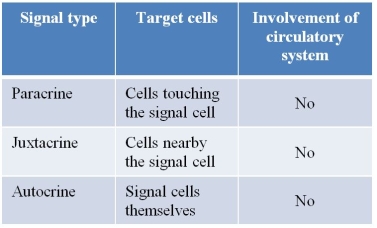 A student created the table to help her remember the differences between chemical signal types.Which statement about the table is true?
 (Multiple Choice)
4.7/5 (77)
(77) The rate of ion flow into or out of a cell is affected by the number of ion channels present in the cell membrane and by the concentrations of small molecules that open and close the channels.Consider that there are signal transduction pathways that stimulate expression of ion channel proteins to increase the number of ion channels in the membrane, and there are signal transduction pathways that stimulate production of small molecules that open or close channels.Which of these signal transduction mechanisms would be most effective for responses that need to change rapidly, and which would be most effective for responses that need to change slowly, and why?
(Essay)
4.7/5 (69)
(69) Which experimental technique would be best used to investigate whether a transcription factor is activated as part of a signal transduction pathway?
(Multiple Choice)
4.8/5 (62)
(62) A cell deep within a large multicellular organism receives its signals from
(Multiple Choice)
4.8/5 (73)
(73) If a ligand binds to a G protein-coupled receptor but the normal exchange of GDP for GTP on the associated G protein does not take place, what will happen in the cell?
(Multiple Choice)
4.9/5 (71)
(71) Increased synthesis of phosphodiesterase would most likely lead to
(Multiple Choice)
4.8/5 (71)
(71) The binding of one molecule of epinephrine to a receptor can result in the activation of 1,000 molecules of glycogen phosphorylase.This is an example of signal _______.
(Short Answer)
5.0/5 (82)
(82) Gap junctions allow passage of ions and small proteins from one cell to the next through small channels called
(Multiple Choice)
4.7/5 (77)
(77) Refer to the figure below. 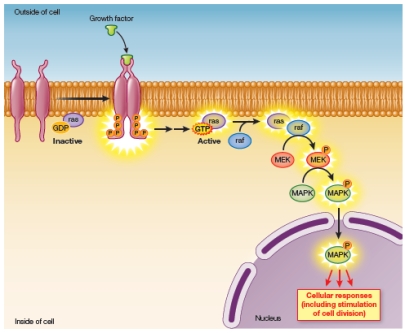 The figure shows a signal transduction pathway in a cell.Which of the following plays a role in signal transduction in this case?
 (Multiple Choice)
5.0/5 (83)
(83) A signal transduction pathway was found to rely on a second messenger molecule that has no enzymes that change its chemical structure and no membrane pumps that remove it after it has completed its signaling function.The likely identity of this second messenger molecule is _______.
(Short Answer)
4.8/5 (87)
(87) Refer to the table below, which summarizes effects of three hormones on different types of human cells. 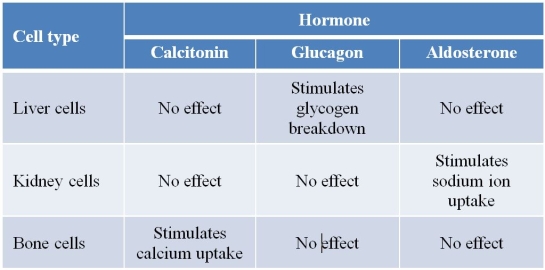 This information supports the concept that only cells with the appropriate _______ can respond to a chemical signal.
 (Short Answer)
4.9/5 (76)
(76) _______ is a second messenger found in the pathway in which epinephrine activates the liver enzyme that breaks down glycogen.
(Short Answer)
4.9/5 (84)
(84) Refer to the figure showing the signal transduction pathway that is initiated by the binding of cortisol to its receptor. 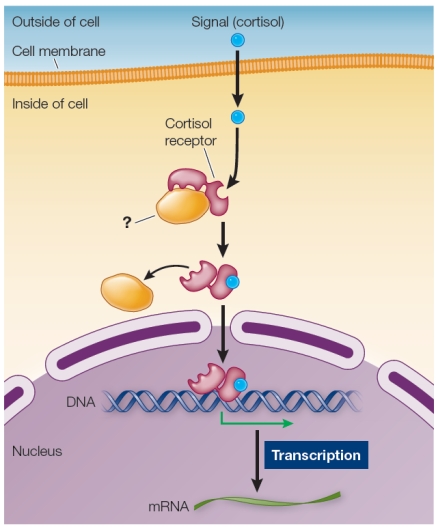 Based on the figure, cortisol acts as a signal and binds to its receptor, which is bound to a _______ protein.
 (Multiple Choice)
4.8/5 (70)
(70) Phosphorylation of a protein can lead to changes in its conformation, which can cause changes in its _______.
(Short Answer)
4.9/5 (93)
(93) A cascade of events initiated by a signal that causes several different intracellular responses is an example of signal
(Multiple Choice)
4.9/5 (76)
(76) Refer to the figure below. 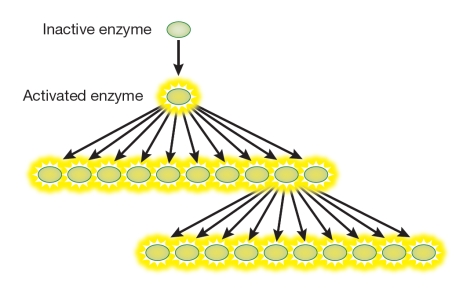 The figure illustrates how the signal in a signal transduction pathway can be _______.
 (Short Answer)
4.9/5 (83)
(83) 
Filters
- Essay(0)
- Multiple Choice(0)
- Short Answer(0)
- True False(0)
- Matching(0)