



 Chat with AI
Exam 7: Cell Communication and Multicellularity

Exam 1: Studying Life246 Questions
Exam 2: Small Molecules and the Chemistry of Life246 Questions
Exam 3: Proteins, Carbohydrates, and Lipids246 Questions
Exam 4: Nucleic Acids and the Origin of Life246 Questions
Exam 5: Cells: the Working Units of Life248 Questions
Exam 6: Cell Membranes246 Questions
Exam 7: Cell Communication and Multicellularity246 Questions
Exam 8: Energy, Enzymes, and Metabolism246 Questions
Exam 9: Pathways That Harvest Chemical Energy246 Questions
Exam 10: Photosynthesis: Energy From Sunlight242 Questions
Exam 11: The Cell Cycle and Cell Division260 Questions
Exam 12: Inheritance, Genes, and Chromosomes250 Questions
Exam 13: Dna and Its Role in Heredity257 Questions
Exam 14: From Dna to Protein: Gene Expression252 Questions
Exam 15: Gene Mutation and Molecular Medicine251 Questions
Exam 16: Regulation of Gene Expression245 Questions
Exam 17: Genomes249 Questions
Exam 18: Recombinant Dna and Biotechnology243 Questions
Exam 20: Mechanisms of Evolution243 Questions
Exam 21: Reconstructing and Using Phylogenies246 Questions
Exam 22: Speciation247 Questions
Exam 23: Evolution of Genes and Genomes252 Questions
Exam 24: The History of Life on Earth246 Questions
Exam 25: Bacteria, Archaea, and Viruses262 Questions
Exam 26: The Origin and Diversification of Eukaryotes252 Questions
Exam 27: Plants Without Seeds: From Water to Land251 Questions
Exam 28: The Evolution of Seed Plants259 Questions
Exam 29: The Evolution and Diversity of Fungi261 Questions
Exam 30: Animal Origins and the Evolution of Body Plans248 Questions
Exam 31: Protostome Animals244 Questions
Exam 32: Deuterostome Animals246 Questions
Exam 33: The Plant Body243 Questions
Exam 34: Transport in Plants248 Questions
Exam 35: Plant Nutrition247 Questions
Exam 36: Regulation of Plant Growth246 Questions
Exam 37: Reproduction in Flowering Plants247 Questions
Exam 38: Plant Responses to Environmental Challenges246 Questions
Exam 39: Physiology, Homeostasis, and Temperature Regulation258 Questions
Exam 40: Animal Hormones249 Questions
Exam 41: Immunology: Animal Defense Systems265 Questions
Exam 42: Animal Reproduction261 Questions
Exam 43: Animal Development261 Questions
Exam 44: Neurons, Glia, and Nervous Systems250 Questions
Exam 45: Sensory Systems249 Questions
Exam 46: The Mammalian Nervous System: Structure and Higher Functions254 Questions
Exam 47: Musculoskeletal Systems259 Questions
Exam 48: Gas Exchange247 Questions
Exam 49: Circulatory Systems252 Questions
Exam 50: Nutrition, Digestion, and Absorption259 Questions
Exam 51: Salt and Water Balance and Nitrogen Excretion251 Questions
Exam 52: Animal Behavior249 Questions
Exam 53: The Physical Environment and Biogeography of Life248 Questions
Exam 54: Populations259 Questions
Exam 55: Species Interactions254 Questions
Exam 56: Communities247 Questions
Exam 57: Ecosystems238 Questions
Exam 58: A Changing Biosphere222 Questions
Select questions type


Refer to the figure below. 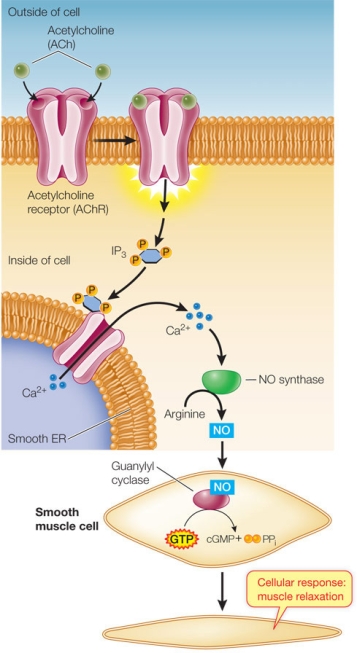 Inositol trisphosphate (IP3) and calcium ions function as second messengers in the signal transduction pathway shown in the figure.Explain one similarity and one difference in the mechanisms of these two second messengers as components of this pathway.
 (Essay)
4.8/5  (89)
(89) Gap junctions are channels that can allow the diffusion between cells of all of the following except
(Multiple Choice)
5.0/5 (77)
(77) Caffeine is an example of a(n) _______ because it binds to a receptor that recognizes adenosine but does not elicit the same cellular response as adenosine.
(Multiple Choice)
4.8/5 (71)
(71) Which example illustrates how an autocrine signal functions in the human body?
(Multiple Choice)
4.9/5 (83)
(83) The larger the dissociation constant KD is, the smaller will be
(Multiple Choice)
4.8/5 (77)
(77) A mouse has a mutation in its oxytocin receptor that keeps the receptor in a constant state of activation.As a result, this mouse can be expected to be
(Multiple Choice)
4.9/5 (99)
(99) Which statement about G protein-coupled receptors is false?
(Multiple Choice)
4.9/5 (81)
(81) In designing a drug to function as an antagonist of a natural ligand in the human body, a pharmaceutical chemist would focus on mimicking which aspect of the natural ligand?
(Multiple Choice)
4.7/5 (98)
(98) If a cell that normally produces juxtacrine signals is unable to produce signals during development, which cells will be most affected?
(Multiple Choice)
4.7/5 (87)
(87) Sketch a signal transduction pathway.Include a protein kinase and/or a G protein-coupled receptor, at least one point at which the signal is amplified, and at least one second messenger.
(Essay)
4.8/5 (89)
(89) Which experimental technique would be useful in determining whether a particular chemical signal is an autocrine or a paracrine signal?
(Multiple Choice)
4.8/5 (86)
(86) Refer to the figure below. 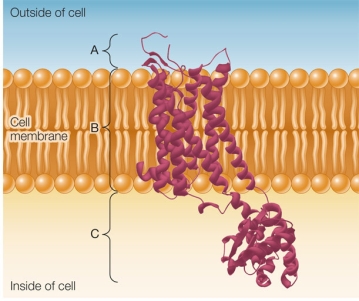 The figure shows a protein receptor that functions in a signal transduction pathway.This receptor binds a ligand and then later binds an antagonist molecule.How do sections of the receptor shown in the figure change in response to the binding of each molecule?
 (Multiple Choice)
4.9/5 (72)
(72) IP3, nitric oxide, cAMP, and calcium ions are all examples of _______ that are used by signal transduction pathways.
(Short Answer)
4.8/5 (89)
(89) Refer to the figure and table below. 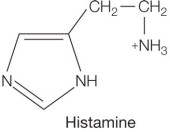
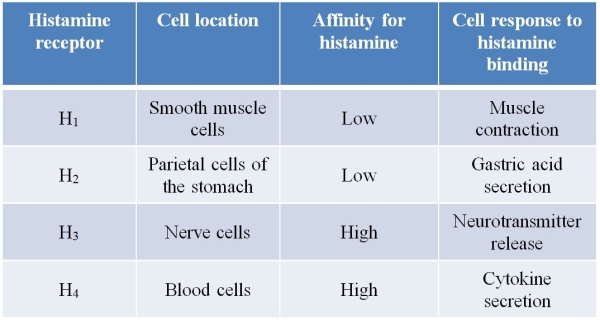 All four histamine receptors are G protein-coupled receptors that share many similarities in structure.However, each has a unique sequence and structure, and each has its own gene.With this information and the information in the table, predict an aspect that is likely shared by the four receptors and an aspect that differs.Explain your reasoning.
 (Essay)
4.8/5 (72)
(72) To respond to a signal, a cell must have a(n) _______ molecule that can detect the signal.
(Multiple Choice)
4.8/5 (78)
(78) Which statement about signal transduction in cells can be used to explain how specificity is achieved in a signal transduction pathway?
(Multiple Choice)
4.8/5 (88)
(88) 
Filters
- Essay(0)
- Multiple Choice(0)
- Short Answer(0)
- True False(0)
- Matching(0)