



 Chat with AI
Exam 7: Cell Communication and Multicellularity

Exam 1: Studying Life246 Questions
Exam 2: Small Molecules and the Chemistry of Life246 Questions
Exam 3: Proteins, Carbohydrates, and Lipids246 Questions
Exam 4: Nucleic Acids and the Origin of Life246 Questions
Exam 5: Cells: the Working Units of Life248 Questions
Exam 6: Cell Membranes246 Questions
Exam 7: Cell Communication and Multicellularity246 Questions
Exam 8: Energy, Enzymes, and Metabolism246 Questions
Exam 9: Pathways That Harvest Chemical Energy246 Questions
Exam 10: Photosynthesis: Energy From Sunlight242 Questions
Exam 11: The Cell Cycle and Cell Division260 Questions
Exam 12: Inheritance, Genes, and Chromosomes250 Questions
Exam 13: Dna and Its Role in Heredity257 Questions
Exam 14: From Dna to Protein: Gene Expression252 Questions
Exam 15: Gene Mutation and Molecular Medicine251 Questions
Exam 16: Regulation of Gene Expression245 Questions
Exam 17: Genomes249 Questions
Exam 18: Recombinant Dna and Biotechnology243 Questions
Exam 20: Mechanisms of Evolution243 Questions
Exam 21: Reconstructing and Using Phylogenies246 Questions
Exam 22: Speciation247 Questions
Exam 23: Evolution of Genes and Genomes252 Questions
Exam 24: The History of Life on Earth246 Questions
Exam 25: Bacteria, Archaea, and Viruses262 Questions
Exam 26: The Origin and Diversification of Eukaryotes252 Questions
Exam 27: Plants Without Seeds: From Water to Land251 Questions
Exam 28: The Evolution of Seed Plants259 Questions
Exam 29: The Evolution and Diversity of Fungi261 Questions
Exam 30: Animal Origins and the Evolution of Body Plans248 Questions
Exam 31: Protostome Animals244 Questions
Exam 32: Deuterostome Animals246 Questions
Exam 33: The Plant Body243 Questions
Exam 34: Transport in Plants248 Questions
Exam 35: Plant Nutrition247 Questions
Exam 36: Regulation of Plant Growth246 Questions
Exam 37: Reproduction in Flowering Plants247 Questions
Exam 38: Plant Responses to Environmental Challenges246 Questions
Exam 39: Physiology, Homeostasis, and Temperature Regulation258 Questions
Exam 40: Animal Hormones249 Questions
Exam 41: Immunology: Animal Defense Systems265 Questions
Exam 42: Animal Reproduction261 Questions
Exam 43: Animal Development261 Questions
Exam 44: Neurons, Glia, and Nervous Systems250 Questions
Exam 45: Sensory Systems249 Questions
Exam 46: The Mammalian Nervous System: Structure and Higher Functions254 Questions
Exam 47: Musculoskeletal Systems259 Questions
Exam 48: Gas Exchange247 Questions
Exam 49: Circulatory Systems252 Questions
Exam 50: Nutrition, Digestion, and Absorption259 Questions
Exam 51: Salt and Water Balance and Nitrogen Excretion251 Questions
Exam 52: Animal Behavior249 Questions
Exam 53: The Physical Environment and Biogeography of Life248 Questions
Exam 54: Populations259 Questions
Exam 55: Species Interactions254 Questions
Exam 56: Communities247 Questions
Exam 57: Ecosystems238 Questions
Exam 58: A Changing Biosphere222 Questions
Select questions type


A key event in the rise of multicellularity is the ability of cells to _______ with one another, as has been observed in some types of algae that live in multicellular clusters.
(Short Answer)
4.7/5  (86)
(86) A pharmaceutical chemist synthesizes a compound that differs chemically from the molecule that binds to a specific three-dimensional site on a cellular receptor.The synthesized compound is a(n) _______ if it elicits the same biological response as its biologically active counterpart.
(Multiple Choice)
4.8/5 (69)
(69) Refer to the figure below. 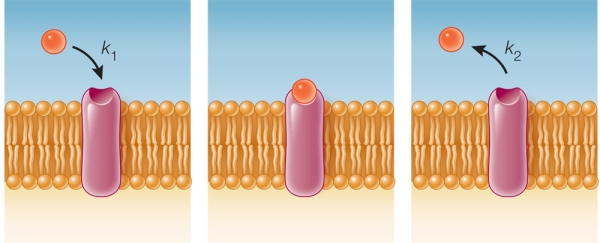 Which equation describes the rate of binding of a ligand to its receptor? In all equations shown, "R" represents a receptor with no ligand bound, "L" represents a free ligand in solution, and "RL" represents a receptor bound to a ligand.
 (Multiple Choice)
4.8/5 (83)
(83) The figure below shows the oxytocin signal transduction pathway in uterine smooth muscle cells.The abbreviation "CaM" refers to calmodulin, and "MLCK" refers to myosin light chain kinase, an enzyme that phosphorylates the light chains of myosin, stimulating smooth muscle contractions. 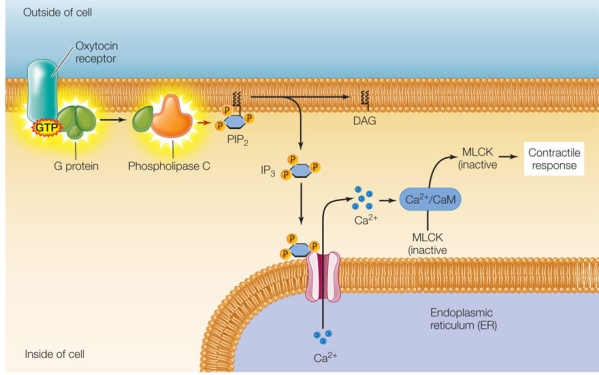 How could this signal transduction pathway be shut off?
 (Multiple Choice)
4.8/5 (82)
(82) A key response in an egg to a signal from an entering sperm is
(Multiple Choice)
4.8/5 (71)
(71) Refer to the figure showing the signal transduction pathway that is initiated by the binding of cortisol to its receptor. 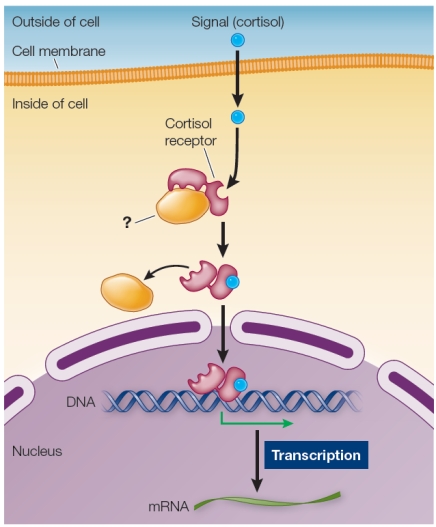 Based on the figure, which can you conclude about this signal transduction pathway?
 (Multiple Choice)
4.9/5 (84)
(84) In transduction pathways used by cells, a physical or chemical stimulus from the environment acts as a
(Multiple Choice)
4.8/5 (80)
(80) Choose the correct order for the following events in the interaction of a cell with a signal: (1) alteration of cell function, (2) signal binding to receptor, (3) signal release from source, (4) signal transduction.
(Multiple Choice)
4.7/5 (90)
(90) Suppose scientists discover a new extracellular protein that causes increases in cell size.In order to investigate whether cell surface receptors are involved in binding this protein, they could
(Multiple Choice)
4.9/5 (91)
(91) Signaling proteins that are characterized by their ability to bind GTP and GDP are known as _______ proteins.
(Short Answer)
4.9/5 (69)
(69) Refer to the table below. 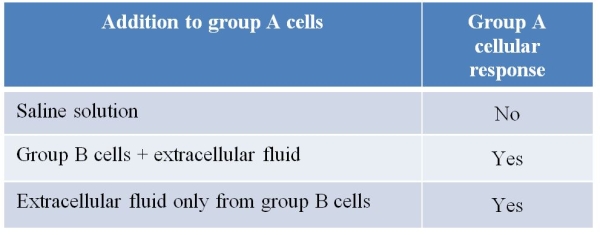 Researchers investigated chemical signaling between two groups of cells located in the same region of a developing fish embryo.They isolated the two groups and tested the ability of group A cells to produce a cellular response to different conditions of incubation, as shown.The type of chemical signaling between groups A and B can be classified as _______ signaling, based on these results.
 (Short Answer)
4.9/5 (83)
(83) A chemical signal produced in the pituitary gland at the base of the brain binds to a receptor on liver cells.This signal would be classified as a(n)
(Multiple Choice)
4.9/5 (81)
(81) Which is an experimental means that can be used to distinguish between a signal transduction pathway that uses a cell membrane receptor and one that uses an intracellular receptor?
(Multiple Choice)
4.9/5 (84)
(84) Sketch the concept of signal amplification taking place in a signal transduction pathway.
(Essay)
4.9/5 (88)
(88) Why are signal transduction pathways highly regulated? What would happen if they were not?
(Essay)
4.8/5 (84)
(84) Refer to the table below, summarizing key features of two signal transduction pathways that result in the same cellular response. 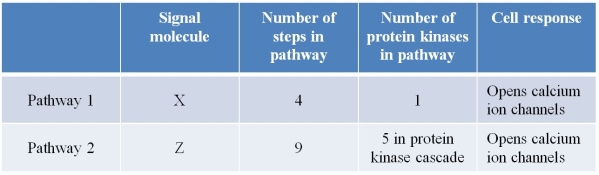 Based on this information, which comparison is most reasonable?
 (Multiple Choice)
4.9/5 (82)
(82) Refer to the figure below. 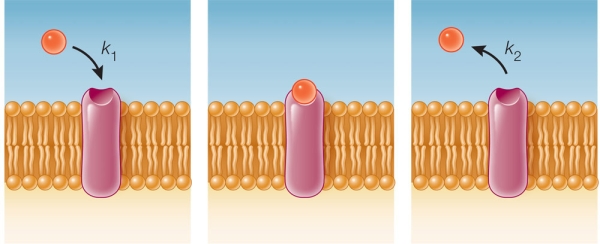 Which equation describes the rate of release of a ligand from a receptor? In all equations shown, "R" represents a receptor with no ligand bound, "L" represents a free ligand in solution, and "RL" represents a receptor bound to a ligand.
 (Multiple Choice)
4.7/5 (58)
(58) Which experimental technique would be useful in determining whether a particular chemical signal is a juxtacrine or a paracrine signal?
(Multiple Choice)
4.9/5 (77)
(77) 
Filters
- Essay(0)
- Multiple Choice(0)
- Short Answer(0)
- True False(0)
- Matching(0)