



 Chat with AI
Exam 7: Cell Communication and Multicellularity

Exam 1: Studying Life246 Questions
Exam 2: Small Molecules and the Chemistry of Life246 Questions
Exam 3: Proteins, Carbohydrates, and Lipids246 Questions
Exam 4: Nucleic Acids and the Origin of Life246 Questions
Exam 5: Cells: the Working Units of Life248 Questions
Exam 6: Cell Membranes246 Questions
Exam 7: Cell Communication and Multicellularity246 Questions
Exam 8: Energy, Enzymes, and Metabolism246 Questions
Exam 9: Pathways That Harvest Chemical Energy246 Questions
Exam 10: Photosynthesis: Energy From Sunlight242 Questions
Exam 11: The Cell Cycle and Cell Division260 Questions
Exam 12: Inheritance, Genes, and Chromosomes250 Questions
Exam 13: Dna and Its Role in Heredity257 Questions
Exam 14: From Dna to Protein: Gene Expression252 Questions
Exam 15: Gene Mutation and Molecular Medicine251 Questions
Exam 16: Regulation of Gene Expression245 Questions
Exam 17: Genomes249 Questions
Exam 18: Recombinant Dna and Biotechnology243 Questions
Exam 20: Mechanisms of Evolution243 Questions
Exam 21: Reconstructing and Using Phylogenies246 Questions
Exam 22: Speciation247 Questions
Exam 23: Evolution of Genes and Genomes252 Questions
Exam 24: The History of Life on Earth246 Questions
Exam 25: Bacteria, Archaea, and Viruses262 Questions
Exam 26: The Origin and Diversification of Eukaryotes252 Questions
Exam 27: Plants Without Seeds: From Water to Land251 Questions
Exam 28: The Evolution of Seed Plants259 Questions
Exam 29: The Evolution and Diversity of Fungi261 Questions
Exam 30: Animal Origins and the Evolution of Body Plans248 Questions
Exam 31: Protostome Animals244 Questions
Exam 32: Deuterostome Animals246 Questions
Exam 33: The Plant Body243 Questions
Exam 34: Transport in Plants248 Questions
Exam 35: Plant Nutrition247 Questions
Exam 36: Regulation of Plant Growth246 Questions
Exam 37: Reproduction in Flowering Plants247 Questions
Exam 38: Plant Responses to Environmental Challenges246 Questions
Exam 39: Physiology, Homeostasis, and Temperature Regulation258 Questions
Exam 40: Animal Hormones249 Questions
Exam 41: Immunology: Animal Defense Systems265 Questions
Exam 42: Animal Reproduction261 Questions
Exam 43: Animal Development261 Questions
Exam 44: Neurons, Glia, and Nervous Systems250 Questions
Exam 45: Sensory Systems249 Questions
Exam 46: The Mammalian Nervous System: Structure and Higher Functions254 Questions
Exam 47: Musculoskeletal Systems259 Questions
Exam 48: Gas Exchange247 Questions
Exam 49: Circulatory Systems252 Questions
Exam 50: Nutrition, Digestion, and Absorption259 Questions
Exam 51: Salt and Water Balance and Nitrogen Excretion251 Questions
Exam 52: Animal Behavior249 Questions
Exam 53: The Physical Environment and Biogeography of Life248 Questions
Exam 54: Populations259 Questions
Exam 55: Species Interactions254 Questions
Exam 56: Communities247 Questions
Exam 57: Ecosystems238 Questions
Exam 58: A Changing Biosphere222 Questions
Select questions type


In a signal transduction pathway involving G protein-coupled receptors, the receptor first binds the ligand and activates a G protein.After the GTP-bound subunit of the G protein separates from the rest of the G protein, it travels until it encounters
(Multiple Choice)
4.8/5  (86)
(86) The second messengers inositol trisphosphate, calcium ions, and nitric oxide are all similar in that they can
(Multiple Choice)
4.8/5 (82)
(82) Refer to the table below. 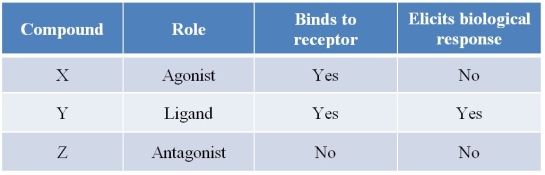 This table was created to summarize features of ligands, agonists, and antagonists.How many cells in the table contain an error?
 (Multiple Choice)
4.9/5 (73)
(73) Refer to the figure and table below. 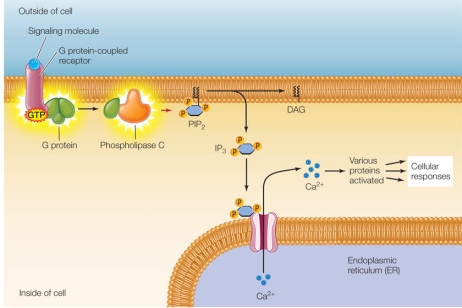
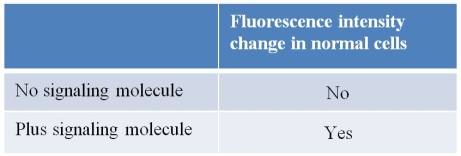 A researcher treated mouse kidney cells growing in culture so that they took up a fluorescent dye into their cytosols without losing viability.(This dye undergoes a change in fluorescence intensity upon binding calcium ions.) The treated cells were then incubated with and without a compound thought to act as a signaling molecule, and the cells were observed for changes in fluorescence.The researcher hypothesizes that the signaling molecule functions according to the pathway shown in the diagram above.As a next step, the researcher wants to acquire evidence that IP3 is involved in this pathway.Which procedure will provide needed evidence about IP3 as the entire experiment is repeated?
 (Multiple Choice)
4.8/5 (82)
(82) Gap junctions that span the gap between plasma membranes of two cells are composed of
(Multiple Choice)
4.9/5 (75)
(75) In some signal transduction pathways, a small nonprotein molecule or ion known as a(n) _______ diffuses through the cytoplasm and mediates the interaction between the receptor and the response of the cell.
(Short Answer)
5.0/5 (90)
(90) Refer to the two figures below. 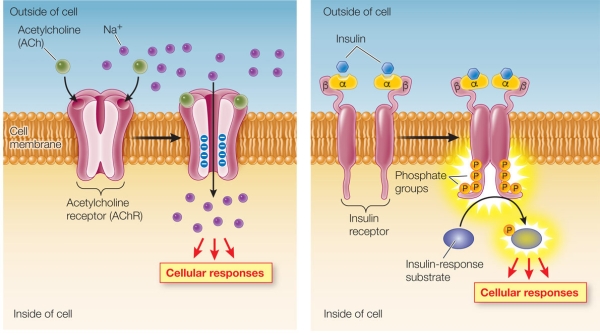 The receptor portions of two signal transduction pathways are shown.The two mechanisms underlying these pathways are similar in that they both involve
 (Multiple Choice)
4.9/5 (72)
(72) A biologist discovers a new signal transduction pathway in fruit flies that involves a protein kinase cascade.As part of a grant proposal he writes to obtain funding for further work on this pathway, the biologist proposes research to look for phosphatase enzymes.Why?
(Multiple Choice)
4.9/5 (83)
(83) A researcher discovered a small protein secreted by the pituitary that functions as a growth factor to stimulate cell division in mouse skin cells.The skin cells of mice that have a mutation in a particular gene do not respond to this growth factor.When the researcher isolated and sequenced the gene, she found that it coded for a protein kinase.Which statement best explains this?
(Multiple Choice)
4.9/5 (77)
(77) Which of the following has its receptors on a gated ion channel for sodium ions (Na+)?
(Multiple Choice)
4.9/5 (73)
(73) Refer to the figure below. 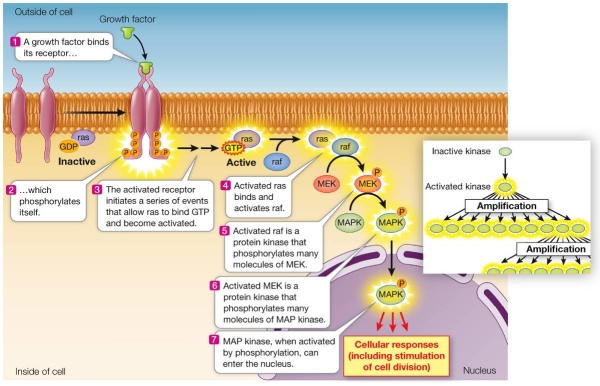 Consider that each time a growth factor binds to its receptor as shown in the figure, two ras G proteins are activated and each ras G protein activates one raf protein.If each raf then activates ten MEK molecules and each activated MEK activates ten molecules of MAP kinase, the original signal will be amplified by a factor of
 (Multiple Choice)
4.8/5 (70)
(70) Compare direct communication via plasmodesmata or gap junctions with receptor-mediated communication between cells.What are the advantages of one method over the other?
(Essay)
4.8/5 (70)
(70) A molecule that binds to the particular three-dimensional structure of a receptor site is known as a(n)
(Multiple Choice)
4.8/5 (77)
(77) Refer to the figure below. 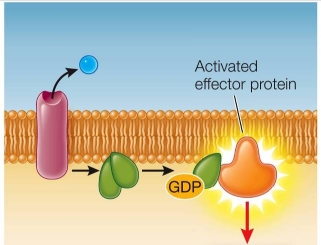 Given the steps shown, what happens next?
 (Multiple Choice)
4.9/5 (78)
(78) Refer to the table below. 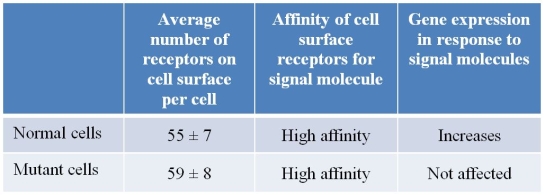 The table shows data collected from studies comparing normal and mutant cells.Mutant cells differ from normal cells in having a mutation in the gene encoding a receptor protein.The mutation results in a single amino acid change from a serine to a cysteine.A possible effect of the mutation is that receptor protein
 (Multiple Choice)
4.9/5 (83)
(83) Which molecule binds directly to a protein kinase receptor?
(Multiple Choice)
4.8/5 (80)
(80) A sequence of chemical reactions that occurs within a cell in response to a signal is a(n)
(Multiple Choice)
4.9/5 (67)
(67) 
Filters
- Essay(0)
- Multiple Choice(0)
- Short Answer(0)
- True False(0)
- Matching(0)