



 Chat with AI
Exam 52: Animal Behavior

Exam 1: Studying Life246 Questions
Exam 2: Small Molecules and the Chemistry of Life246 Questions
Exam 3: Proteins, Carbohydrates, and Lipids246 Questions
Exam 4: Nucleic Acids and the Origin of Life246 Questions
Exam 5: Cells: the Working Units of Life248 Questions
Exam 6: Cell Membranes246 Questions
Exam 7: Cell Communication and Multicellularity246 Questions
Exam 8: Energy, Enzymes, and Metabolism246 Questions
Exam 9: Pathways That Harvest Chemical Energy246 Questions
Exam 10: Photosynthesis: Energy From Sunlight242 Questions
Exam 11: The Cell Cycle and Cell Division260 Questions
Exam 12: Inheritance, Genes, and Chromosomes250 Questions
Exam 13: Dna and Its Role in Heredity257 Questions
Exam 14: From Dna to Protein: Gene Expression252 Questions
Exam 15: Gene Mutation and Molecular Medicine251 Questions
Exam 16: Regulation of Gene Expression245 Questions
Exam 17: Genomes249 Questions
Exam 18: Recombinant Dna and Biotechnology243 Questions
Exam 20: Mechanisms of Evolution243 Questions
Exam 21: Reconstructing and Using Phylogenies246 Questions
Exam 22: Speciation247 Questions
Exam 23: Evolution of Genes and Genomes252 Questions
Exam 24: The History of Life on Earth246 Questions
Exam 25: Bacteria, Archaea, and Viruses262 Questions
Exam 26: The Origin and Diversification of Eukaryotes252 Questions
Exam 27: Plants Without Seeds: From Water to Land251 Questions
Exam 28: The Evolution of Seed Plants259 Questions
Exam 29: The Evolution and Diversity of Fungi261 Questions
Exam 30: Animal Origins and the Evolution of Body Plans248 Questions
Exam 31: Protostome Animals244 Questions
Exam 32: Deuterostome Animals246 Questions
Exam 33: The Plant Body243 Questions
Exam 34: Transport in Plants248 Questions
Exam 35: Plant Nutrition247 Questions
Exam 36: Regulation of Plant Growth246 Questions
Exam 37: Reproduction in Flowering Plants247 Questions
Exam 38: Plant Responses to Environmental Challenges246 Questions
Exam 39: Physiology, Homeostasis, and Temperature Regulation258 Questions
Exam 40: Animal Hormones249 Questions
Exam 41: Immunology: Animal Defense Systems265 Questions
Exam 42: Animal Reproduction261 Questions
Exam 43: Animal Development261 Questions
Exam 44: Neurons, Glia, and Nervous Systems250 Questions
Exam 45: Sensory Systems249 Questions
Exam 46: The Mammalian Nervous System: Structure and Higher Functions254 Questions
Exam 47: Musculoskeletal Systems259 Questions
Exam 48: Gas Exchange247 Questions
Exam 49: Circulatory Systems252 Questions
Exam 50: Nutrition, Digestion, and Absorption259 Questions
Exam 51: Salt and Water Balance and Nitrogen Excretion251 Questions
Exam 52: Animal Behavior249 Questions
Exam 53: The Physical Environment and Biogeography of Life248 Questions
Exam 54: Populations259 Questions
Exam 55: Species Interactions254 Questions
Exam 56: Communities247 Questions
Exam 57: Ecosystems238 Questions
Exam 58: A Changing Biosphere222 Questions
Select questions type


Whereas the field of animal behavior known as behaviorism focused on controlled laboratory studies of a small number of species, the field of animal behavior known as _______ concentrated on comparative studies of diverse animals in their natural environments.
(Short Answer)
4.8/5  (73)
(73) Refer to the figure showing sonograms for three birds. 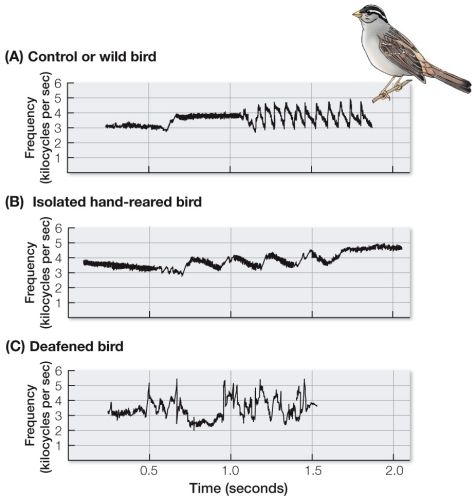 The sonogram in part C (deafened bird) shows the song of a male that heard his species-specific song during the appropriate sensitive period, but was deafened before he began singing.What does the abnormal sonogram indicate?
 (Essay)
4.8/5 (87)
(87) When compared with untreated male Yarrow's lizards, males with testosterone implants in summer displayed all of the following except
(Multiple Choice)
4.9/5 (81)
(81) Name two methods by which genes are manipulated to show that a single gene influences development and expression of a behavior.
(Short Answer)
4.9/5 (74)
(74) A honey bee is performing a waggle dance straight down on the honeycomb, and the waggle runs have a very short duration.What is the bee communicating to her hivemates?
(Multiple Choice)
4.7/5 (72)
(72) If you were interested in studying how animals defend food resources, you might select a study species
(Multiple Choice)
4.9/5 (89)
(89) Which statement about sex steroids and sexual behavior in rats is false?
(Multiple Choice)
4.7/5 (87)
(87) Which male white-crowned sparrow will sing his species-specific song?
(Multiple Choice)
4.9/5 (82)
(82) Ivan Pavlov and B.F.Skinner were practitioners of the field of animal behavior called _______.
(Short Answer)
4.9/5 (94)
(94) Which of the following does not influence the development of singing behavior in male birds?
(Multiple Choice)
5.0/5 (87)
(87) It has been discovered that certain planktonic larvae of marine organisms select their settlement site using signals that indicate the suitability of the site for sustaining life.Which of the following is the most likely signal initiating this settling response?
(Multiple Choice)
4.8/5 (79)
(79) Adult male mice are usually aggressive toward newborn mice.You suspect that the hormone prolactin being expressed in the adult males underlies this aggression and have identified a gene for prolactin receptors.The next logical step in your study would be to
(Multiple Choice)
4.8/5 (82)
(82) In a diploid organism, the fitness benefit that is accrued by rearing one's own offspring is _______ that accrued by rearing a sister's offspring.
(Multiple Choice)
4.7/5 (68)
(68) A(n) _______ is an area where males defend small territories on which they perform displays to attract females.
(Short Answer)
4.8/5 (87)
(87) The _______ of a circadian rhythm is not exactly 24 hours.
(Multiple Choice)
4.8/5 (89)
(89) Northern flickers are woodpeckers of the eastern United States.Males, but not females, have black feathers that resemble a moustache extending from the bill along each side of the head.Aggression between males is common, but male and female members of breeding pairs are not aggressive toward one another.However, when scientists painted a moustache on female members of breeding pairs, their mates attacked them.This suggests that
(Multiple Choice)
5.0/5 (76)
(76) During your field observations you notice that many of the social groups of your study species consist of multiple males that provide care to the offspring of one female.The mating system of your study species is likely
(Multiple Choice)
4.9/5 (69)
(69) During imprinting, parents learn to distinguish their own young from other young by learning key stimuli during a window of time called the _______.
(Short Answer)
4.8/5 (81)
(81) 
Filters
- Essay(0)
- Multiple Choice(0)
- Short Answer(0)
- True False(0)
- Matching(0)