



 Chat with AI
Exam 52: Animal Behavior

Exam 1: Studying Life246 Questions
Exam 2: Small Molecules and the Chemistry of Life246 Questions
Exam 3: Proteins, Carbohydrates, and Lipids246 Questions
Exam 4: Nucleic Acids and the Origin of Life246 Questions
Exam 5: Cells: the Working Units of Life248 Questions
Exam 6: Cell Membranes246 Questions
Exam 7: Cell Communication and Multicellularity246 Questions
Exam 8: Energy, Enzymes, and Metabolism246 Questions
Exam 9: Pathways That Harvest Chemical Energy246 Questions
Exam 10: Photosynthesis: Energy From Sunlight242 Questions
Exam 11: The Cell Cycle and Cell Division260 Questions
Exam 12: Inheritance, Genes, and Chromosomes250 Questions
Exam 13: Dna and Its Role in Heredity257 Questions
Exam 14: From Dna to Protein: Gene Expression252 Questions
Exam 15: Gene Mutation and Molecular Medicine251 Questions
Exam 16: Regulation of Gene Expression245 Questions
Exam 17: Genomes249 Questions
Exam 18: Recombinant Dna and Biotechnology243 Questions
Exam 20: Mechanisms of Evolution243 Questions
Exam 21: Reconstructing and Using Phylogenies246 Questions
Exam 22: Speciation247 Questions
Exam 23: Evolution of Genes and Genomes252 Questions
Exam 24: The History of Life on Earth246 Questions
Exam 25: Bacteria, Archaea, and Viruses262 Questions
Exam 26: The Origin and Diversification of Eukaryotes252 Questions
Exam 27: Plants Without Seeds: From Water to Land251 Questions
Exam 28: The Evolution of Seed Plants259 Questions
Exam 29: The Evolution and Diversity of Fungi261 Questions
Exam 30: Animal Origins and the Evolution of Body Plans248 Questions
Exam 31: Protostome Animals244 Questions
Exam 32: Deuterostome Animals246 Questions
Exam 33: The Plant Body243 Questions
Exam 34: Transport in Plants248 Questions
Exam 35: Plant Nutrition247 Questions
Exam 36: Regulation of Plant Growth246 Questions
Exam 37: Reproduction in Flowering Plants247 Questions
Exam 38: Plant Responses to Environmental Challenges246 Questions
Exam 39: Physiology, Homeostasis, and Temperature Regulation258 Questions
Exam 40: Animal Hormones249 Questions
Exam 41: Immunology: Animal Defense Systems265 Questions
Exam 42: Animal Reproduction261 Questions
Exam 43: Animal Development261 Questions
Exam 44: Neurons, Glia, and Nervous Systems250 Questions
Exam 45: Sensory Systems249 Questions
Exam 46: The Mammalian Nervous System: Structure and Higher Functions254 Questions
Exam 47: Musculoskeletal Systems259 Questions
Exam 48: Gas Exchange247 Questions
Exam 49: Circulatory Systems252 Questions
Exam 50: Nutrition, Digestion, and Absorption259 Questions
Exam 51: Salt and Water Balance and Nitrogen Excretion251 Questions
Exam 52: Animal Behavior249 Questions
Exam 53: The Physical Environment and Biogeography of Life248 Questions
Exam 54: Populations259 Questions
Exam 55: Species Interactions254 Questions
Exam 56: Communities247 Questions
Exam 57: Ecosystems238 Questions
Exam 58: A Changing Biosphere222 Questions
Select questions type


An observer of the night sky in the Northern Hemisphere would be able to see that
(Multiple Choice)
4.8/5  (87)
(87) Briefly describe the limitations of the energy maximization hypothesis of optimal foraging theory.
(Essay)
4.9/5 (81)
(81) Which statement about sexual differentiation and behavior of the fruit fly Drosophila melanogaster is false?
(Multiple Choice)
4.7/5 (81)
(81) To be classified as eusocial, the social groups of a species must contain _______.
(Short Answer)
4.9/5 (76)
(76) Refer to the figure showing the honey bee waggle dance. 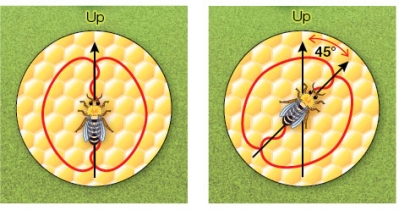 The bee performing the waggle dance in part A of the figure is communicating what to her hivemates?
 (Short Answer)
4.9/5 (70)
(70) Which studies or experiments were not performed by ethologists?
(Multiple Choice)
4.8/5 (84)
(84) Which of the following does not characterize haplodiploidy?
(Multiple Choice)
4.8/5 (75)
(75) Refer to the graph showing the locomotor activity of Drosophila melanogaster flies that have been subjected to various gene-knockout experiments. 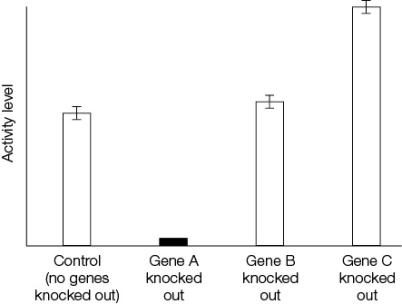 What can be inferred about the normal function of gene B in the graph?
 (Multiple Choice)
4.8/5 (87)
(87) Most prairie vole offspring stay at their natal (birth) burrow and help their parents raise the next litter(s).Which statement most likely does not characterize this example of "helpers at the nest"?
(Multiple Choice)
4.8/5 (84)
(84) When studying moose foraging behavior, you note that moose spend some time eating aquatic plants even though the leaves of deciduous trees along the shore have higher energy content.What might explain this observation?
(Multiple Choice)
4.8/5 (81)
(81) You are interested in examining how living in social groups affects survival and reproductive success of prairie voles.Which of Tinbergen's four questions does this type of question represent, and does it refer to a proximate or ultimate cause of behavior?
(Multiple Choice)
4.8/5 (90)
(90) Refer to the figure showing sex hormone manipulations of male rats. 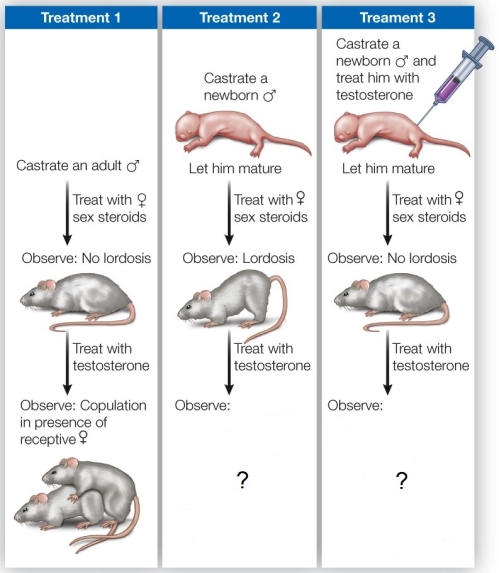 What is the correct final observation for male rats in the presence of a receptive female in treatments 2 and 3?
 (Multiple Choice)
4.7/5 (97)
(97) Which white-crowned sparrow will only sing the species-typical song in adulthood?
(Multiple Choice)
4.9/5 (82)
(82) Which of the following does not characterize the suprachiasmatic nuclei (SCN) of mammals?
(Multiple Choice)
4.9/5 (76)
(76) 
Filters
- Essay(0)
- Multiple Choice(0)
- Short Answer(0)
- True False(0)
- Matching(0)