



 Chat with AI
Exam 52: Animal Behavior

Exam 1: Studying Life246 Questions
Exam 2: Small Molecules and the Chemistry of Life246 Questions
Exam 3: Proteins, Carbohydrates, and Lipids246 Questions
Exam 4: Nucleic Acids and the Origin of Life246 Questions
Exam 5: Cells: the Working Units of Life248 Questions
Exam 6: Cell Membranes246 Questions
Exam 7: Cell Communication and Multicellularity246 Questions
Exam 8: Energy, Enzymes, and Metabolism246 Questions
Exam 9: Pathways That Harvest Chemical Energy246 Questions
Exam 10: Photosynthesis: Energy From Sunlight242 Questions
Exam 11: The Cell Cycle and Cell Division260 Questions
Exam 12: Inheritance, Genes, and Chromosomes250 Questions
Exam 13: Dna and Its Role in Heredity257 Questions
Exam 14: From Dna to Protein: Gene Expression252 Questions
Exam 15: Gene Mutation and Molecular Medicine251 Questions
Exam 16: Regulation of Gene Expression245 Questions
Exam 17: Genomes249 Questions
Exam 18: Recombinant Dna and Biotechnology243 Questions
Exam 20: Mechanisms of Evolution243 Questions
Exam 21: Reconstructing and Using Phylogenies246 Questions
Exam 22: Speciation247 Questions
Exam 23: Evolution of Genes and Genomes252 Questions
Exam 24: The History of Life on Earth246 Questions
Exam 25: Bacteria, Archaea, and Viruses262 Questions
Exam 26: The Origin and Diversification of Eukaryotes252 Questions
Exam 27: Plants Without Seeds: From Water to Land251 Questions
Exam 28: The Evolution of Seed Plants259 Questions
Exam 29: The Evolution and Diversity of Fungi261 Questions
Exam 30: Animal Origins and the Evolution of Body Plans248 Questions
Exam 31: Protostome Animals244 Questions
Exam 32: Deuterostome Animals246 Questions
Exam 33: The Plant Body243 Questions
Exam 34: Transport in Plants248 Questions
Exam 35: Plant Nutrition247 Questions
Exam 36: Regulation of Plant Growth246 Questions
Exam 37: Reproduction in Flowering Plants247 Questions
Exam 38: Plant Responses to Environmental Challenges246 Questions
Exam 39: Physiology, Homeostasis, and Temperature Regulation258 Questions
Exam 40: Animal Hormones249 Questions
Exam 41: Immunology: Animal Defense Systems265 Questions
Exam 42: Animal Reproduction261 Questions
Exam 43: Animal Development261 Questions
Exam 44: Neurons, Glia, and Nervous Systems250 Questions
Exam 45: Sensory Systems249 Questions
Exam 46: The Mammalian Nervous System: Structure and Higher Functions254 Questions
Exam 47: Musculoskeletal Systems259 Questions
Exam 48: Gas Exchange247 Questions
Exam 49: Circulatory Systems252 Questions
Exam 50: Nutrition, Digestion, and Absorption259 Questions
Exam 51: Salt and Water Balance and Nitrogen Excretion251 Questions
Exam 52: Animal Behavior249 Questions
Exam 53: The Physical Environment and Biogeography of Life248 Questions
Exam 54: Populations259 Questions
Exam 55: Species Interactions254 Questions
Exam 56: Communities247 Questions
Exam 57: Ecosystems238 Questions
Exam 58: A Changing Biosphere222 Questions
Select questions type


Pigeons have been shown to use the position of the sun as a compass.In an experiment, a pigeon is trained to feed from the southeast end of a circular cage.At sunrise, a mirror is used to shift the sun 45 degrees to the right (in a clockwise direction) from its real position.At which location in the cage will the pigeon attempt to feed?
(Multiple Choice)
4.7/5  (77)
(77) Although _______ signals cannot be changed rapidly, they convey complex information to conspecifics.
(Short Answer)
4.9/5 (79)
(79) Refer to the figure showing sonograms for three birds. 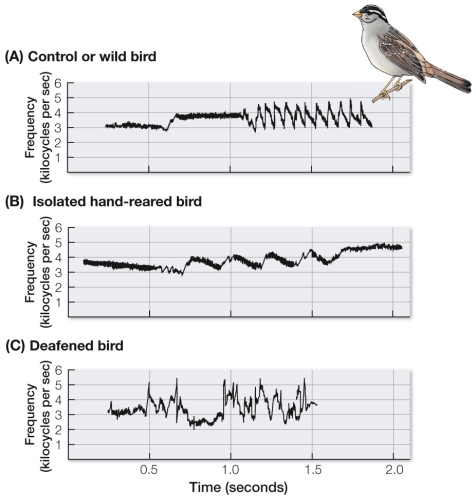 Evaluate this statement: The sonogram in part B (isolated hand-reared bird) shows the song of a male that has not heard his species-specific song during the sensitive period in adulthood.
 (Essay)
4.9/5 (74)
(74) Refer to the graph showing the locomotor activity of Drosophila melanogaster flies that have been subjected to various gene-knockout experiments. 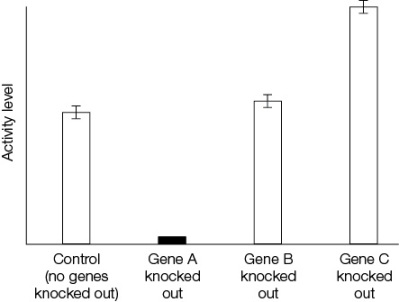 What can be inferred about the normal function of gene C in the graph?
 (Multiple Choice)
4.8/5 (78)
(78) If male white-crowned sparrows are reared in the laboratory under controlled conditions, which one will produce the species-specific song as an adult?
(Multiple Choice)
4.9/5 (92)
(92) Choose the incorrect match of mating system and description.
(Multiple Choice)
4.8/5 (59)
(59) Refer to the figure showing the apparatus used to test the importance of song variation and female choice in zebra finches. 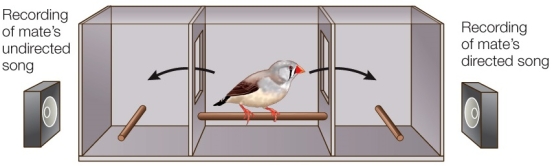 Which statement about the results of the experiment is false?
 (Multiple Choice)
4.9/5 (66)
(66) Which of the following does not characterize visual signals?
(Multiple Choice)
5.0/5 (92)
(92) Which statement about the costs and benefits of behaviors is false?
(Multiple Choice)
4.8/5 (84)
(84) In Pavlov's learning experiments with dogs, food was the _______ and sound was the _______, which was presented immediately _______ the natural stimulus.
(Multiple Choice)
4.9/5 (83)
(83) Biologists can show the effect of a single gene on a behavior by performing _______ experiments.
(Short Answer)
4.9/5 (86)
(86) The ability of pigeons to return to their loft after being transported to remote sites is based on a navigational capacity called
(Multiple Choice)
4.8/5 (79)
(79) Which research question does not address ultimate causes of behavior?
(Multiple Choice)
4.9/5 (87)
(87) Refer to the figure showing a series of experiments carried out on female rats. 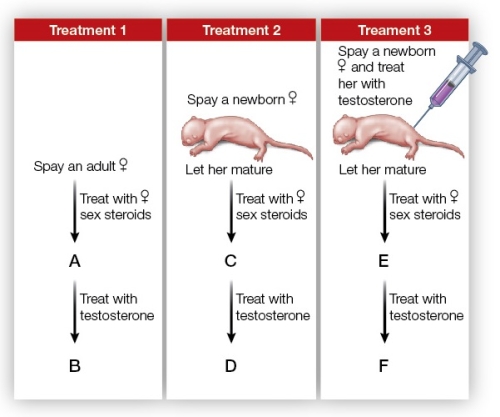 Based on the figure, which statement about sex steroids and rat sexual behavior is false?
 (Multiple Choice)
4.9/5 (89)
(89) How does behaviorism differ from ethology with respect to research questions, study species, and settings in which experiments were conducted?
(Essay)
4.8/5 (87)
(87) In Moore and Marler's study of Yarrow's spiny lizards, males were implanted with testosterone capsules in the summer, when testosterone levels are normally low.Which of the following was not a result of this study?
(Multiple Choice)
4.8/5 (79)
(79) According to Tinbergen, questions that should be considered in behavioral biology include those addressing proximate causes of behavior, such as _______, and those addressing ultimate causes of behavior, such as _______.
(Multiple Choice)
4.7/5 (82)
(82) A solitary, nocturnal mammal living in a complex habitat wishes to leave a long-lasting message for conspecifics.This individual should communicate with other members of its species via _______ signals.
(Short Answer)
4.8/5 (72)
(72) 
Filters
- Essay(0)
- Multiple Choice(0)
- Short Answer(0)
- True False(0)
- Matching(0)