



 Chat with AI
Exam 52: Animal Behavior

Exam 1: Studying Life246 Questions
Exam 2: Small Molecules and the Chemistry of Life246 Questions
Exam 3: Proteins, Carbohydrates, and Lipids246 Questions
Exam 4: Nucleic Acids and the Origin of Life246 Questions
Exam 5: Cells: the Working Units of Life248 Questions
Exam 6: Cell Membranes246 Questions
Exam 7: Cell Communication and Multicellularity246 Questions
Exam 8: Energy, Enzymes, and Metabolism246 Questions
Exam 9: Pathways That Harvest Chemical Energy246 Questions
Exam 10: Photosynthesis: Energy From Sunlight242 Questions
Exam 11: The Cell Cycle and Cell Division260 Questions
Exam 12: Inheritance, Genes, and Chromosomes250 Questions
Exam 13: Dna and Its Role in Heredity257 Questions
Exam 14: From Dna to Protein: Gene Expression252 Questions
Exam 15: Gene Mutation and Molecular Medicine251 Questions
Exam 16: Regulation of Gene Expression245 Questions
Exam 17: Genomes249 Questions
Exam 18: Recombinant Dna and Biotechnology243 Questions
Exam 20: Mechanisms of Evolution243 Questions
Exam 21: Reconstructing and Using Phylogenies246 Questions
Exam 22: Speciation247 Questions
Exam 23: Evolution of Genes and Genomes252 Questions
Exam 24: The History of Life on Earth246 Questions
Exam 25: Bacteria, Archaea, and Viruses262 Questions
Exam 26: The Origin and Diversification of Eukaryotes252 Questions
Exam 27: Plants Without Seeds: From Water to Land251 Questions
Exam 28: The Evolution of Seed Plants259 Questions
Exam 29: The Evolution and Diversity of Fungi261 Questions
Exam 30: Animal Origins and the Evolution of Body Plans248 Questions
Exam 31: Protostome Animals244 Questions
Exam 32: Deuterostome Animals246 Questions
Exam 33: The Plant Body243 Questions
Exam 34: Transport in Plants248 Questions
Exam 35: Plant Nutrition247 Questions
Exam 36: Regulation of Plant Growth246 Questions
Exam 37: Reproduction in Flowering Plants247 Questions
Exam 38: Plant Responses to Environmental Challenges246 Questions
Exam 39: Physiology, Homeostasis, and Temperature Regulation258 Questions
Exam 40: Animal Hormones249 Questions
Exam 41: Immunology: Animal Defense Systems265 Questions
Exam 42: Animal Reproduction261 Questions
Exam 43: Animal Development261 Questions
Exam 44: Neurons, Glia, and Nervous Systems250 Questions
Exam 45: Sensory Systems249 Questions
Exam 46: The Mammalian Nervous System: Structure and Higher Functions254 Questions
Exam 47: Musculoskeletal Systems259 Questions
Exam 48: Gas Exchange247 Questions
Exam 49: Circulatory Systems252 Questions
Exam 50: Nutrition, Digestion, and Absorption259 Questions
Exam 51: Salt and Water Balance and Nitrogen Excretion251 Questions
Exam 52: Animal Behavior249 Questions
Exam 53: The Physical Environment and Biogeography of Life248 Questions
Exam 54: Populations259 Questions
Exam 55: Species Interactions254 Questions
Exam 56: Communities247 Questions
Exam 57: Ecosystems238 Questions
Exam 58: A Changing Biosphere222 Questions
Select questions type


Which statement about the singing behavior of white-crowned sparrows is false?
(Multiple Choice)
4.9/5  (88)
(88) Which of the following does not characterize eusocial species?
(Multiple Choice)
4.8/5 (97)
(97) Which statement about scrub jays helping at the nest is false?
(Multiple Choice)
4.7/5 (73)
(73) African wild dogs are cooperative hunters that live in packs of various sizes.A researcher wants to study how pack size influences hunting success as well as survival and reproduction in this species.Which of Tinbergen's four questions is the researcher asking, and does the research question address proximate or ultimate causes of behavior?
(Short Answer)
4.9/5 (77)
(77) Which of the following does not characterize deprivation experiments?
(Multiple Choice)
4.9/5 (89)
(89) A dung beetle engaged in mating behavior has thereby forfeited time it could have spent foraging.The lost food is an example of
(Multiple Choice)
4.9/5 (78)
(78) A woodchuck in your yard has learned to associate the jingle of your dog's license and rabies tags with the appearance of your dog.Immediately before the dog races around the corner, upon hearing the jingle, the woodchuck disappears into its burrow.In this situation, the _______ is the _______.
(Multiple Choice)
4.8/5 (78)
(78) Which mating system would a species likely display if offspring survival is low when only the mother is present at the nest and fathers have almost no chance of finding another mate?
(Multiple Choice)
4.8/5 (78)
(78) Which rat will display lordosis (a component of female sexual behavior) in adulthood?
(Multiple Choice)
4.8/5 (72)
(72) Karl von Frisch, Konrad Lorenz, and Niko Tinbergen were instrumental in starting a new field of study called _______ in which scientists studied a range of species, typically in the field, and focused on instinctive behaviors.
(Short Answer)
4.9/5 (70)
(70) In mammals, the energetic and opportunity costs of reproduction are _______ in females than males, so females maximize their fitness by investing in _______.
(Multiple Choice)
4.9/5 (85)
(85) Chemical communication between members of the same species can be performed by means of molecules called _______.
(Short Answer)
4.8/5 (89)
(89) Refer to the figure showing the honey bee waggle dance. 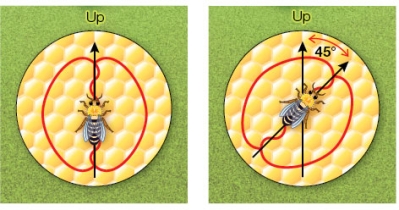 The bee performing the waggle dance in part B of the figure is communicating what to her hivemates?
 (Short Answer)
4.7/5 (80)
(80) Two mice, Alison and Benny, were placed in a lab with continuous light.The graph describes their activity patterns. 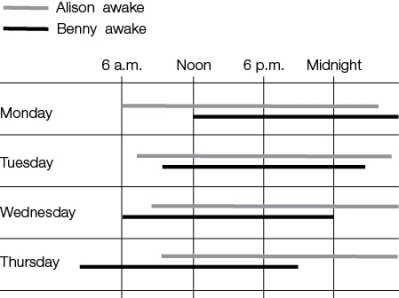 To remain in phase with a 24-hour cycle, would Benny's cycle need to be phase-advanced or phase-delayed?
 (Short Answer)
4.8/5 (83)
(83) Refer to the figure showing a series of experiments carried out on female rats. 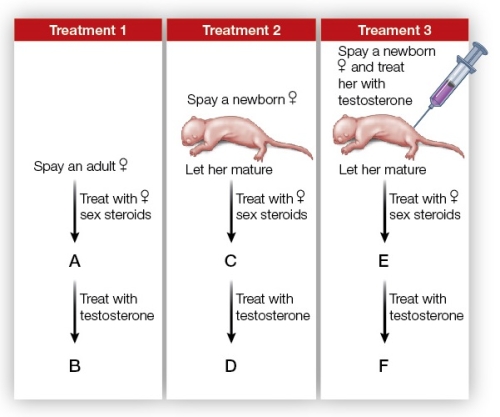 Based on the figure, which statement about sex steroids and rat sexual behavior is false?
 (Multiple Choice)
4.8/5 (82)
(82) Which cue is not involved in the courtship behavior of fruit flies?
(Multiple Choice)
4.7/5 (84)
(84) 
Filters
- Essay(0)
- Multiple Choice(0)
- Short Answer(0)
- True False(0)
- Matching(0)