



 Chat with AI
Exam 52: Animal Behavior

Exam 1: Studying Life246 Questions
Exam 2: Small Molecules and the Chemistry of Life246 Questions
Exam 3: Proteins, Carbohydrates, and Lipids246 Questions
Exam 4: Nucleic Acids and the Origin of Life246 Questions
Exam 5: Cells: the Working Units of Life248 Questions
Exam 6: Cell Membranes246 Questions
Exam 7: Cell Communication and Multicellularity246 Questions
Exam 8: Energy, Enzymes, and Metabolism246 Questions
Exam 9: Pathways That Harvest Chemical Energy246 Questions
Exam 10: Photosynthesis: Energy From Sunlight242 Questions
Exam 11: The Cell Cycle and Cell Division260 Questions
Exam 12: Inheritance, Genes, and Chromosomes250 Questions
Exam 13: Dna and Its Role in Heredity257 Questions
Exam 14: From Dna to Protein: Gene Expression252 Questions
Exam 15: Gene Mutation and Molecular Medicine251 Questions
Exam 16: Regulation of Gene Expression245 Questions
Exam 17: Genomes249 Questions
Exam 18: Recombinant Dna and Biotechnology243 Questions
Exam 20: Mechanisms of Evolution243 Questions
Exam 21: Reconstructing and Using Phylogenies246 Questions
Exam 22: Speciation247 Questions
Exam 23: Evolution of Genes and Genomes252 Questions
Exam 24: The History of Life on Earth246 Questions
Exam 25: Bacteria, Archaea, and Viruses262 Questions
Exam 26: The Origin and Diversification of Eukaryotes252 Questions
Exam 27: Plants Without Seeds: From Water to Land251 Questions
Exam 28: The Evolution of Seed Plants259 Questions
Exam 29: The Evolution and Diversity of Fungi261 Questions
Exam 30: Animal Origins and the Evolution of Body Plans248 Questions
Exam 31: Protostome Animals244 Questions
Exam 32: Deuterostome Animals246 Questions
Exam 33: The Plant Body243 Questions
Exam 34: Transport in Plants248 Questions
Exam 35: Plant Nutrition247 Questions
Exam 36: Regulation of Plant Growth246 Questions
Exam 37: Reproduction in Flowering Plants247 Questions
Exam 38: Plant Responses to Environmental Challenges246 Questions
Exam 39: Physiology, Homeostasis, and Temperature Regulation258 Questions
Exam 40: Animal Hormones249 Questions
Exam 41: Immunology: Animal Defense Systems265 Questions
Exam 42: Animal Reproduction261 Questions
Exam 43: Animal Development261 Questions
Exam 44: Neurons, Glia, and Nervous Systems250 Questions
Exam 45: Sensory Systems249 Questions
Exam 46: The Mammalian Nervous System: Structure and Higher Functions254 Questions
Exam 47: Musculoskeletal Systems259 Questions
Exam 48: Gas Exchange247 Questions
Exam 49: Circulatory Systems252 Questions
Exam 50: Nutrition, Digestion, and Absorption259 Questions
Exam 51: Salt and Water Balance and Nitrogen Excretion251 Questions
Exam 52: Animal Behavior249 Questions
Exam 53: The Physical Environment and Biogeography of Life248 Questions
Exam 54: Populations259 Questions
Exam 55: Species Interactions254 Questions
Exam 56: Communities247 Questions
Exam 57: Ecosystems238 Questions
Exam 58: A Changing Biosphere222 Questions
Select questions type


Pigeons determine compass direction using the position of the sun with respect to their circadian clock.This phenomenon
(Multiple Choice)
4.7/5  (72)
(72) Most humans have circadian rhythms that are about 25 hours long.The presence of sunlight in the morning helps to _______ us to the 24-hour cycle of Earth's day.
(Short Answer)
4.9/5 (73)
(73) Choose the incorrect match between circadian rhythms terms and their definition.
(Multiple Choice)
4.8/5 (76)
(76) _______ rhythms are biological rhythms that occur on an annual basis.
(Multiple Choice)
4.9/5 (81)
(81) Which rat will show male sexual behavior (mounting) in adulthood?
(Multiple Choice)
4.8/5 (80)
(80) Avoiding being eaten is typically a compromise for animals.If a male frog remains silent, then he can't attract mates.Inability to attract mates is a(n) _______ cost of remaining silent for the male frog.
(Multiple Choice)
4.8/5 (70)
(70) Refer to the figure showing the steps in a conditioned reflex experiment. 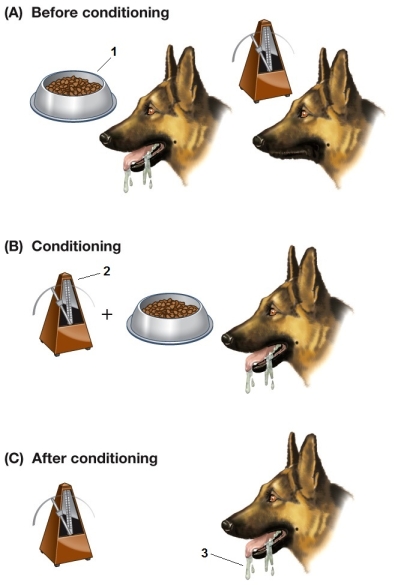 Based on the figure, the object at point 1 is the
 (Multiple Choice)
4.7/5 (82)
(82) For song to develop normally, a young male songbird must hear _______ during his first several months of life and be able to hear himself sing as his song develops.
(Short Answer)
5.0/5 (73)
(73) Researchers lesioned the suprachiasmatic nuclei (SCN) of adult hamsters with typical 24-hour rhythms and later transplanted SCN from hamster fetuses with short-day rhythmicity.As a result the recipients
(Multiple Choice)
4.8/5 (77)
(77) The waggle dance of bees is an example of a(n) _______ signal.
(Multiple Choice)
4.8/5 (70)
(70) Tinbergen outlined four questions he thought behavioral biologists should be asking.Which of the following was not a consideration when investigating behavior, according to Tinbergen?
(Multiple Choice)
4.7/5 (84)
(84) Refer to the table.Match one of these mating systems to the description listed in the table: monogamy, polyandry, polygyny, promiscuity.(Note: The order should read from top to bottom.) 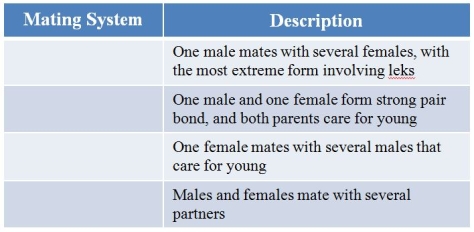
(Multiple Choice)
4.9/5 (85)
(85) Two mice, Alison and Benny, were placed in a lab with continuous light.The graph describes their activity patterns. 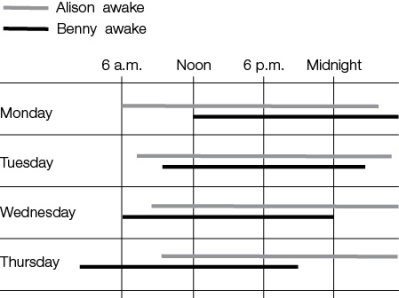 All other things being equal, which mouse would be entrained most easily to a 24-hour cycle?
 (Short Answer)
4.9/5 (78)
(78) According to optimal foraging theory, which of the following would be associated with a foraging animal that rapidly attains its energetic requirements?
(Multiple Choice)
4.9/5 (84)
(84) Which hormone is most immediately responsible for causing increases each spring in song-learning regions of the brains of male songbirds?
(Multiple Choice)
4.8/5 (88)
(88) Experimental evidence suggests that the ability to detect _______ allows pigeons that are displaced long distances to return home even on overcast days.
(Multiple Choice)
4.9/5 (78)
(78) Any object, condition, or event that is required to elicit a fixed action pattern is called a(n) _______.
(Short Answer)
4.9/5 (72)
(72) In haplodiploid organisms, what percentage of alleles do females share with their sisters if their mother mated with only one male?
(Multiple Choice)
4.8/5 (74)
(74) Refer to the figure showing the steps in a conditioned reflex experiment. 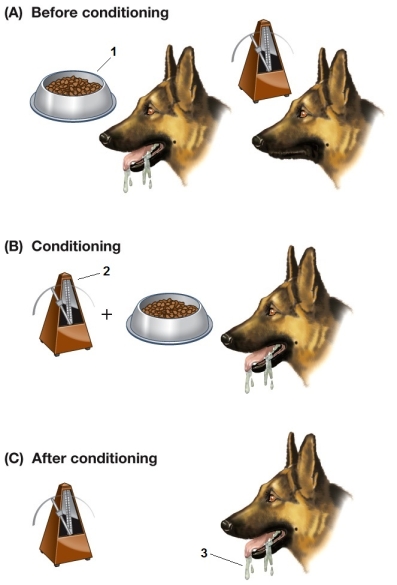 Which statement about the experiment shown in the figure is false?
 (Multiple Choice)
4.8/5 (91)
(91) Which of the following does not characterize star compass orientation?
(Multiple Choice)
4.8/5 (88)
(88) 
Filters
- Essay(0)
- Multiple Choice(0)
- Short Answer(0)
- True False(0)
- Matching(0)