



 Chat with AI
Exam 9: Pathways That Harvest Chemical Energy

Exam 1: Studying Life246 Questions
Exam 2: Small Molecules and the Chemistry of Life246 Questions
Exam 3: Proteins, Carbohydrates, and Lipids246 Questions
Exam 4: Nucleic Acids and the Origin of Life246 Questions
Exam 5: Cells: the Working Units of Life248 Questions
Exam 6: Cell Membranes246 Questions
Exam 7: Cell Communication and Multicellularity246 Questions
Exam 8: Energy, Enzymes, and Metabolism246 Questions
Exam 9: Pathways That Harvest Chemical Energy246 Questions
Exam 10: Photosynthesis: Energy From Sunlight242 Questions
Exam 11: The Cell Cycle and Cell Division260 Questions
Exam 12: Inheritance, Genes, and Chromosomes250 Questions
Exam 13: Dna and Its Role in Heredity257 Questions
Exam 14: From Dna to Protein: Gene Expression252 Questions
Exam 15: Gene Mutation and Molecular Medicine251 Questions
Exam 16: Regulation of Gene Expression245 Questions
Exam 17: Genomes249 Questions
Exam 18: Recombinant Dna and Biotechnology243 Questions
Exam 20: Mechanisms of Evolution243 Questions
Exam 21: Reconstructing and Using Phylogenies246 Questions
Exam 22: Speciation247 Questions
Exam 23: Evolution of Genes and Genomes252 Questions
Exam 24: The History of Life on Earth246 Questions
Exam 25: Bacteria, Archaea, and Viruses262 Questions
Exam 26: The Origin and Diversification of Eukaryotes252 Questions
Exam 27: Plants Without Seeds: From Water to Land251 Questions
Exam 28: The Evolution of Seed Plants259 Questions
Exam 29: The Evolution and Diversity of Fungi261 Questions
Exam 30: Animal Origins and the Evolution of Body Plans248 Questions
Exam 31: Protostome Animals244 Questions
Exam 32: Deuterostome Animals246 Questions
Exam 33: The Plant Body243 Questions
Exam 34: Transport in Plants248 Questions
Exam 35: Plant Nutrition247 Questions
Exam 36: Regulation of Plant Growth246 Questions
Exam 37: Reproduction in Flowering Plants247 Questions
Exam 38: Plant Responses to Environmental Challenges246 Questions
Exam 39: Physiology, Homeostasis, and Temperature Regulation258 Questions
Exam 40: Animal Hormones249 Questions
Exam 41: Immunology: Animal Defense Systems265 Questions
Exam 42: Animal Reproduction261 Questions
Exam 43: Animal Development261 Questions
Exam 44: Neurons, Glia, and Nervous Systems250 Questions
Exam 45: Sensory Systems249 Questions
Exam 46: The Mammalian Nervous System: Structure and Higher Functions254 Questions
Exam 47: Musculoskeletal Systems259 Questions
Exam 48: Gas Exchange247 Questions
Exam 49: Circulatory Systems252 Questions
Exam 50: Nutrition, Digestion, and Absorption259 Questions
Exam 51: Salt and Water Balance and Nitrogen Excretion251 Questions
Exam 52: Animal Behavior249 Questions
Exam 53: The Physical Environment and Biogeography of Life248 Questions
Exam 54: Populations259 Questions
Exam 55: Species Interactions254 Questions
Exam 56: Communities247 Questions
Exam 57: Ecosystems238 Questions
Exam 58: A Changing Biosphere222 Questions
Select questions type


Refer to the figure below, which shows an oxidation-reduction reaction that occurs spontaneously. 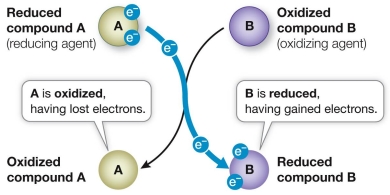 Which statement correctly compares the free energy stored in molecules shown in the figure?
 (Multiple Choice)
4.9/5  (89)
(89) Which statement best describes steps 1, 2, and 3 of glycolysis (glucose glucose 6-phosphate fructose 1,6-bisphosphate)?
(Multiple Choice)
4.8/5 (84)
(84) Refer to the figure below, showing inputs and outputs of glucose oxidation in a cell under aerobic conditions. 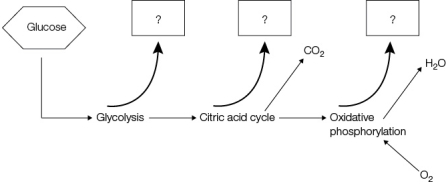 Each box with a question mark should be labeled _______.
 (Short Answer)
4.9/5 (75)
(75) Refer to the figure below. 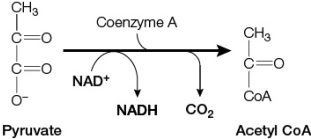 This reaction links glycolysis to the citric acid cycle.Which statement correctly describes the chemical changes depicted in this reaction?
 (Multiple Choice)
4.8/5 (96)
(96) The main difference between lactic acid fermentation and alcoholic fermentation is that lactic acid fermentation
(Multiple Choice)
4.9/5 (76)
(76) Refer to the reaction below. Glyceraldehyde 3-phosphate (G3P) + NAD+ + H+ + Pi 1,3-bisphosphoglycerate (BPG) + NADH
In this redox reaction, _______ is oxidized and _______ is reduced.
(Multiple Choice)
4.8/5 (84)
(84) The link between glycolysis and the citric acid cycle is called _______.
(Short Answer)
4.9/5 (88)
(88) How are steps 1-3 of glycolysis different from steps 6-10?
(Multiple Choice)
4.7/5 (75)
(75) In steps 6 through 10 of glycolysis, the conversion of 1 mole of glyceraldehyde 3-phosphate to pyruvate yields 2 moles of ATP.But the oxidation of glucose to pyruvate produces a total of 4 moles of ATP.Where do the remaining 2 moles of ATP come from?
(Multiple Choice)
4.8/5 (69)
(69) Refer to the figure below. 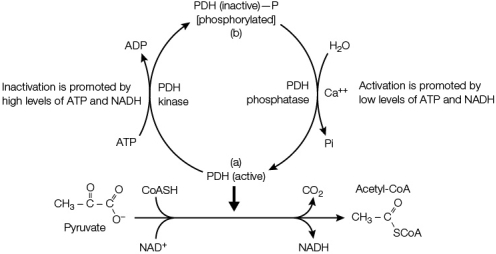 Which two regulatory mechanisms are at work in the figure?
 (Multiple Choice)
5.0/5 (95)
(95) Data shown in the two graphs below are from experiments carried out on pyruvate dehydrogenase (PDH), the enzyme that catalyzes the conversion of pyruvate to acetyl CoA and carbon dioxide. 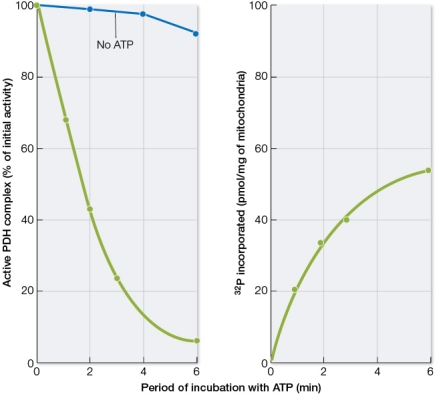 In the experiments, extracts of mitochondria were incubated for 6 minutes with high concentrations of ATP labeled with phosphorus-32.At various times, samples were removed and tested for PDH activity and incorporation of phosphorus-32 (32P) label into PDH.The results shown in the graphs suggest that PDH is regulated via a mechanism involving _______ of the PDH protein.
 (Short Answer)
4.9/5 (81)
(81) If the regeneration of NAD+ were inhibited during lactic acid fermentation, which of the following would likely occur?
(Multiple Choice)
4.8/5 (81)
(81) Refer to the table below.  This table compares glucose oxidation carried out in a laboratory and in a living cell.To complete this table, _______ should be used to replace the question mark in the last column.
 (Short Answer)
4.8/5 (84)
(84) When the supply of acetyl CoA being produced exceeds the demands of the citric acid cycle, some of the acetyl CoA is diverted to the synthesis of
(Multiple Choice)
4.7/5 (88)
(88) Which is a viable path that a carbon atom could take as it moves through metabolic pathways in a cell?
(Multiple Choice)
4.9/5 (74)
(74) 
Filters
- Essay(0)
- Multiple Choice(0)
- Short Answer(0)
- True False(0)
- Matching(0)