



 Chat with AI
Exam 9: Pathways That Harvest Chemical Energy

Exam 1: Studying Life246 Questions
Exam 2: Small Molecules and the Chemistry of Life246 Questions
Exam 3: Proteins, Carbohydrates, and Lipids246 Questions
Exam 4: Nucleic Acids and the Origin of Life246 Questions
Exam 5: Cells: the Working Units of Life248 Questions
Exam 6: Cell Membranes246 Questions
Exam 7: Cell Communication and Multicellularity246 Questions
Exam 8: Energy, Enzymes, and Metabolism246 Questions
Exam 9: Pathways That Harvest Chemical Energy246 Questions
Exam 10: Photosynthesis: Energy From Sunlight242 Questions
Exam 11: The Cell Cycle and Cell Division260 Questions
Exam 12: Inheritance, Genes, and Chromosomes250 Questions
Exam 13: Dna and Its Role in Heredity257 Questions
Exam 14: From Dna to Protein: Gene Expression252 Questions
Exam 15: Gene Mutation and Molecular Medicine251 Questions
Exam 16: Regulation of Gene Expression245 Questions
Exam 17: Genomes249 Questions
Exam 18: Recombinant Dna and Biotechnology243 Questions
Exam 20: Mechanisms of Evolution243 Questions
Exam 21: Reconstructing and Using Phylogenies246 Questions
Exam 22: Speciation247 Questions
Exam 23: Evolution of Genes and Genomes252 Questions
Exam 24: The History of Life on Earth246 Questions
Exam 25: Bacteria, Archaea, and Viruses262 Questions
Exam 26: The Origin and Diversification of Eukaryotes252 Questions
Exam 27: Plants Without Seeds: From Water to Land251 Questions
Exam 28: The Evolution of Seed Plants259 Questions
Exam 29: The Evolution and Diversity of Fungi261 Questions
Exam 30: Animal Origins and the Evolution of Body Plans248 Questions
Exam 31: Protostome Animals244 Questions
Exam 32: Deuterostome Animals246 Questions
Exam 33: The Plant Body243 Questions
Exam 34: Transport in Plants248 Questions
Exam 35: Plant Nutrition247 Questions
Exam 36: Regulation of Plant Growth246 Questions
Exam 37: Reproduction in Flowering Plants247 Questions
Exam 38: Plant Responses to Environmental Challenges246 Questions
Exam 39: Physiology, Homeostasis, and Temperature Regulation258 Questions
Exam 40: Animal Hormones249 Questions
Exam 41: Immunology: Animal Defense Systems265 Questions
Exam 42: Animal Reproduction261 Questions
Exam 43: Animal Development261 Questions
Exam 44: Neurons, Glia, and Nervous Systems250 Questions
Exam 45: Sensory Systems249 Questions
Exam 46: The Mammalian Nervous System: Structure and Higher Functions254 Questions
Exam 47: Musculoskeletal Systems259 Questions
Exam 48: Gas Exchange247 Questions
Exam 49: Circulatory Systems252 Questions
Exam 50: Nutrition, Digestion, and Absorption259 Questions
Exam 51: Salt and Water Balance and Nitrogen Excretion251 Questions
Exam 52: Animal Behavior249 Questions
Exam 53: The Physical Environment and Biogeography of Life248 Questions
Exam 54: Populations259 Questions
Exam 55: Species Interactions254 Questions
Exam 56: Communities247 Questions
Exam 57: Ecosystems238 Questions
Exam 58: A Changing Biosphere222 Questions
Select questions type


Refer to the figure below. 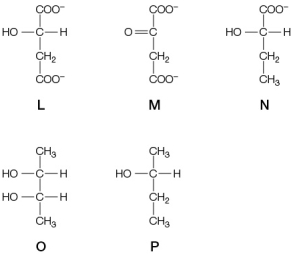 Of the compounds shown, which is the most oxidized, and which is the most reduced?
 (Multiple Choice)
4.8/5  (78)
(78) Refer to the table below. 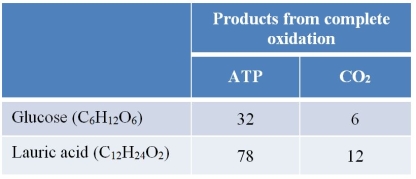 The table summarizes the products (in moles) of the complete oxidation of 1 mole of glucose and the complete oxidation of 1 mole of lauric acid, a fatty acid.Use this information to determine how energy production will compare when an equivalent amount of carbon dioxide is produced from oxidation events involving these two molecules.
 (Multiple Choice)
4.8/5 (64)
(64) During alcoholic fermentation, NAD+ is regenerated from NADH by the reduction of acetaldehyde to _______.
(Short Answer)
4.8/5 (78)
(78) Life in its earliest stages was very simple, and bacteria were the dominant life form.However, things changed about 2.3 billion years ago that allowed many new life forms to evolve and multicellularity to emerge.These changes were due to the rise in _______ levels in the atmosphere.
(Short Answer)
4.7/5 (80)
(80) Malate dehydrogenase is responsible for catalyzing which reaction?
(Multiple Choice)
4.8/5 (86)
(86) Refer to the table showing an accounting of ATP yield from different metabolic processes in a mouse cell.Yield is defined as the net number of molecules of ATP formed for every glucose molecule oxidized. 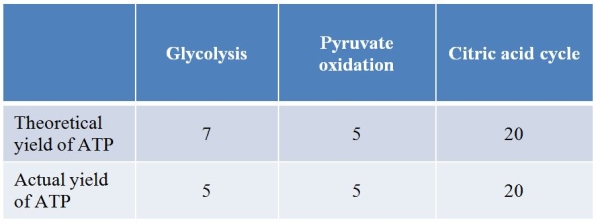 Which statement explains why the two sets of values differ?
 (Multiple Choice)
4.9/5 (77)
(77) Atoms in triglycerides could be used in the synthesis of DNA.Which metabolic intermediate and pathway will function as crossover points between triglycerides and DNA?
(Multiple Choice)
4.9/5 (78)
(78) Examine the figure below, then answer the questions that follow.
a. Which is the oxidizing agent, and which is the reducing agent?
b. At the end of the reaction, which compound is oxidized and which is reduced?
c. If this figure represents the metabolism of glucose, which letter represents glucose? Which letter represents O2? 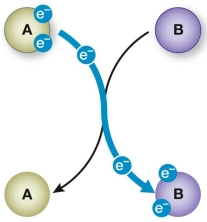
(Essay)
4.8/5 (62)
(62) How many moles of high-energy phosphates are generated in converting 1 mole of glucose to lactate?
(Multiple Choice)
4.8/5 (84)
(84) Refer to the graphs below, illustrating the free energy changes that occur during reactions in which glucose is oxidized to carbon dioxide and water. 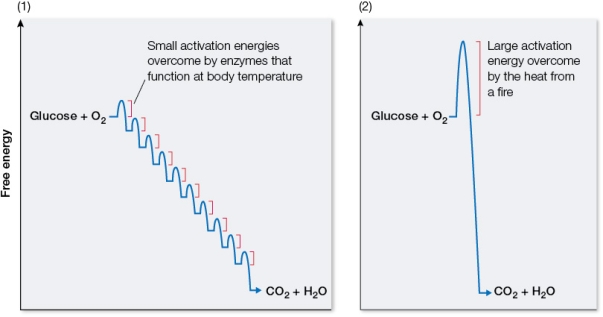 Identify which graph corresponds to the laboratory oxidation of glucose and which corresponds to cellular oxidation of glucose.Explain how the overall free energy change compares in these two reactions and why.Also compare the form that the released energy takes in these two reactions.
 (Essay)
4.8/5 (87)
(87) Organisms regulate certain metabolic enzymes in cells in order to maintain
(Multiple Choice)
4.7/5 (71)
(71) Refer to the figure below. 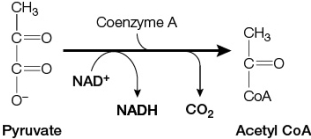 Some of the chemical energy present in pyruvate is harvested during an oxidation-reduction process taking place in the multistep reaction shown in the figure.In which molecule is this harvested chemical energy stored?
 (Multiple Choice)
4.9/5 (81)
(81) Refer to the figure below. 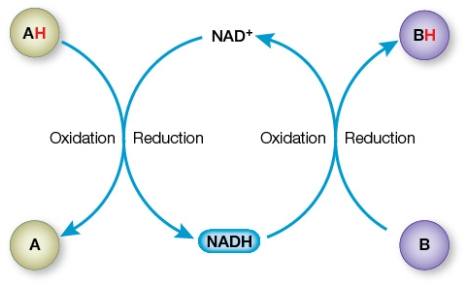 This figure illustrates how two oxidation-reduction reactions are coupled with electrons moving from one compound through another via the coenzyme _______.
 (Short Answer)
4.9/5 (74)
(74) Which component of the respiratory chain is a peripheral protein?
(Multiple Choice)
4.9/5 (69)
(69) Absence of _______ would disrupt the citric acid cycle but not glycolysis.
(Multiple Choice)
4.8/5 (82)
(82) Which statement about the respiratory electron transport chain is true?
(Multiple Choice)
5.0/5 (67)
(67) 
Filters
- Essay(0)
- Multiple Choice(0)
- Short Answer(0)
- True False(0)
- Matching(0)