



 Chat with AI
Exam 9: Pathways That Harvest Chemical Energy

Exam 1: Studying Life246 Questions
Exam 2: Small Molecules and the Chemistry of Life246 Questions
Exam 3: Proteins, Carbohydrates, and Lipids246 Questions
Exam 4: Nucleic Acids and the Origin of Life246 Questions
Exam 5: Cells: the Working Units of Life248 Questions
Exam 6: Cell Membranes246 Questions
Exam 7: Cell Communication and Multicellularity246 Questions
Exam 8: Energy, Enzymes, and Metabolism246 Questions
Exam 9: Pathways That Harvest Chemical Energy246 Questions
Exam 10: Photosynthesis: Energy From Sunlight242 Questions
Exam 11: The Cell Cycle and Cell Division260 Questions
Exam 12: Inheritance, Genes, and Chromosomes250 Questions
Exam 13: Dna and Its Role in Heredity257 Questions
Exam 14: From Dna to Protein: Gene Expression252 Questions
Exam 15: Gene Mutation and Molecular Medicine251 Questions
Exam 16: Regulation of Gene Expression245 Questions
Exam 17: Genomes249 Questions
Exam 18: Recombinant Dna and Biotechnology243 Questions
Exam 20: Mechanisms of Evolution243 Questions
Exam 21: Reconstructing and Using Phylogenies246 Questions
Exam 22: Speciation247 Questions
Exam 23: Evolution of Genes and Genomes252 Questions
Exam 24: The History of Life on Earth246 Questions
Exam 25: Bacteria, Archaea, and Viruses262 Questions
Exam 26: The Origin and Diversification of Eukaryotes252 Questions
Exam 27: Plants Without Seeds: From Water to Land251 Questions
Exam 28: The Evolution of Seed Plants259 Questions
Exam 29: The Evolution and Diversity of Fungi261 Questions
Exam 30: Animal Origins and the Evolution of Body Plans248 Questions
Exam 31: Protostome Animals244 Questions
Exam 32: Deuterostome Animals246 Questions
Exam 33: The Plant Body243 Questions
Exam 34: Transport in Plants248 Questions
Exam 35: Plant Nutrition247 Questions
Exam 36: Regulation of Plant Growth246 Questions
Exam 37: Reproduction in Flowering Plants247 Questions
Exam 38: Plant Responses to Environmental Challenges246 Questions
Exam 39: Physiology, Homeostasis, and Temperature Regulation258 Questions
Exam 40: Animal Hormones249 Questions
Exam 41: Immunology: Animal Defense Systems265 Questions
Exam 42: Animal Reproduction261 Questions
Exam 43: Animal Development261 Questions
Exam 44: Neurons, Glia, and Nervous Systems250 Questions
Exam 45: Sensory Systems249 Questions
Exam 46: The Mammalian Nervous System: Structure and Higher Functions254 Questions
Exam 47: Musculoskeletal Systems259 Questions
Exam 48: Gas Exchange247 Questions
Exam 49: Circulatory Systems252 Questions
Exam 50: Nutrition, Digestion, and Absorption259 Questions
Exam 51: Salt and Water Balance and Nitrogen Excretion251 Questions
Exam 52: Animal Behavior249 Questions
Exam 53: The Physical Environment and Biogeography of Life248 Questions
Exam 54: Populations259 Questions
Exam 55: Species Interactions254 Questions
Exam 56: Communities247 Questions
Exam 57: Ecosystems238 Questions
Exam 58: A Changing Biosphere222 Questions
Select questions type


Glycolysis converts glucose to pyruvate with the formation of ATP and NADH.This process requires
(Multiple Choice)
4.9/5  (66)
(66) The chemiosmotic formation of ATP during the operation of the mitochondrial respiratory chain is called _______.
(Short Answer)
4.8/5 (93)
(93) Arsenate is used by phosphate-requiring enzymes as an alternative substrate to phosphate.Arsenate poisoning would have the greatest effect on cellular respiration by inhibiting which enzyme?
(Multiple Choice)
4.9/5 (85)
(85) Refer to the table summarizing data regarding a common metabolic intermediate produced when three different fuel molecules are catabolized. 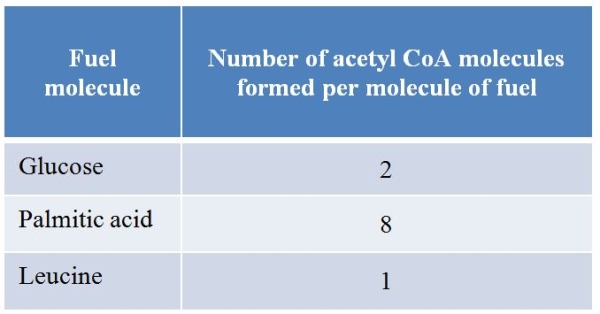 The data suggest that _______ are much better sources of energy than either _______ or _______.
 (Multiple Choice)
4.8/5 (83)
(83) Some aerobic bacterial species have respiratory chains with fewer components than those in mammalian respiratory chains.Which other characteristic would you expect to differ between these bacteria and mammalian cells?
(Multiple Choice)
4.8/5 (78)
(78) Refer to the table below, summarizing energy expenditures of various human tissues exposed to different temperatures. 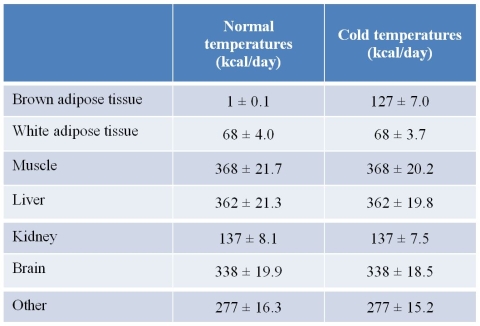 Based on the data and your knowledge of the characteristics of brown adipose tissue, which metabolic process is stimulated in brown adipose tissue but not in other tissues in response to cold?
 (Multiple Choice)
4.8/5 (77)
(77) Refer to the graph below. 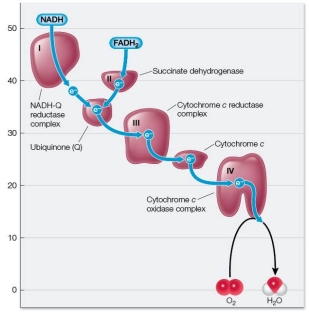 How should the y (vertical) axis be labeled?
 (Multiple Choice)
4.9/5 (81)
(81) Refer to the table, which summarizes the inputs and outputs of glycolysis. 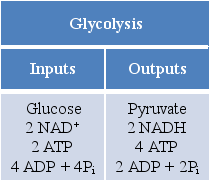 Which group represents the net outputs of glycolysis?
 (Multiple Choice)
4.7/5 (86)
(86) Before starch can be used for respiratory ATP production, it must be hydrolyzed to
(Multiple Choice)
4.9/5 (82)
(82) Overall, four molecules of ATP are produced during glycolysis.However, at the end of glycolysis there are two ATP molecules, two pyruvate molecules, and two NADH molecules present.The ATP numbers do not match because
(Multiple Choice)
4.7/5 (73)
(73) The synthesis of ATP from ADP and Pi is an _______ reaction.In mitochondria, ATP synthesis is driven by the flow of _______ down a concentration gradient established by _______.
(Multiple Choice)
4.8/5 (84)
(84) During cellular respiration, H2O is produced as a result of the
(Multiple Choice)
4.8/5 (89)
(89) When acetyl CoA builds up in the cell, it increases the activity of the enzyme that synthesizes oxaloacetate from pyruvate and CO2.In this case, acetyl CoA is acting as a(n)
(Multiple Choice)
4.9/5 (94)
(94) Cyanide inhibits the enzyme in the mitochondrial electron transport chain that reduces O2 to water.Suppose you added cyanide to a suspension of muscle cells from a rat.Which statement is accurate with respect to the effects of cyanide on glucose catabolism?
(Multiple Choice)
4.9/5 (88)
(88) Overall, the _______ within each complex of the respiratory chain decreases as electrons move from the first to the last complex.
(Multiple Choice)
4.7/5 (69)
(69) Refer to the figure below, illustrating how two redox reactions are coupled in an energy-harvesting pathway in a cell. 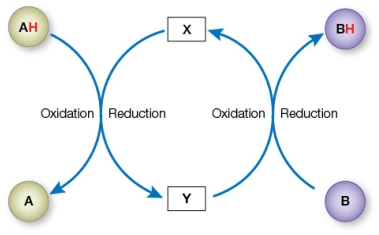 Which molecules could serve as compounds X and Y, respectively?
 (Multiple Choice)
4.7/5 (93)
(93) 
Filters
- Essay(0)
- Multiple Choice(0)
- Short Answer(0)
- True False(0)
- Matching(0)