



 Chat with AI
Exam 9: Pathways That Harvest Chemical Energy

Exam 1: Studying Life246 Questions
Exam 2: Small Molecules and the Chemistry of Life246 Questions
Exam 3: Proteins, Carbohydrates, and Lipids246 Questions
Exam 4: Nucleic Acids and the Origin of Life246 Questions
Exam 5: Cells: the Working Units of Life248 Questions
Exam 6: Cell Membranes246 Questions
Exam 7: Cell Communication and Multicellularity246 Questions
Exam 8: Energy, Enzymes, and Metabolism246 Questions
Exam 9: Pathways That Harvest Chemical Energy246 Questions
Exam 10: Photosynthesis: Energy From Sunlight242 Questions
Exam 11: The Cell Cycle and Cell Division260 Questions
Exam 12: Inheritance, Genes, and Chromosomes250 Questions
Exam 13: Dna and Its Role in Heredity257 Questions
Exam 14: From Dna to Protein: Gene Expression252 Questions
Exam 15: Gene Mutation and Molecular Medicine251 Questions
Exam 16: Regulation of Gene Expression245 Questions
Exam 17: Genomes249 Questions
Exam 18: Recombinant Dna and Biotechnology243 Questions
Exam 20: Mechanisms of Evolution243 Questions
Exam 21: Reconstructing and Using Phylogenies246 Questions
Exam 22: Speciation247 Questions
Exam 23: Evolution of Genes and Genomes252 Questions
Exam 24: The History of Life on Earth246 Questions
Exam 25: Bacteria, Archaea, and Viruses262 Questions
Exam 26: The Origin and Diversification of Eukaryotes252 Questions
Exam 27: Plants Without Seeds: From Water to Land251 Questions
Exam 28: The Evolution of Seed Plants259 Questions
Exam 29: The Evolution and Diversity of Fungi261 Questions
Exam 30: Animal Origins and the Evolution of Body Plans248 Questions
Exam 31: Protostome Animals244 Questions
Exam 32: Deuterostome Animals246 Questions
Exam 33: The Plant Body243 Questions
Exam 34: Transport in Plants248 Questions
Exam 35: Plant Nutrition247 Questions
Exam 36: Regulation of Plant Growth246 Questions
Exam 37: Reproduction in Flowering Plants247 Questions
Exam 38: Plant Responses to Environmental Challenges246 Questions
Exam 39: Physiology, Homeostasis, and Temperature Regulation258 Questions
Exam 40: Animal Hormones249 Questions
Exam 41: Immunology: Animal Defense Systems265 Questions
Exam 42: Animal Reproduction261 Questions
Exam 43: Animal Development261 Questions
Exam 44: Neurons, Glia, and Nervous Systems250 Questions
Exam 45: Sensory Systems249 Questions
Exam 46: The Mammalian Nervous System: Structure and Higher Functions254 Questions
Exam 47: Musculoskeletal Systems259 Questions
Exam 48: Gas Exchange247 Questions
Exam 49: Circulatory Systems252 Questions
Exam 50: Nutrition, Digestion, and Absorption259 Questions
Exam 51: Salt and Water Balance and Nitrogen Excretion251 Questions
Exam 52: Animal Behavior249 Questions
Exam 53: The Physical Environment and Biogeography of Life248 Questions
Exam 54: Populations259 Questions
Exam 55: Species Interactions254 Questions
Exam 56: Communities247 Questions
Exam 57: Ecosystems238 Questions
Exam 58: A Changing Biosphere222 Questions
Select questions type


The graph represents data collected by researchers interested in observing how diet affects cell metabolism.In the investigation, mice were grouped into control (C) and experimental (E) groups according to diet. 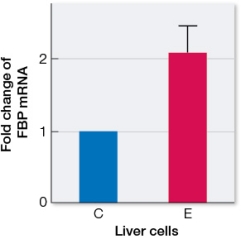 Control mice were fed normal mouse chow that has a mix of carbohydrate, protein, and fat.Experimental mice were fed chow made up of equal parts of protein and fat, with very little carbohydrate.After 8 weeks, samples of liver tissue were analyzed in various ways.In one assay, the expression of mRNA transcripts of the gene for fructose 1,6-bisphosphatase (FBP mRNA) was quantified.FBP is important in the gluconeogenesis pathway and catalyzes the conversion of fructose 1,6-bisphosphate to fructose 6-phosphate.The graph represents the results of this analysis.Explain what the data indicate about metabolic regulation in the liver when intake of carbohydrates is very low.
 (Essay)
4.9/5  (72)
(72) Refer to the table below. 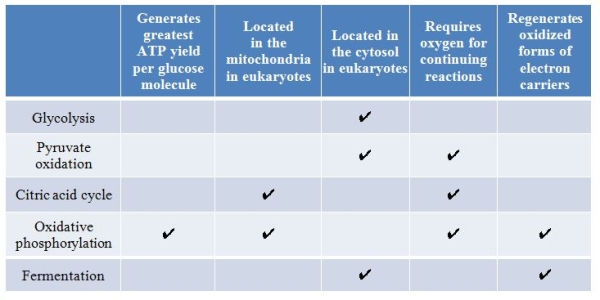 A student made this table as a study guide for learning the various catabolic pathways that cells use for harvesting energy from glucose.Which statement best evaluates the accuracy of the student's efforts?
 (Multiple Choice)
4.8/5 (79)
(79) The drug 2,4-dinitrophenol (DNP) destroys the proton gradient across the inner mitochondrial membrane.What would be the effect of incubating isolated mitochondria in a solution of DNP?
(Multiple Choice)
4.9/5 (81)
(81) Refer to the reaction below.  This reaction occurs in several steps in the mitochondria of a cell and is responsible for the formation of a proton gradient across the inner mitochondrial membrane.The sign needed to fill in the blank above is _______.
 (Short Answer)
4.9/5 (72)
(72) Oxidative phosphorylation has two major components: _______ and _______.
(Multiple Choice)
4.8/5 (70)
(70) Refer to the figure below. 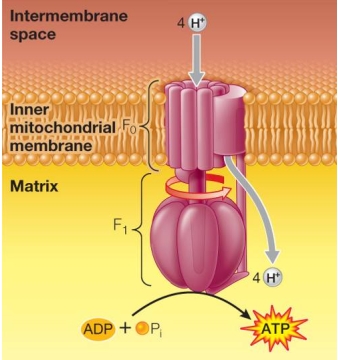 The figure illustrates how the F1 subunit _______ as protons move from high to low concentration through the channel formed by the F0 subunit.
 (Short Answer)
4.9/5 (60)
(60) Some poisons are compounds that interfere with metabolic pathways.Which poison would interfere with the citric acid cycle but not affect glycolysis?
(Multiple Choice)
4.9/5 (83)
(83) Fermentation is an important process that allows organisms growing in anaerobic environments to harvest energy from glucose.Which statement about fermentation explains one other reason why fermentation is important to anaerobic organisms?
(Multiple Choice)
5.0/5 (75)
(75) Which statement could be used as part of a description of how carbohydrate, lipid, and protein are linked through catabolic and anabolic pathways?
(Multiple Choice)
4.7/5 (90)
(90) How many enzymatic steps are involved in glycolysis in animals?
(Multiple Choice)
4.9/5 (87)
(87) Refer to the figure showing how cells in different organs of the body respond during intense exercise. 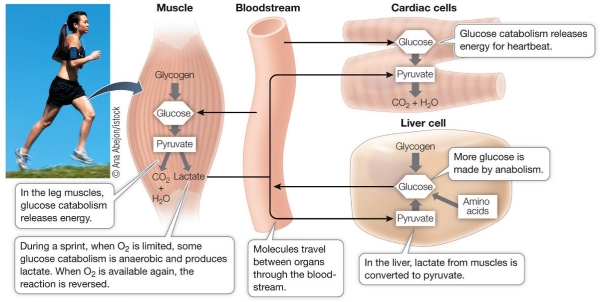 Which statement explains how cell metabolism in these organs will shift when the woman in the photo stops running and enters a period of rest?
 (Multiple Choice)
4.9/5 (77)
(77) The cell harvests a very large amount of free energy from glucose in the form of ATP.Which statement can be used as part of an explanation about how the cell accomplishes this harvesting process with high efficiency (i.e., with very little loss in energy as heat)?
(Multiple Choice)
4.8/5 (77)
(77) Regardless of the electron or hydrogen acceptor employed, fermentation always produces
(Multiple Choice)
4.7/5 (69)
(69) A chemical reaction resulting in the transfer of electrons or hydrogen atoms from one molecule to another is called a(n) _______ reaction.
(Short Answer)
4.9/5 (77)
(77) 
Filters
- Essay(0)
- Multiple Choice(0)
- Short Answer(0)
- True False(0)
- Matching(0)