



 Chat with AI
Exam 9: Pathways That Harvest Chemical Energy

Exam 1: Studying Life246 Questions
Exam 2: Small Molecules and the Chemistry of Life246 Questions
Exam 3: Proteins, Carbohydrates, and Lipids246 Questions
Exam 4: Nucleic Acids and the Origin of Life246 Questions
Exam 5: Cells: the Working Units of Life248 Questions
Exam 6: Cell Membranes246 Questions
Exam 7: Cell Communication and Multicellularity246 Questions
Exam 8: Energy, Enzymes, and Metabolism246 Questions
Exam 9: Pathways That Harvest Chemical Energy246 Questions
Exam 10: Photosynthesis: Energy From Sunlight242 Questions
Exam 11: The Cell Cycle and Cell Division260 Questions
Exam 12: Inheritance, Genes, and Chromosomes250 Questions
Exam 13: Dna and Its Role in Heredity257 Questions
Exam 14: From Dna to Protein: Gene Expression252 Questions
Exam 15: Gene Mutation and Molecular Medicine251 Questions
Exam 16: Regulation of Gene Expression245 Questions
Exam 17: Genomes249 Questions
Exam 18: Recombinant Dna and Biotechnology243 Questions
Exam 20: Mechanisms of Evolution243 Questions
Exam 21: Reconstructing and Using Phylogenies246 Questions
Exam 22: Speciation247 Questions
Exam 23: Evolution of Genes and Genomes252 Questions
Exam 24: The History of Life on Earth246 Questions
Exam 25: Bacteria, Archaea, and Viruses262 Questions
Exam 26: The Origin and Diversification of Eukaryotes252 Questions
Exam 27: Plants Without Seeds: From Water to Land251 Questions
Exam 28: The Evolution of Seed Plants259 Questions
Exam 29: The Evolution and Diversity of Fungi261 Questions
Exam 30: Animal Origins and the Evolution of Body Plans248 Questions
Exam 31: Protostome Animals244 Questions
Exam 32: Deuterostome Animals246 Questions
Exam 33: The Plant Body243 Questions
Exam 34: Transport in Plants248 Questions
Exam 35: Plant Nutrition247 Questions
Exam 36: Regulation of Plant Growth246 Questions
Exam 37: Reproduction in Flowering Plants247 Questions
Exam 38: Plant Responses to Environmental Challenges246 Questions
Exam 39: Physiology, Homeostasis, and Temperature Regulation258 Questions
Exam 40: Animal Hormones249 Questions
Exam 41: Immunology: Animal Defense Systems265 Questions
Exam 42: Animal Reproduction261 Questions
Exam 43: Animal Development261 Questions
Exam 44: Neurons, Glia, and Nervous Systems250 Questions
Exam 45: Sensory Systems249 Questions
Exam 46: The Mammalian Nervous System: Structure and Higher Functions254 Questions
Exam 47: Musculoskeletal Systems259 Questions
Exam 48: Gas Exchange247 Questions
Exam 49: Circulatory Systems252 Questions
Exam 50: Nutrition, Digestion, and Absorption259 Questions
Exam 51: Salt and Water Balance and Nitrogen Excretion251 Questions
Exam 52: Animal Behavior249 Questions
Exam 53: The Physical Environment and Biogeography of Life248 Questions
Exam 54: Populations259 Questions
Exam 55: Species Interactions254 Questions
Exam 56: Communities247 Questions
Exam 57: Ecosystems238 Questions
Exam 58: A Changing Biosphere222 Questions
Select questions type


The reduction of pyruvate to lactic acid during fermentation allows glycolysis to continue in the absence of O2 because this reaction
(Multiple Choice)
4.9/5  (79)
(79) Yeasts are single-celled organisms that can grow in aerobic or anaerobic conditions.Explain how and why a yeast population growing in an aerobic environment would be affected if the environment suddenly became an anaerobic one.In your discussion, address energy, growth rate, and gene expression.
(Essay)
4.9/5 (101)
(101) A research scientist divides mouse liver cells growing in culture into two groups.One group (fed group) is supplied with a complete set of nutrients and a constant supply of glucose at the level normally supplied by the blood in the whole animal.A second group (fasted group) is supplied with the same medium without glucose.The fasted cells are predicted to increase _______ breakdown, while the fed cells are predicted to show no change in this pathway.
(Short Answer)
4.9/5 (71)
(71) A suspension of yeast supplied with glucose as its source of energy was transferred from an aerobic environment to an anaerobic one.Which result would you predict for the rate of glucose utilization and the rate of ethanol production after the transfer? Assume that the yeast must expend the same amount of energy to survive in both environments.
(Multiple Choice)
4.8/5 (78)
(78) Refer to the diagram below. 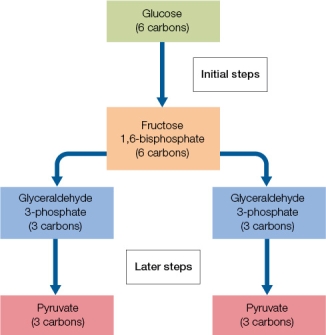 The diagram illustrates how the glycolytic pathway can be separated into two groups of steps-initial steps and later steps.Explain how the initial steps in the glycolytic pathway differ from later steps.In your discussion, address the types of reactions taking place and how energy is involved.
 (Essay)
4.8/5 (83)
(83) Which of the following statements can be used as evidence that living cells follow the same basic principles of chemistry that nonliving systems follow?
(Multiple Choice)
4.8/5 (85)
(85) Which product of glycolysis is transported across the mitochondrial membrane, where it is converted to the molecule that enters the citric acid cycle?
(Multiple Choice)
4.8/5 (89)
(89) In an experiment, the F1 portion of the ATP synthase was labeled with a fluorescently labeled microfilament and attached to a glass slide.The rotation of the ATP synthase was observed when ATP was added.When ATP plus oligomycin was added to the slide, the rotation continued even though oligomycin can inhibit ATP hydrolysis in mitochondrial inner membrane vesicles containing ATP synthase (F1-F0).Based on your knowledge of ATP synthase, which hypothesis is supported by these observations?
(Multiple Choice)
4.9/5 (70)
(70) Which describes how the components of the respiratory chain are ordered?
(Multiple Choice)
4.9/5 (78)
(78) Refer to the figure below. 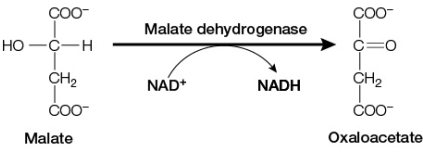 Which statement correctly describes this oxidation-reduction reaction?
 (Multiple Choice)
4.8/5 (78)
(78) The following reaction summarizes the overall chemical change that takes place as the result of electrons transferred along the respiratory chain.  The formation of ATP from ADP and Pi requires the input of 7.3 kcal/mol.The respiratory chain can efficiently convert the majority of the free energy released from electrons to the chemical energy of phosphate bonds in ATP molecules, without a lot of wasted energy given off as heat.Which characteristic of the respiratory chain explains how this is possible?
 (Multiple Choice)
4.8/5 (84)
(84) Electrons are shuttled from glycolysis and the citric acid cycle to the respiratory chain via
(Multiple Choice)
4.7/5 (86)
(86) Construct a graph to show how the free energy of an electron changes as it is passed along the respiratory chain.
(Essay)
4.8/5 (80)
(80) When a person runs for an extended period of time, the main source of glucose for muscle cells comes from the breakdown of glycogen in the
(Multiple Choice)
4.7/5 (77)
(77) Allosteric regulation of an enzyme means that the enzyme may
(Multiple Choice)
4.9/5 (86)
(86) Refer to the diagram below, showing electron transport and ATP synthesis.When pure reduced cytochrome c is added to isolated mitochondria in a solution containing ADP, Pi, O2, and antimycin A (a mitochondria complex II inhibitor), the cytochrome c becomes oxidized and ATP is formed. 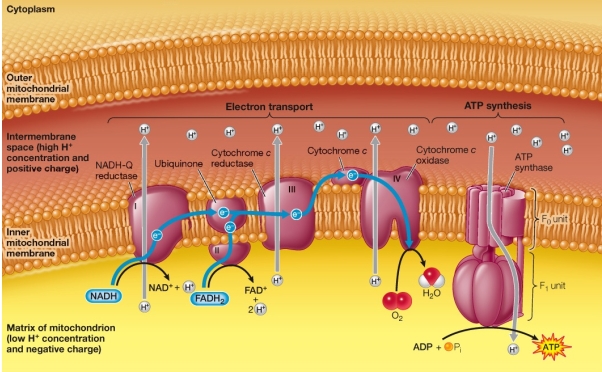 Which sequence represents the probable flow of electrons in this system?
 (Multiple Choice)
4.8/5 (80)
(80) Which analogy best describes the mechanism of ATP synthase?
(Multiple Choice)
4.7/5 (62)
(62) 
Filters
- Essay(0)
- Multiple Choice(0)
- Short Answer(0)
- True False(0)
- Matching(0)