



 Chat with AI
Exam 9: Pathways That Harvest Chemical Energy

Exam 1: Studying Life246 Questions
Exam 2: Small Molecules and the Chemistry of Life246 Questions
Exam 3: Proteins, Carbohydrates, and Lipids246 Questions
Exam 4: Nucleic Acids and the Origin of Life246 Questions
Exam 5: Cells: the Working Units of Life248 Questions
Exam 6: Cell Membranes246 Questions
Exam 7: Cell Communication and Multicellularity246 Questions
Exam 8: Energy, Enzymes, and Metabolism246 Questions
Exam 9: Pathways That Harvest Chemical Energy246 Questions
Exam 10: Photosynthesis: Energy From Sunlight242 Questions
Exam 11: The Cell Cycle and Cell Division260 Questions
Exam 12: Inheritance, Genes, and Chromosomes250 Questions
Exam 13: Dna and Its Role in Heredity257 Questions
Exam 14: From Dna to Protein: Gene Expression252 Questions
Exam 15: Gene Mutation and Molecular Medicine251 Questions
Exam 16: Regulation of Gene Expression245 Questions
Exam 17: Genomes249 Questions
Exam 18: Recombinant Dna and Biotechnology243 Questions
Exam 20: Mechanisms of Evolution243 Questions
Exam 21: Reconstructing and Using Phylogenies246 Questions
Exam 22: Speciation247 Questions
Exam 23: Evolution of Genes and Genomes252 Questions
Exam 24: The History of Life on Earth246 Questions
Exam 25: Bacteria, Archaea, and Viruses262 Questions
Exam 26: The Origin and Diversification of Eukaryotes252 Questions
Exam 27: Plants Without Seeds: From Water to Land251 Questions
Exam 28: The Evolution of Seed Plants259 Questions
Exam 29: The Evolution and Diversity of Fungi261 Questions
Exam 30: Animal Origins and the Evolution of Body Plans248 Questions
Exam 31: Protostome Animals244 Questions
Exam 32: Deuterostome Animals246 Questions
Exam 33: The Plant Body243 Questions
Exam 34: Transport in Plants248 Questions
Exam 35: Plant Nutrition247 Questions
Exam 36: Regulation of Plant Growth246 Questions
Exam 37: Reproduction in Flowering Plants247 Questions
Exam 38: Plant Responses to Environmental Challenges246 Questions
Exam 39: Physiology, Homeostasis, and Temperature Regulation258 Questions
Exam 40: Animal Hormones249 Questions
Exam 41: Immunology: Animal Defense Systems265 Questions
Exam 42: Animal Reproduction261 Questions
Exam 43: Animal Development261 Questions
Exam 44: Neurons, Glia, and Nervous Systems250 Questions
Exam 45: Sensory Systems249 Questions
Exam 46: The Mammalian Nervous System: Structure and Higher Functions254 Questions
Exam 47: Musculoskeletal Systems259 Questions
Exam 48: Gas Exchange247 Questions
Exam 49: Circulatory Systems252 Questions
Exam 50: Nutrition, Digestion, and Absorption259 Questions
Exam 51: Salt and Water Balance and Nitrogen Excretion251 Questions
Exam 52: Animal Behavior249 Questions
Exam 53: The Physical Environment and Biogeography of Life248 Questions
Exam 54: Populations259 Questions
Exam 55: Species Interactions254 Questions
Exam 56: Communities247 Questions
Exam 57: Ecosystems238 Questions
Exam 58: A Changing Biosphere222 Questions
Select questions type


Metabolic pathways can be controlled through the availability of enzymes and modulation of their catalytic activities.Enzyme availability can be regulated via _______, while enzyme activity is commonly regulated via _______.
(Multiple Choice)
4.7/5  (74)
(74) Refer to the figure below, showing the exergonic reaction that links glycolysis to the citric acid cycle. 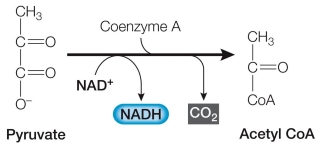 Which statement about the molecules participating in this cellular reaction is correct?
 (Multiple Choice)
4.9/5 (83)
(83) Refer to the table showing the products from the complete oxidation of glucose and the complete oxidation of palmitic acid (a fatty acid). 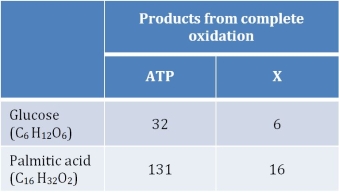 The label "X" should be replaced with _______.
 (Short Answer)
4.8/5 (83)
(83) Isocitrate dehydrogenase is considered a main control point in the citric acid cycle because it is
(Multiple Choice)
4.8/5 (75)
(75) Refer to the graph below. 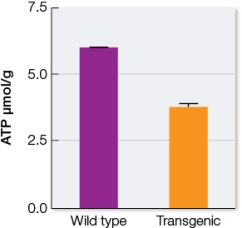 Uncoupling protein 1 (UCP1) is normally expressed in fat cells, but not in skeletal muscle cells.A research team created transgenic mice that expressed UCP1 in skeletal muscle.They took cell samples from the leg muscles of wild-type and transgenic mice and measured ATP synthesis in their mitochondria.The results are shown in the graph.If these researchers had measured heat output in these samples, they likely would have observed (more/less) _______ heat output from the transgenic mice than from the wild-type mice.
 (Short Answer)
4.7/5 (58)
(58) A recently identified organism produces methane when provided with glucose in the absence of oxygen.This means the organism is
(Multiple Choice)
4.9/5 (67)
(67) The conversion of malate to oxaloacetate in the citric acid cycle takes place with the conversion of NAD+ to NADH.In this reaction, NAD+ is a(n)
(Multiple Choice)
4.8/5 (85)
(85) Which statement best describes how key molecules are regenerated to allow continued metabolism in a cell?
(Multiple Choice)
4.9/5 (83)
(83) Draw a diagram to illustrate the main features of the citric acid cycle.In your diagram, include the overall shape of the pathway as well as the inputs and outputs.
(Essay)
4.9/5 (78)
(78) The component of aerobic respiration that produces the most ATP per mole of glucose is
(Multiple Choice)
4.8/5 (66)
(66) The types of chemical reactions involved in the aerobic breakdown of glucose by a cell include
(Multiple Choice)
4.9/5 (89)
(89) Rotenone is a potent inhibitor of mitochondrial complex I.If you were to treat isolated mitochondria with rotenone, what would happen to ATP production by oxidative phosphorylation?
(Multiple Choice)
4.7/5 (68)
(68) Which sequence represents a possible path of a carbon atom as it moves through a catabolic series of reactions in a cell?
(Multiple Choice)
4.9/5 (79)
(79) Refer to the figure below. 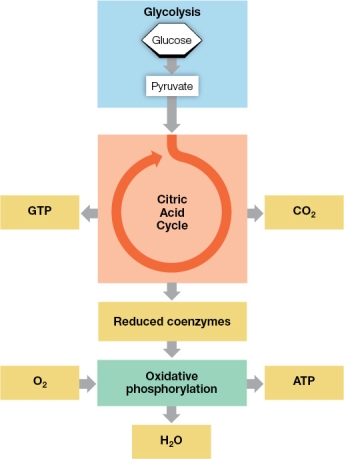 A student made this diagram as a study guide for learning the steps involved in the aerobic catabolism of glucose.One step could be added to better illustrate these steps.Which step should be added?
 (Multiple Choice)
4.9/5 (84)
(84) Refer to the table below, which summarizes similarities and differences between glycolysis and the citric acid cycle in animal cells. 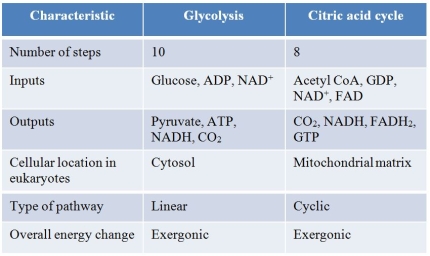 A student prepared this table as an aid to her study of these metabolic processes.Which statement best evaluates the accuracy of the student's work?
 (Multiple Choice)
4.9/5 (77)
(77) The formation of glucose from glycolytic and citric acid intermediates is called _______.
(Short Answer)
4.9/5 (80)
(80) 
Filters
- Essay(0)
- Multiple Choice(0)
- Short Answer(0)
- True False(0)
- Matching(0)