



 Chat with AI
Exam 9: Pathways That Harvest Chemical Energy

Exam 1: Studying Life246 Questions
Exam 2: Small Molecules and the Chemistry of Life246 Questions
Exam 3: Proteins, Carbohydrates, and Lipids246 Questions
Exam 4: Nucleic Acids and the Origin of Life246 Questions
Exam 5: Cells: the Working Units of Life248 Questions
Exam 6: Cell Membranes246 Questions
Exam 7: Cell Communication and Multicellularity246 Questions
Exam 8: Energy, Enzymes, and Metabolism246 Questions
Exam 9: Pathways That Harvest Chemical Energy246 Questions
Exam 10: Photosynthesis: Energy From Sunlight242 Questions
Exam 11: The Cell Cycle and Cell Division260 Questions
Exam 12: Inheritance, Genes, and Chromosomes250 Questions
Exam 13: Dna and Its Role in Heredity257 Questions
Exam 14: From Dna to Protein: Gene Expression252 Questions
Exam 15: Gene Mutation and Molecular Medicine251 Questions
Exam 16: Regulation of Gene Expression245 Questions
Exam 17: Genomes249 Questions
Exam 18: Recombinant Dna and Biotechnology243 Questions
Exam 20: Mechanisms of Evolution243 Questions
Exam 21: Reconstructing and Using Phylogenies246 Questions
Exam 22: Speciation247 Questions
Exam 23: Evolution of Genes and Genomes252 Questions
Exam 24: The History of Life on Earth246 Questions
Exam 25: Bacteria, Archaea, and Viruses262 Questions
Exam 26: The Origin and Diversification of Eukaryotes252 Questions
Exam 27: Plants Without Seeds: From Water to Land251 Questions
Exam 28: The Evolution of Seed Plants259 Questions
Exam 29: The Evolution and Diversity of Fungi261 Questions
Exam 30: Animal Origins and the Evolution of Body Plans248 Questions
Exam 31: Protostome Animals244 Questions
Exam 32: Deuterostome Animals246 Questions
Exam 33: The Plant Body243 Questions
Exam 34: Transport in Plants248 Questions
Exam 35: Plant Nutrition247 Questions
Exam 36: Regulation of Plant Growth246 Questions
Exam 37: Reproduction in Flowering Plants247 Questions
Exam 38: Plant Responses to Environmental Challenges246 Questions
Exam 39: Physiology, Homeostasis, and Temperature Regulation258 Questions
Exam 40: Animal Hormones249 Questions
Exam 41: Immunology: Animal Defense Systems265 Questions
Exam 42: Animal Reproduction261 Questions
Exam 43: Animal Development261 Questions
Exam 44: Neurons, Glia, and Nervous Systems250 Questions
Exam 45: Sensory Systems249 Questions
Exam 46: The Mammalian Nervous System: Structure and Higher Functions254 Questions
Exam 47: Musculoskeletal Systems259 Questions
Exam 48: Gas Exchange247 Questions
Exam 49: Circulatory Systems252 Questions
Exam 50: Nutrition, Digestion, and Absorption259 Questions
Exam 51: Salt and Water Balance and Nitrogen Excretion251 Questions
Exam 52: Animal Behavior249 Questions
Exam 53: The Physical Environment and Biogeography of Life248 Questions
Exam 54: Populations259 Questions
Exam 55: Species Interactions254 Questions
Exam 56: Communities247 Questions
Exam 57: Ecosystems238 Questions
Exam 58: A Changing Biosphere222 Questions
Select questions type


What amount of free energy is released by the oxidation of 2 moles of NADH?
(Multiple Choice)
4.7/5  (82)
(82) In eukaryotes, the organelle containing the enzyme(s) necessary for oxidation of glucose beyond glycolysis is the
(Multiple Choice)
4.8/5 (68)
(68) Which is an example of a negative allosteric regulator of glycolysis or the citric acid cycle?
(Multiple Choice)
4.8/5 (89)
(89) Key events in the rise of multicellularity in living organisms included the increase in _______ in/on Earth's _______ as a result of photosynthesis, and the evolution of _______ that enabled organisms to use _______.
(Multiple Choice)
4.9/5 (80)
(80) A biochemist discovers several new microorganisms in a sample taken from the bottom of a deep lake in Antarctica.In characterizing one of these organisms, she finds that it cannot survive in an aerobic environment and produces lactic acid as a waste product.What is also likely true about this organism?
(Multiple Choice)
4.8/5 (92)
(92) Complete the following reaction found in the NADH shuttle mechanism in some eukaryotic cells: FAD + glycerol 3-ophsphate _______ + DHAP.
(Multiple Choice)
4.9/5 (81)
(81) Reagents, such as dinitrophenol, increase the permeability of the mitochondrial inner membrane to protons.The addition of dinitrophenol to a suspension of animal cells should
(Multiple Choice)
4.9/5 (77)
(77) Refer to the graph below. 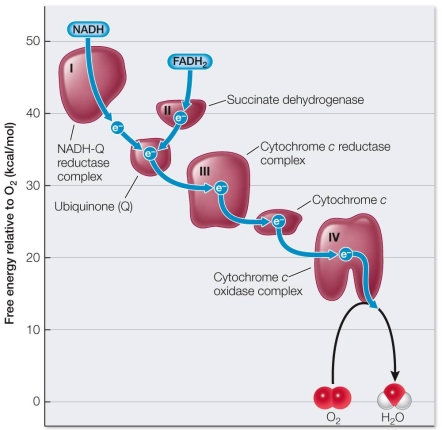 Which statement about the respiratory chain best explains the information presented in the graph?
 (Multiple Choice)
4.9/5 (88)
(88) Refer to the graph below, showing changes in the source of blood glucose as a person goes from a state of active food intake to a state of starvation. 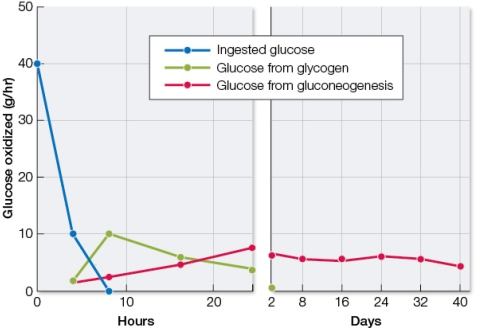 The person's blood glucose levels remain very stable; only the source of glucose changes.Liver cells play an active role in maintaining the stable levels of blood glucose.Which changes in liver cell metabolism could account for the data shown?
 (Multiple Choice)
4.8/5 (96)
(96) Refer to the figure below, showing the flux of carbon through metabolic pathways involving both the cytosol and mitochondria in a human muscle cell.The shade of the arrows (light and dark) is proportional to the rate of flux through that pathway. 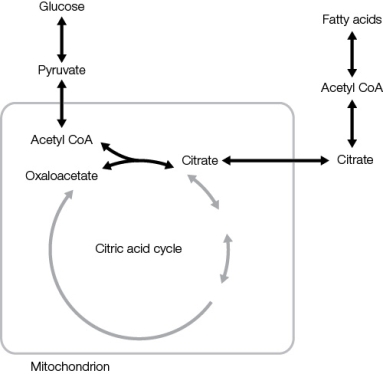 Do you expect this cell to be undergoing rapid contractions or to be inactive, and what do you expect would change as the cell suddenly shifted into the opposite level of activity?
 (Multiple Choice)
4.9/5 (87)
(87) The pyruvate dehydrogenase complex, a multienzyme complex in the citric acid cycle, is located in the
(Multiple Choice)
4.8/5 (92)
(92) Refer to the diagram below, showing energy-releasing metabolic pathways. 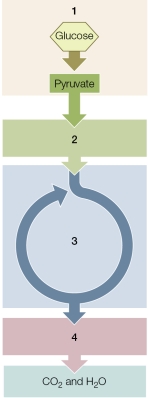 Where in the cell is each step of the pathway located?
 (Essay)
4.9/5 (78)
(78) In eukaryotes, the proton-motive force allows protons to move passively through ATP synthase in which direction?
(Multiple Choice)
4.9/5 (77)
(77) Refer to the figure below. 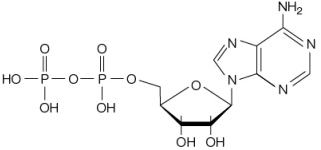 How is this molecule involved in the cellular harvesting of energy from glucose oxidation?
 (Multiple Choice)
4.9/5 (62)
(62) 
Filters
- Essay(0)
- Multiple Choice(0)
- Short Answer(0)
- True False(0)
- Matching(0)