



 Chat with AI
Exam 9: Pathways That Harvest Chemical Energy

Exam 1: Studying Life246 Questions
Exam 2: Small Molecules and the Chemistry of Life246 Questions
Exam 3: Proteins, Carbohydrates, and Lipids246 Questions
Exam 4: Nucleic Acids and the Origin of Life246 Questions
Exam 5: Cells: the Working Units of Life248 Questions
Exam 6: Cell Membranes246 Questions
Exam 7: Cell Communication and Multicellularity246 Questions
Exam 8: Energy, Enzymes, and Metabolism246 Questions
Exam 9: Pathways That Harvest Chemical Energy246 Questions
Exam 10: Photosynthesis: Energy From Sunlight242 Questions
Exam 11: The Cell Cycle and Cell Division260 Questions
Exam 12: Inheritance, Genes, and Chromosomes250 Questions
Exam 13: Dna and Its Role in Heredity257 Questions
Exam 14: From Dna to Protein: Gene Expression252 Questions
Exam 15: Gene Mutation and Molecular Medicine251 Questions
Exam 16: Regulation of Gene Expression245 Questions
Exam 17: Genomes249 Questions
Exam 18: Recombinant Dna and Biotechnology243 Questions
Exam 20: Mechanisms of Evolution243 Questions
Exam 21: Reconstructing and Using Phylogenies246 Questions
Exam 22: Speciation247 Questions
Exam 23: Evolution of Genes and Genomes252 Questions
Exam 24: The History of Life on Earth246 Questions
Exam 25: Bacteria, Archaea, and Viruses262 Questions
Exam 26: The Origin and Diversification of Eukaryotes252 Questions
Exam 27: Plants Without Seeds: From Water to Land251 Questions
Exam 28: The Evolution of Seed Plants259 Questions
Exam 29: The Evolution and Diversity of Fungi261 Questions
Exam 30: Animal Origins and the Evolution of Body Plans248 Questions
Exam 31: Protostome Animals244 Questions
Exam 32: Deuterostome Animals246 Questions
Exam 33: The Plant Body243 Questions
Exam 34: Transport in Plants248 Questions
Exam 35: Plant Nutrition247 Questions
Exam 36: Regulation of Plant Growth246 Questions
Exam 37: Reproduction in Flowering Plants247 Questions
Exam 38: Plant Responses to Environmental Challenges246 Questions
Exam 39: Physiology, Homeostasis, and Temperature Regulation258 Questions
Exam 40: Animal Hormones249 Questions
Exam 41: Immunology: Animal Defense Systems265 Questions
Exam 42: Animal Reproduction261 Questions
Exam 43: Animal Development261 Questions
Exam 44: Neurons, Glia, and Nervous Systems250 Questions
Exam 45: Sensory Systems249 Questions
Exam 46: The Mammalian Nervous System: Structure and Higher Functions254 Questions
Exam 47: Musculoskeletal Systems259 Questions
Exam 48: Gas Exchange247 Questions
Exam 49: Circulatory Systems252 Questions
Exam 50: Nutrition, Digestion, and Absorption259 Questions
Exam 51: Salt and Water Balance and Nitrogen Excretion251 Questions
Exam 52: Animal Behavior249 Questions
Exam 53: The Physical Environment and Biogeography of Life248 Questions
Exam 54: Populations259 Questions
Exam 55: Species Interactions254 Questions
Exam 56: Communities247 Questions
Exam 57: Ecosystems238 Questions
Exam 58: A Changing Biosphere222 Questions
Select questions type


The oxidation of acetyl CoA to CO2 takes place in the _______ cycle.
(Short Answer)
4.8/5  (74)
(74) In the citric acid cycle, isocitrate dehydrogenase is regulated in part by the supply and demand of downstream products of cellular respiration and metabolism.Which product acts as an allosteric inhibitor of isocitrate dehydrogenase activity?
(Multiple Choice)
4.9/5 (77)
(77) Refer to the figure below. 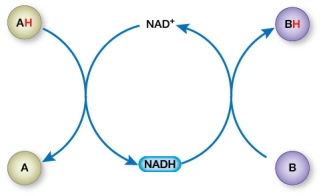 Which half-reactions represent a change from more stored free energy to less stored free energy?
 (Multiple Choice)
4.9/5 (71)
(71) Energy production occurs in different locations in prokaryotic and eukaryotic cells.Which statement is true for prokaryotes?
(Multiple Choice)
4.7/5 (84)
(84) Choose the phrase that does not correctly complete this sentence: Oxidative phosphorylation is a process
(Multiple Choice)
4.9/5 (78)
(78) Refer to the table below. 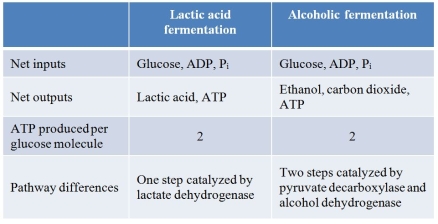 A student created this table as a study guide for learning the similarities and differences between lactic acid and alcoholic fermentation.Which statement best evaluates the accuracy of the student's efforts?
 (Multiple Choice)
4.8/5 (84)
(84) Which list places the molecules, from left to right, from most oxidized to least oxidized?
(Multiple Choice)
4.8/5 (83)
(83) Refer to the table below. 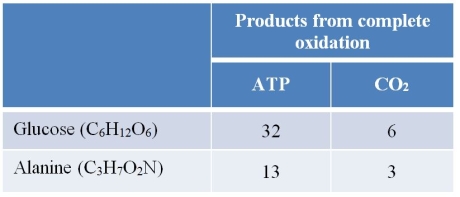 The complete oxidation of 1 mole of glucose and the complete oxidation of 1 mole of alanine give the same products in different quantities, as shown in the table.Given this information, it can be stated that
 (Multiple Choice)
4.9/5 (87)
(87) Mouse mitochondria were isolated and incubated with two different compounds to see whether they affected FADH2 oxidation, NADH oxidation, or ATP formation.A control sample was run in the absence of either compound.The results are summarized in the table as "yes" if a process was observed and "no" if a process was not observed. 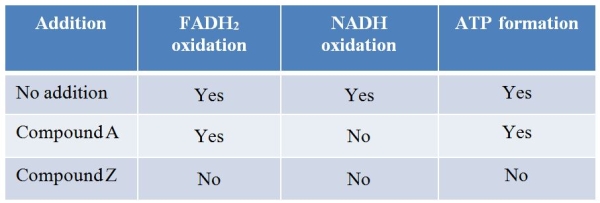 Which statement is consistent with these data?
 (Multiple Choice)
4.9/5 (72)
(72) Electron transport within NADH-Q reductase, cytochrome reductase, and cytochrome oxidase can be coupled to proton transport from the mitochondrial matrix to the space between the inner and outer mitochondrial membranes.This is because those protein complexes
(Multiple Choice)
5.0/5 (87)
(87) The fermentation process in vertebrate muscle cells produces
(Multiple Choice)
4.9/5 (85)
(85) The compound citrate is generated as part of the citric acid cycle.Citrate activates the enzyme fatty acid synthase to shuttle excess carbon into fatty acids and inhibits the enzyme phosphofructokinase to slow glycolysis.Both of these processes involve binding of citrate to the enzymes, where it exerts its effects through _______ regulation.
(Short Answer)
4.8/5 (70)
(70) A student wants to develop a demonstration to explain the energy changes taking place as electrons are transferred along the respiratory chain.Which everyday objects could he use to accomplish his goal?
(Multiple Choice)
4.8/5 (97)
(97) How many reaction steps are involved in the citric acid cycle?
(Multiple Choice)
4.9/5 (76)
(76) The fate of acetyl CoA differs according to how much ATP is present in the cell.Explain what happens to acetyl CoA when ATP is limited, and compare this to what happens when ATP is abundant.
(Essay)
4.9/5 (85)
(85) 
Filters
- Essay(0)
- Multiple Choice(0)
- Short Answer(0)
- True False(0)
- Matching(0)