



 Chat with AI
Exam 9: Pathways That Harvest Chemical Energy

Exam 1: Studying Life246 Questions
Exam 2: Small Molecules and the Chemistry of Life246 Questions
Exam 3: Proteins, Carbohydrates, and Lipids246 Questions
Exam 4: Nucleic Acids and the Origin of Life246 Questions
Exam 5: Cells: the Working Units of Life248 Questions
Exam 6: Cell Membranes246 Questions
Exam 7: Cell Communication and Multicellularity246 Questions
Exam 8: Energy, Enzymes, and Metabolism246 Questions
Exam 9: Pathways That Harvest Chemical Energy246 Questions
Exam 10: Photosynthesis: Energy From Sunlight242 Questions
Exam 11: The Cell Cycle and Cell Division260 Questions
Exam 12: Inheritance, Genes, and Chromosomes250 Questions
Exam 13: Dna and Its Role in Heredity257 Questions
Exam 14: From Dna to Protein: Gene Expression252 Questions
Exam 15: Gene Mutation and Molecular Medicine251 Questions
Exam 16: Regulation of Gene Expression245 Questions
Exam 17: Genomes249 Questions
Exam 18: Recombinant Dna and Biotechnology243 Questions
Exam 20: Mechanisms of Evolution243 Questions
Exam 21: Reconstructing and Using Phylogenies246 Questions
Exam 22: Speciation247 Questions
Exam 23: Evolution of Genes and Genomes252 Questions
Exam 24: The History of Life on Earth246 Questions
Exam 25: Bacteria, Archaea, and Viruses262 Questions
Exam 26: The Origin and Diversification of Eukaryotes252 Questions
Exam 27: Plants Without Seeds: From Water to Land251 Questions
Exam 28: The Evolution of Seed Plants259 Questions
Exam 29: The Evolution and Diversity of Fungi261 Questions
Exam 30: Animal Origins and the Evolution of Body Plans248 Questions
Exam 31: Protostome Animals244 Questions
Exam 32: Deuterostome Animals246 Questions
Exam 33: The Plant Body243 Questions
Exam 34: Transport in Plants248 Questions
Exam 35: Plant Nutrition247 Questions
Exam 36: Regulation of Plant Growth246 Questions
Exam 37: Reproduction in Flowering Plants247 Questions
Exam 38: Plant Responses to Environmental Challenges246 Questions
Exam 39: Physiology, Homeostasis, and Temperature Regulation258 Questions
Exam 40: Animal Hormones249 Questions
Exam 41: Immunology: Animal Defense Systems265 Questions
Exam 42: Animal Reproduction261 Questions
Exam 43: Animal Development261 Questions
Exam 44: Neurons, Glia, and Nervous Systems250 Questions
Exam 45: Sensory Systems249 Questions
Exam 46: The Mammalian Nervous System: Structure and Higher Functions254 Questions
Exam 47: Musculoskeletal Systems259 Questions
Exam 48: Gas Exchange247 Questions
Exam 49: Circulatory Systems252 Questions
Exam 50: Nutrition, Digestion, and Absorption259 Questions
Exam 51: Salt and Water Balance and Nitrogen Excretion251 Questions
Exam 52: Animal Behavior249 Questions
Exam 53: The Physical Environment and Biogeography of Life248 Questions
Exam 54: Populations259 Questions
Exam 55: Species Interactions254 Questions
Exam 56: Communities247 Questions
Exam 57: Ecosystems238 Questions
Exam 58: A Changing Biosphere222 Questions
Select questions type


The loss of a(n) _______ by a ferrous ion (Fe2+) to yield a ferric ion (Fe3+) is called oxidation.
(Short Answer)
4.8/5  (88)
(88) The reaction equation that represents the chemical change resulting from glycolysis followed by cellular respiration is C6H12O6 + 6 O2 6 CO2 + _______ ATP + 6 _______.
(Multiple Choice)
4.8/5 (77)
(77) Some microbes use non-O2 electron acceptors to complete the electron transport chain.An example of an organism that carries out this type of electron transport is a soil bacterium that takes in nitrate (NO3−) and releases nitrogen gas (N2).The nitrate functions as a(n)
(Multiple Choice)
4.8/5 (79)
(79) Refer to the figure below. 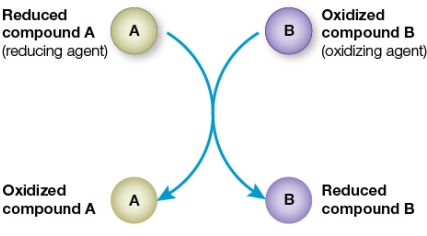 Of the two compounds that react as shown in the figure, compound _______ has the greater chemical energy.
 (Short Answer)
4.9/5 (79)
(79) Refer to the figure below.A biochemist inoculated a test tube containing liquid medium with a few bacterial cells of a single species.A concentration gradient of oxygen was present in the tube, with very low levels of oxygen at the bottom of the tube and increasingly higher concentrations toward the top of the tube.The highest levels of oxygen were at the top of the liquid medium.Glucose was present in equal concentrations throughout the tube. 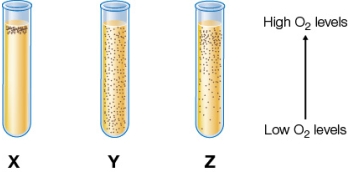 The particular bacterial species used to inoculate the tube is able to grow either aerobically or anaerobically.Which tube would most likely represent the growth pattern of bacteria under these conditions?
 (Multiple Choice)
4.8/5 (84)
(84) Refer to the figure showing the effects of four allosteric modifiers of the enzyme phosphofructokinase (PFK).Green arrows indicate allosteric activators, and red lines indicate allosteric inhibitors. 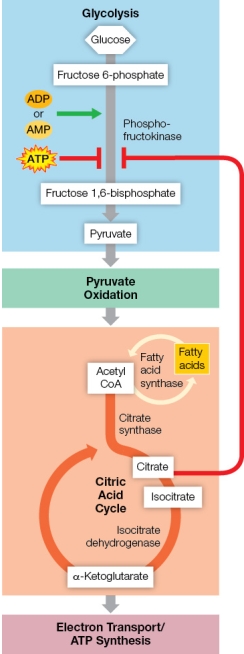 Which statement correctly explains how one of these regulatory molecules functions to regulate flow of matter through the glycolytic pathway?
 (Multiple Choice)
4.8/5 (89)
(89) How could a carbon atom that was originally present in a glucose molecule end up in a purine base that becomes incorporated in a molecule of DNA?
(Multiple Choice)
4.8/5 (74)
(74) Refer to the diagram below, showing energy-releasing metabolic pathways. 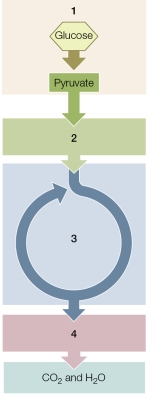 Identify each numbered pathway.
 (Essay)
4.8/5 (82)
(82) The electron transport chain contains four large protein complexes (I, II, III, and IV) plus cytochrome c and ubiquinone.One function of these components is to
(Multiple Choice)
4.9/5 (71)
(71) Carbon atoms originating in glucose are _______ oxidized after the citric acid cycle than they are after glycolysis.
(Short Answer)
4.9/5 (85)
(85) Compare the amount of glucose consumption needed by an anaerobic fermenting microorganism with that needed by an aerobic organism in order to perform the same functions.The anaerobe would need much (more/less) _______ glucose than the aerobe.
(Short Answer)
4.8/5 (83)
(83) When a cell needs energy, cellular respiration is regulated by isocitrate dehydrogenase, an enzyme of the citric acid cycle.This enzyme is stimulated in part by
(Multiple Choice)
4.8/5 (67)
(67) Which reaction is not an example of an oxidation-reduction reaction?
(Multiple Choice)
4.8/5 (75)
(75) Different organisms have different ATP yields from cellular respiration.Organisms with lower yields often have _______ systems that are energy consumptive but enable NADH produced by glycolysis to move into the mitochondria where it can enter oxidative phosphorylation.
(Short Answer)
4.8/5 (88)
(88) The figure below illustrates one type of mechanism used by a cell to regulate its metabolism. 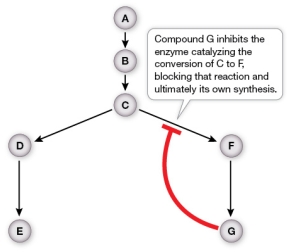 This is an example of a(n) _______ mechanism of regulation.
 (Short Answer)
4.9/5 (75)
(75) Construct a diagram to explain how the free energy stored in the electrons present in NADH and FADH2 is transferred to the terminal phosphate bond of ATP.
(Essay)
4.8/5 (83)
(83) Humans can exist quite well on high-protein diets with very little carbohydrate.The body still maintains constant blood glucose levels even though very little glucose or other sugars come in through the diet.In this case, liver cells use pathways such as the citric acid cycle and gluconeogenesis to convert _______ from protein breakdown into glucose to maintain glucose levels in the blood.
(Short Answer)
4.9/5 (64)
(64) 
Filters
- Essay(0)
- Multiple Choice(0)
- Short Answer(0)
- True False(0)
- Matching(0)