



 Chat with AI
Exam 9: Pathways That Harvest Chemical Energy

Exam 1: Studying Life246 Questions
Exam 2: Small Molecules and the Chemistry of Life246 Questions
Exam 3: Proteins, Carbohydrates, and Lipids246 Questions
Exam 4: Nucleic Acids and the Origin of Life246 Questions
Exam 5: Cells: the Working Units of Life248 Questions
Exam 6: Cell Membranes246 Questions
Exam 7: Cell Communication and Multicellularity246 Questions
Exam 8: Energy, Enzymes, and Metabolism246 Questions
Exam 9: Pathways That Harvest Chemical Energy246 Questions
Exam 10: Photosynthesis: Energy From Sunlight242 Questions
Exam 11: The Cell Cycle and Cell Division260 Questions
Exam 12: Inheritance, Genes, and Chromosomes250 Questions
Exam 13: Dna and Its Role in Heredity257 Questions
Exam 14: From Dna to Protein: Gene Expression252 Questions
Exam 15: Gene Mutation and Molecular Medicine251 Questions
Exam 16: Regulation of Gene Expression245 Questions
Exam 17: Genomes249 Questions
Exam 18: Recombinant Dna and Biotechnology243 Questions
Exam 20: Mechanisms of Evolution243 Questions
Exam 21: Reconstructing and Using Phylogenies246 Questions
Exam 22: Speciation247 Questions
Exam 23: Evolution of Genes and Genomes252 Questions
Exam 24: The History of Life on Earth246 Questions
Exam 25: Bacteria, Archaea, and Viruses262 Questions
Exam 26: The Origin and Diversification of Eukaryotes252 Questions
Exam 27: Plants Without Seeds: From Water to Land251 Questions
Exam 28: The Evolution of Seed Plants259 Questions
Exam 29: The Evolution and Diversity of Fungi261 Questions
Exam 30: Animal Origins and the Evolution of Body Plans248 Questions
Exam 31: Protostome Animals244 Questions
Exam 32: Deuterostome Animals246 Questions
Exam 33: The Plant Body243 Questions
Exam 34: Transport in Plants248 Questions
Exam 35: Plant Nutrition247 Questions
Exam 36: Regulation of Plant Growth246 Questions
Exam 37: Reproduction in Flowering Plants247 Questions
Exam 38: Plant Responses to Environmental Challenges246 Questions
Exam 39: Physiology, Homeostasis, and Temperature Regulation258 Questions
Exam 40: Animal Hormones249 Questions
Exam 41: Immunology: Animal Defense Systems265 Questions
Exam 42: Animal Reproduction261 Questions
Exam 43: Animal Development261 Questions
Exam 44: Neurons, Glia, and Nervous Systems250 Questions
Exam 45: Sensory Systems249 Questions
Exam 46: The Mammalian Nervous System: Structure and Higher Functions254 Questions
Exam 47: Musculoskeletal Systems259 Questions
Exam 48: Gas Exchange247 Questions
Exam 49: Circulatory Systems252 Questions
Exam 50: Nutrition, Digestion, and Absorption259 Questions
Exam 51: Salt and Water Balance and Nitrogen Excretion251 Questions
Exam 52: Animal Behavior249 Questions
Exam 53: The Physical Environment and Biogeography of Life248 Questions
Exam 54: Populations259 Questions
Exam 55: Species Interactions254 Questions
Exam 56: Communities247 Questions
Exam 57: Ecosystems238 Questions
Exam 58: A Changing Biosphere222 Questions
Select questions type


Refer to the figure below, which shows a series of coupled reactions. 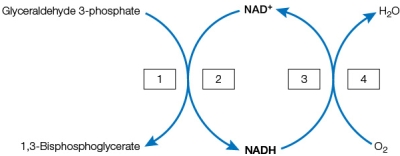 Which terms belong in the numbered boxes?
 (Multiple Choice)
4.9/5  (87)
(87) Fatty acids must be converted to _______ before they can be used for mitochondrial ATP production.
(Short Answer)
4.9/5 (91)
(91) What is the cellular location of glycolysis in eukaryotes?
(Multiple Choice)
4.7/5 (75)
(75) Refer to the table summarizing information collected from acetyl CoA carboxylase, the enzyme that catalyzes the first committed step in the biosynthesis of fatty acids from acetyl CoA. 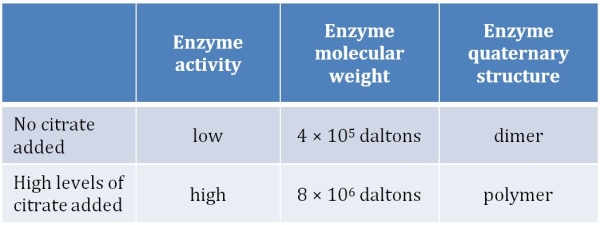 In these samples, enzyme purified from rat adipose tissue was used.No other cellular components were present when the enzyme in buffer solution was tested as outlined in the table.Based on the results shown, which statement describes how citrate is likely involved in the regulation of acetyl CoA carboxylase?
 (Multiple Choice)
4.8/5 (71)
(71) When NADH is the electron donor to the respiratory chain, 2.5 ATP are formed, but when FADH2 is the electron donor, only 1.5 ATP are formed.This difference occurs because
(Multiple Choice)
4.8/5 (72)
(72) A microbiologist is characterizing a newly discovered microorganism that requires an anaerobic environment to live and uses either lactic acid or alcoholic fermentation in its energy metabolism.Which would be a way to determine the type of fermentation the microorganism uses?
(Multiple Choice)
4.7/5 (80)
(80) During the energy-investing portion of glycolysis, the phosphates from ATP molecules are
(Multiple Choice)
4.9/5 (76)
(76) A species of bacteria was cultured in a test tube containing a uniform distribution of glucose but a varying distribution of oxygen.Oxygen was highest near the top of the tube and very low at the bottom.If this bacterial species is incapable of carrying out fermentation or other anaerobic energy-harvesting pathways, which test tube represents the expected growth pattern of the bacterial culture?
(Multiple Choice)
4.8/5 (77)
(77) Refer to the figure below. 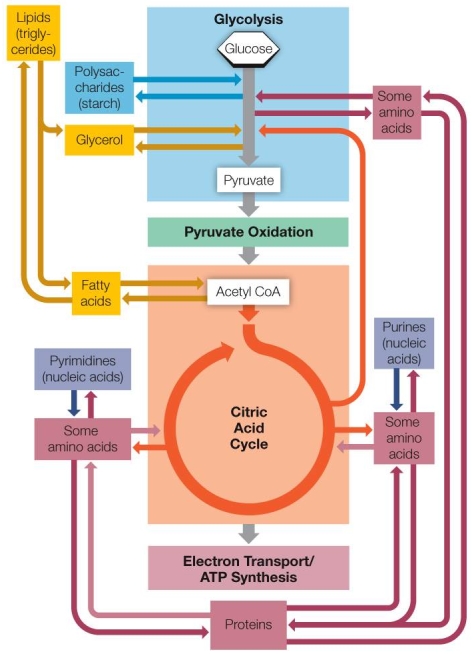 Which sequence of metabolic paths could a carbon atom take to go from a molecule of glucose to a molecule of DNA?
 (Multiple Choice)
4.8/5 (60)
(60) Energy production occurs in different locations in prokaryotic and eukaryotic cells.Which statement is true for eukaryotes?
(Multiple Choice)
4.7/5 (77)
(77) _______ is the reduced form of one of the most common electron carriers in cells.
(Short Answer)
4.7/5 (80)
(80) Refer to the figure, showing allosteric regulation of glycolysis and the citric acid cycle. 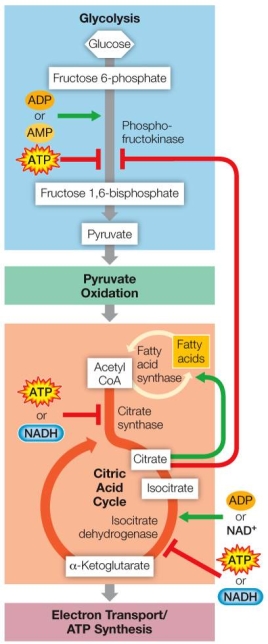 If a cell is fed a large supply of fatty acids, which outcome can be expected?
 (Multiple Choice)
4.9/5 (72)
(72) Workers in wine production facilities have an occupational hazard that workers in yogurt-manufacturing facilities do not have.Both wine production and yogurt production involve fermentation.However, only wineries must be diligent about providing proper ventilation to areas where fermentation occurs.This is because wine is made using alcoholic fermentation, which produces _______, a substance that can cause asphyxia, unconsciousness, and even death if present in high levels.Yogurt, made using lactic acid fermentation, does not produce this product.
(Short Answer)
4.7/5 (82)
(82) Which compounds link glycolysis and the citric acid cycle to the electron transport chain?
(Multiple Choice)
4.8/5 (76)
(76) Refer to the figure below. 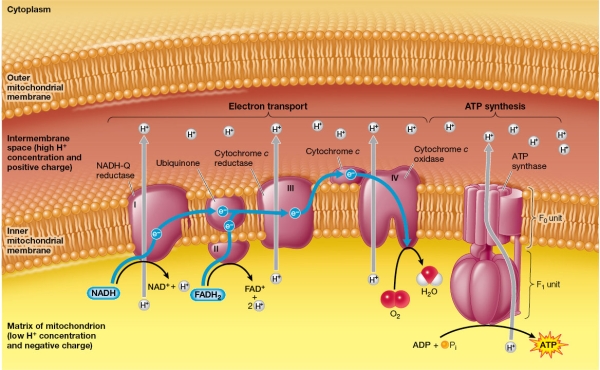 Does this figure have any inaccuracies?
 (Multiple Choice)
4.9/5 (69)
(69) The end result of glycolysis includes the formation of many molecules, including the
(Multiple Choice)
4.7/5 (70)
(70) Which path could a carbon atom follow if it began in an amino acid in a protein in some tuna that was eaten by a cat and eventually ended up in a lipid in the cell membrane of one of the cat's muscle cells?
(Multiple Choice)
4.9/5 (79)
(79) Carbon-13 is a non-radioactive isotope of carbon that is safe for humans to ingest.This isotope can be identified and quantified using an analytical instrument called a mass spectrometer.The figure below shows results of such an analysis of the fate of 13C-labeled alanine given orally to human volunteers just before they began intensive and prolonged exercise. 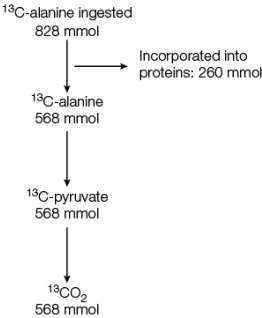 From the results shown, it can be concluded that the majority of alanine ingested just before exercise is used as a(n) _______ source.
 (Short Answer)
4.8/5 (73)
(73) Which molecule from glycolysis or the citric acid pathway serves as the building block for lipid synthesis?
(Multiple Choice)
4.9/5 (71)
(71) 
Filters
- Essay(0)
- Multiple Choice(0)
- Short Answer(0)
- True False(0)
- Matching(0)