



 Chat with AI
Exam 25: Bacteria, Archaea, and Viruses

Exam 1: Studying Life246 Questions
Exam 2: Small Molecules and the Chemistry of Life246 Questions
Exam 3: Proteins, Carbohydrates, and Lipids246 Questions
Exam 4: Nucleic Acids and the Origin of Life246 Questions
Exam 5: Cells: the Working Units of Life248 Questions
Exam 6: Cell Membranes246 Questions
Exam 7: Cell Communication and Multicellularity246 Questions
Exam 8: Energy, Enzymes, and Metabolism246 Questions
Exam 9: Pathways That Harvest Chemical Energy246 Questions
Exam 10: Photosynthesis: Energy From Sunlight242 Questions
Exam 11: The Cell Cycle and Cell Division260 Questions
Exam 12: Inheritance, Genes, and Chromosomes250 Questions
Exam 13: Dna and Its Role in Heredity257 Questions
Exam 14: From Dna to Protein: Gene Expression252 Questions
Exam 15: Gene Mutation and Molecular Medicine251 Questions
Exam 16: Regulation of Gene Expression245 Questions
Exam 17: Genomes249 Questions
Exam 18: Recombinant Dna and Biotechnology243 Questions
Exam 20: Mechanisms of Evolution243 Questions
Exam 21: Reconstructing and Using Phylogenies246 Questions
Exam 22: Speciation247 Questions
Exam 23: Evolution of Genes and Genomes252 Questions
Exam 24: The History of Life on Earth246 Questions
Exam 25: Bacteria, Archaea, and Viruses262 Questions
Exam 26: The Origin and Diversification of Eukaryotes252 Questions
Exam 27: Plants Without Seeds: From Water to Land251 Questions
Exam 28: The Evolution of Seed Plants259 Questions
Exam 29: The Evolution and Diversity of Fungi261 Questions
Exam 30: Animal Origins and the Evolution of Body Plans248 Questions
Exam 31: Protostome Animals244 Questions
Exam 32: Deuterostome Animals246 Questions
Exam 33: The Plant Body243 Questions
Exam 34: Transport in Plants248 Questions
Exam 35: Plant Nutrition247 Questions
Exam 36: Regulation of Plant Growth246 Questions
Exam 37: Reproduction in Flowering Plants247 Questions
Exam 38: Plant Responses to Environmental Challenges246 Questions
Exam 39: Physiology, Homeostasis, and Temperature Regulation258 Questions
Exam 40: Animal Hormones249 Questions
Exam 41: Immunology: Animal Defense Systems265 Questions
Exam 42: Animal Reproduction261 Questions
Exam 43: Animal Development261 Questions
Exam 44: Neurons, Glia, and Nervous Systems250 Questions
Exam 45: Sensory Systems249 Questions
Exam 46: The Mammalian Nervous System: Structure and Higher Functions254 Questions
Exam 47: Musculoskeletal Systems259 Questions
Exam 48: Gas Exchange247 Questions
Exam 49: Circulatory Systems252 Questions
Exam 50: Nutrition, Digestion, and Absorption259 Questions
Exam 51: Salt and Water Balance and Nitrogen Excretion251 Questions
Exam 52: Animal Behavior249 Questions
Exam 53: The Physical Environment and Biogeography of Life248 Questions
Exam 54: Populations259 Questions
Exam 55: Species Interactions254 Questions
Exam 56: Communities247 Questions
Exam 57: Ecosystems238 Questions
Exam 58: A Changing Biosphere222 Questions
Select questions type


Antibiotics would likely have no effect on prokaryotic _______, which lack _______ in their cell walls.
(Short Answer)
4.8/5  (89)
(89) One factor that determines the consequences of a bacterial infection for the host is the ability of the bacterium to produce chemical substances injurious to the host's tissues.The anthrax-causing bacterium Bacillus anthracis produces a small amount of a few toxins.However, it can multiply readily, and ultimately it invades the entire bloodstream.Such a bacterium, therefore, has qualities of _______ invasiveness and _______ toxigenicity.
(Multiple Choice)
4.9/5 (76)
(76) Which group of prokaryotes was responsible for converting Earth's early atmosphere from an anaerobic to an aerobic environment?
(Multiple Choice)
4.7/5 (81)
(81) The space between the outer membrane and the cell membrane of a Gram-negative bacterium is called the _______ space.
(Multiple Choice)
4.9/5 (76)
(76) The bacterium Staphylococcus aureus is found on the skin of many healthy adults; however, it is a common source of wound infection.Which hurdle facing potential pathogens is overcome when a wound is infected?
(Multiple Choice)
4.9/5 (85)
(85) The best place to look for a new, heat-tolerant DNA polymerase enzyme would be among the
(Multiple Choice)
4.7/5 (86)
(86) Refer to the figure. 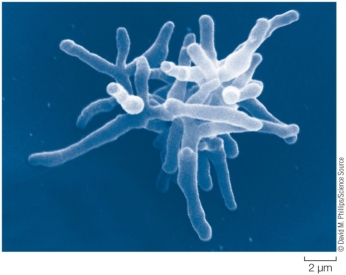 A patient is admitted to the hospital complaining of pain when breathing, fatigue, and night sweats.You collect a cell culture from the patient's lungs and view it under the microscope.Based on the microscope image shown, what conclusions can you draw about the causal agent of the disease your patient is suffering from?
 (Essay)
4.9/5 (76)
(76) _______ is the source of the thermally stable DNA polymerase that was critical for the development of the widely used polymerase chain reaction (PCR) and can occur in domestic water heaters.
(Multiple Choice)
4.9/5 (77)
(77) You are interested in studying RPP13, a plant gene involved in disease resistance.The genomic copy of RPP13 is full of introns, and to simplify your experimental design, you isolate the mRNA of this gene (which lacks introns).Which enzyme will be crucial in the next step of generating a cDNA version of RPP13?
(Multiple Choice)
4.9/5 (73)
(73) You work for a wastewater treatment plant.An organism is getting past your treatment process, and fish are dying in a stream that the runoff enters.You are able to isolate the organism.Using a microscope, how can you tell whether the organism is a prokaryote or a eukaryote?
(Essay)
4.7/5 (79)
(79) Refer to the figure. 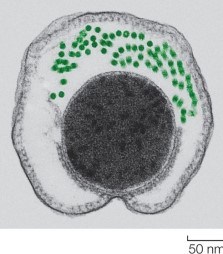 This cross section of a bacterium shows the axial filaments used to produce a corkscrew-like movement.This feature is characteristic of the group of bacteria known as
 (Multiple Choice)
4.9/5 (78)
(78) You and your team of researchers excavate a cluster of endospores from a core of Arctic ice.What conclusion can you draw from this find?
(Multiple Choice)
4.9/5 (66)
(66) After completing a course of antibiotics that target peptidoglycan, a patient is still suffering from diarrhea.Which would not be a reasonable explanation?
(Multiple Choice)
4.9/5 (79)
(79) Refer to the figure. 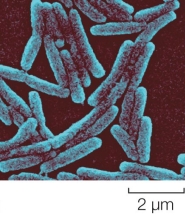 Judging only from the morphology of the cells, which bacterial genus could this micrograph be showing?
 (Multiple Choice)
4.9/5 (80)
(80) Living bacterial pathogens can produce _______, which are protein substances injurious to the tissues of the host.
(Short Answer)
4.9/5 (93)
(93) Organisms that metabolize compounds in dead organic material and return the products to the environment as inorganic substances
(Multiple Choice)
4.9/5 (82)
(82) 
Filters
- Essay(0)
- Multiple Choice(0)
- Short Answer(0)
- True False(0)
- Matching(0)