



 Chat with AI
Exam 25: Bacteria, Archaea, and Viruses

Exam 1: Studying Life246 Questions
Exam 2: Small Molecules and the Chemistry of Life246 Questions
Exam 3: Proteins, Carbohydrates, and Lipids246 Questions
Exam 4: Nucleic Acids and the Origin of Life246 Questions
Exam 5: Cells: the Working Units of Life248 Questions
Exam 6: Cell Membranes246 Questions
Exam 7: Cell Communication and Multicellularity246 Questions
Exam 8: Energy, Enzymes, and Metabolism246 Questions
Exam 9: Pathways That Harvest Chemical Energy246 Questions
Exam 10: Photosynthesis: Energy From Sunlight242 Questions
Exam 11: The Cell Cycle and Cell Division260 Questions
Exam 12: Inheritance, Genes, and Chromosomes250 Questions
Exam 13: Dna and Its Role in Heredity257 Questions
Exam 14: From Dna to Protein: Gene Expression252 Questions
Exam 15: Gene Mutation and Molecular Medicine251 Questions
Exam 16: Regulation of Gene Expression245 Questions
Exam 17: Genomes249 Questions
Exam 18: Recombinant Dna and Biotechnology243 Questions
Exam 20: Mechanisms of Evolution243 Questions
Exam 21: Reconstructing and Using Phylogenies246 Questions
Exam 22: Speciation247 Questions
Exam 23: Evolution of Genes and Genomes252 Questions
Exam 24: The History of Life on Earth246 Questions
Exam 25: Bacteria, Archaea, and Viruses262 Questions
Exam 26: The Origin and Diversification of Eukaryotes252 Questions
Exam 27: Plants Without Seeds: From Water to Land251 Questions
Exam 28: The Evolution of Seed Plants259 Questions
Exam 29: The Evolution and Diversity of Fungi261 Questions
Exam 30: Animal Origins and the Evolution of Body Plans248 Questions
Exam 31: Protostome Animals244 Questions
Exam 32: Deuterostome Animals246 Questions
Exam 33: The Plant Body243 Questions
Exam 34: Transport in Plants248 Questions
Exam 35: Plant Nutrition247 Questions
Exam 36: Regulation of Plant Growth246 Questions
Exam 37: Reproduction in Flowering Plants247 Questions
Exam 38: Plant Responses to Environmental Challenges246 Questions
Exam 39: Physiology, Homeostasis, and Temperature Regulation258 Questions
Exam 40: Animal Hormones249 Questions
Exam 41: Immunology: Animal Defense Systems265 Questions
Exam 42: Animal Reproduction261 Questions
Exam 43: Animal Development261 Questions
Exam 44: Neurons, Glia, and Nervous Systems250 Questions
Exam 45: Sensory Systems249 Questions
Exam 46: The Mammalian Nervous System: Structure and Higher Functions254 Questions
Exam 47: Musculoskeletal Systems259 Questions
Exam 48: Gas Exchange247 Questions
Exam 49: Circulatory Systems252 Questions
Exam 50: Nutrition, Digestion, and Absorption259 Questions
Exam 51: Salt and Water Balance and Nitrogen Excretion251 Questions
Exam 52: Animal Behavior249 Questions
Exam 53: The Physical Environment and Biogeography of Life248 Questions
Exam 54: Populations259 Questions
Exam 55: Species Interactions254 Questions
Exam 56: Communities247 Questions
Exam 57: Ecosystems238 Questions
Exam 58: A Changing Biosphere222 Questions
Select questions type


Ninety percent of the cells of a human body are microbes-mostly prokaryotes and some microscopic eukaryotes.Which statement concerning human microbiomes is false?
(Multiple Choice)
4.8/5  (88)
(88) A tiny percentage of prokaryotes are pathogens.All known pathogenic prokaryotes are bacteria, although many archaeal species live with humans and other eukaryotes.What explains this phenomenon?
(Multiple Choice)
5.0/5 (85)
(85) Refer to the figure. 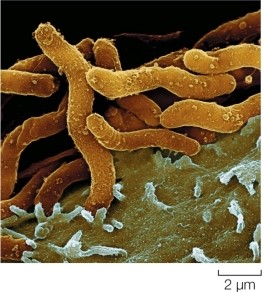 In the 1990s, stomach ulcers were shown by Koch's postulates to be caused by the bacterium Helicobacter pylori.Which of the following is not one of Koch's postulates used to identify pathogens?
 (Multiple Choice)
4.9/5 (74)
(74) 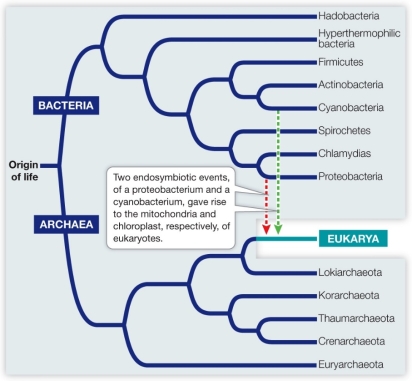 The phylogenetic tree shows that
Which of the following is a characteristic of Archaea, but not Bacteria or Eukarya?
(Multiple Choice)
5.0/5 (67)
(67) An increase in cattle and rice cultivation would likely result an increase in greenhouse gases due to the presence of additional _______.
(Short Answer)
4.9/5 (91)
(91) Legionella pneumophila is a Gram-negative bacterium that can cause Legionnaires' disease in immunocompromised individuals.Much of its success is attributed to its ability to form a biofilm in the lungs of its host.In this instance, what is the best explanation for the advantage conferred by biofilm formation?
(Multiple Choice)
4.9/5 (77)
(77) Low-GC Gram-positive bacteria of the genus Staphylococcus-the staphylococci-
(Multiple Choice)
4.8/5 (62)
(62) Which statement about cyanobacteria and the photosynthetic eukaryotes is false?
(Multiple Choice)
4.9/5 (88)
(88) Which statement about single-stranded RNA that is the complement of the mRNA needed for protein translation is false?
(Multiple Choice)
4.8/5 (78)
(78) Which of the following is a property of prokaryotes but not of eukaryotes?
(Multiple Choice)
4.9/5 (76)
(76) An important set of rules for the determination of bacterial disease transmission is known as
(Multiple Choice)
5.0/5 (74)
(74) Which nutritional category of bacteria can exist independently of other organisms?
(Multiple Choice)
4.8/5 (81)
(81) 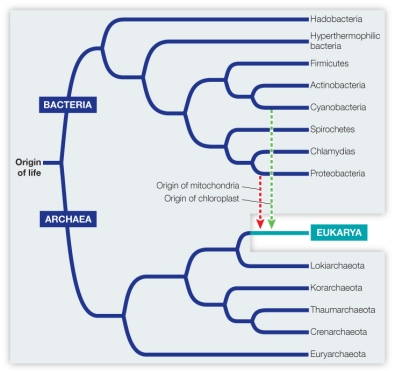 In the figure, the phylogenetic tree
Which statement about high-GC Gram-positive bacteria (actinobacteria) is false?
(Multiple Choice)
4.7/5 (81)
(81) Which of the following is a potential application of biofilms?
(Multiple Choice)
4.9/5 (85)
(85) Chlamydias are known as "energy parasites." If a mutation were introduced into their _______ gene, their ability to acquire ATP from a host would be severely compromised.
(Short Answer)
4.9/5 (85)
(85) You have a bacterial infection that is unresponsive to mild doses of common antibiotics.Your doctor prescribes a strong oral antibiotic known to disrupt chemical signaling in bacteria.Based on the mode of action of the new antibiotic prescribed, the doctor probably believes the bacteria exist in a _______.
(Short Answer)
4.9/5 (79)
(79) A classmate argues that the three domains of life should be four domains, with the fourth domain containing viruses.Which is not an appropriate response to this argument?
(Multiple Choice)
4.7/5 (86)
(86) 
Filters
- Essay(0)
- Multiple Choice(0)
- Short Answer(0)
- True False(0)
- Matching(0)