



 Chat with AI
Exam 25: Bacteria, Archaea, and Viruses

Exam 1: Studying Life246 Questions
Exam 2: Small Molecules and the Chemistry of Life246 Questions
Exam 3: Proteins, Carbohydrates, and Lipids246 Questions
Exam 4: Nucleic Acids and the Origin of Life246 Questions
Exam 5: Cells: the Working Units of Life248 Questions
Exam 6: Cell Membranes246 Questions
Exam 7: Cell Communication and Multicellularity246 Questions
Exam 8: Energy, Enzymes, and Metabolism246 Questions
Exam 9: Pathways That Harvest Chemical Energy246 Questions
Exam 10: Photosynthesis: Energy From Sunlight242 Questions
Exam 11: The Cell Cycle and Cell Division260 Questions
Exam 12: Inheritance, Genes, and Chromosomes250 Questions
Exam 13: Dna and Its Role in Heredity257 Questions
Exam 14: From Dna to Protein: Gene Expression252 Questions
Exam 15: Gene Mutation and Molecular Medicine251 Questions
Exam 16: Regulation of Gene Expression245 Questions
Exam 17: Genomes249 Questions
Exam 18: Recombinant Dna and Biotechnology243 Questions
Exam 20: Mechanisms of Evolution243 Questions
Exam 21: Reconstructing and Using Phylogenies246 Questions
Exam 22: Speciation247 Questions
Exam 23: Evolution of Genes and Genomes252 Questions
Exam 24: The History of Life on Earth246 Questions
Exam 25: Bacteria, Archaea, and Viruses262 Questions
Exam 26: The Origin and Diversification of Eukaryotes252 Questions
Exam 27: Plants Without Seeds: From Water to Land251 Questions
Exam 28: The Evolution of Seed Plants259 Questions
Exam 29: The Evolution and Diversity of Fungi261 Questions
Exam 30: Animal Origins and the Evolution of Body Plans248 Questions
Exam 31: Protostome Animals244 Questions
Exam 32: Deuterostome Animals246 Questions
Exam 33: The Plant Body243 Questions
Exam 34: Transport in Plants248 Questions
Exam 35: Plant Nutrition247 Questions
Exam 36: Regulation of Plant Growth246 Questions
Exam 37: Reproduction in Flowering Plants247 Questions
Exam 38: Plant Responses to Environmental Challenges246 Questions
Exam 39: Physiology, Homeostasis, and Temperature Regulation258 Questions
Exam 40: Animal Hormones249 Questions
Exam 41: Immunology: Animal Defense Systems265 Questions
Exam 42: Animal Reproduction261 Questions
Exam 43: Animal Development261 Questions
Exam 44: Neurons, Glia, and Nervous Systems250 Questions
Exam 45: Sensory Systems249 Questions
Exam 46: The Mammalian Nervous System: Structure and Higher Functions254 Questions
Exam 47: Musculoskeletal Systems259 Questions
Exam 48: Gas Exchange247 Questions
Exam 49: Circulatory Systems252 Questions
Exam 50: Nutrition, Digestion, and Absorption259 Questions
Exam 51: Salt and Water Balance and Nitrogen Excretion251 Questions
Exam 52: Animal Behavior249 Questions
Exam 53: The Physical Environment and Biogeography of Life248 Questions
Exam 54: Populations259 Questions
Exam 55: Species Interactions254 Questions
Exam 56: Communities247 Questions
Exam 57: Ecosystems238 Questions
Exam 58: A Changing Biosphere222 Questions
Select questions type


Refer to the figure, which shows the phylogenetic tree of major groups of living organisms. 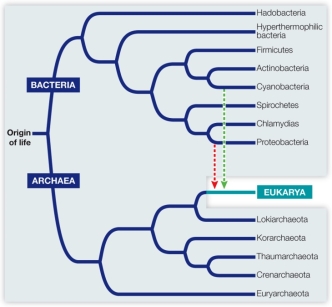 Based on the figure, which statement about the endosymbiotic origin of eukaryotic mitochondria is true?
 (Multiple Choice)
4.9/5  (70)
(70) Which of the following is a broad nutritional category of prokaryotes that is recognized by biologists?
(Multiple Choice)
4.9/5 (95)
(95) Hundreds of different antibiotics are produced by members of the genus
(Multiple Choice)
4.8/5 (72)
(72) Ninety percent of the cells in the human body are microbes-mostly prokaryotes and some microscopic eukaryotes.Which statement about human microbiomes is true?
(Multiple Choice)
4.8/5 (85)
(85) Many Gram-negative bacteria that cause disease have _______ composed of lipopolysaccharides, which can cause fever and vomiting when the bacteria burst.
(Short Answer)
4.7/5 (81)
(81) Refer to the figure. 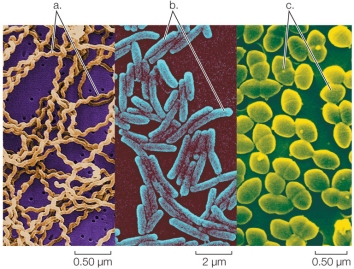 Label the three basic shapes of bacteria shown.
 (Short Answer)
4.9/5 (91)
(91) When building phylogenetic trees, scientists approach the task by using single gene sequences, multiple gene sequences, or _______ gene sequences.
(Short Answer)
4.7/5 (67)
(67) A strain of heat-tolerant pathogenic bacteria has acquired resistance to all known antibiotics.Which method would you propose to best control its future spread?
(Multiple Choice)
4.8/5 (93)
(93) Some biologists do not consider viruses to be a form of life because they
(Multiple Choice)
4.8/5 (73)
(73) Medications and environmental influences that destroy numerous microbes in the human body would
(Multiple Choice)
4.7/5 (85)
(85) Which of the following is not a reason that ribosomal RNA is useful for studying the evolutionary relationships among living organisms?
(Multiple Choice)
4.9/5 (87)
(87) Viruses are difficult to control with antiviral medications, because
(Multiple Choice)
4.9/5 (77)
(77) The genetic makeup of many viruses supports the hypothesis that they are derived from "escaped" cellular components.Judging from its genetic makeup, the virus most likely derived from an "escaped" cellular component is a
(Multiple Choice)
4.9/5 (72)
(72) Bacteria that lack cell walls, are mostly plant and animal parasites, and are among the smallest cellular creatures are
(Multiple Choice)
4.9/5 (75)
(75) Refer to the figure, which shows a variety of viruses. 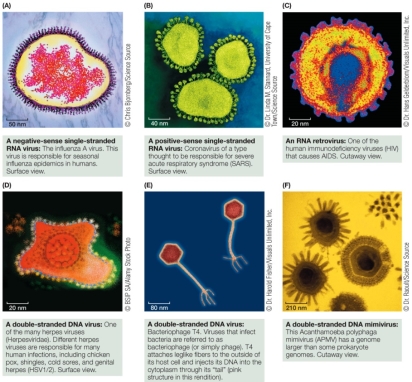 According to the figure, which statement about viruses is true?
 (Multiple Choice)
4.9/5 (84)
(84) Which of the following is not one of Koch's postulates for determining whether a particular microorganism causes a particular disease?
(Multiple Choice)
4.7/5 (76)
(76) 
Filters
- Essay(0)
- Multiple Choice(0)
- Short Answer(0)
- True False(0)
- Matching(0)