



 Chat with AI
Exam 25: Bacteria, Archaea, and Viruses

Exam 1: Studying Life246 Questions
Exam 2: Small Molecules and the Chemistry of Life246 Questions
Exam 3: Proteins, Carbohydrates, and Lipids246 Questions
Exam 4: Nucleic Acids and the Origin of Life246 Questions
Exam 5: Cells: the Working Units of Life248 Questions
Exam 6: Cell Membranes246 Questions
Exam 7: Cell Communication and Multicellularity246 Questions
Exam 8: Energy, Enzymes, and Metabolism246 Questions
Exam 9: Pathways That Harvest Chemical Energy246 Questions
Exam 10: Photosynthesis: Energy From Sunlight242 Questions
Exam 11: The Cell Cycle and Cell Division260 Questions
Exam 12: Inheritance, Genes, and Chromosomes250 Questions
Exam 13: Dna and Its Role in Heredity257 Questions
Exam 14: From Dna to Protein: Gene Expression252 Questions
Exam 15: Gene Mutation and Molecular Medicine251 Questions
Exam 16: Regulation of Gene Expression245 Questions
Exam 17: Genomes249 Questions
Exam 18: Recombinant Dna and Biotechnology243 Questions
Exam 20: Mechanisms of Evolution243 Questions
Exam 21: Reconstructing and Using Phylogenies246 Questions
Exam 22: Speciation247 Questions
Exam 23: Evolution of Genes and Genomes252 Questions
Exam 24: The History of Life on Earth246 Questions
Exam 25: Bacteria, Archaea, and Viruses262 Questions
Exam 26: The Origin and Diversification of Eukaryotes252 Questions
Exam 27: Plants Without Seeds: From Water to Land251 Questions
Exam 28: The Evolution of Seed Plants259 Questions
Exam 29: The Evolution and Diversity of Fungi261 Questions
Exam 30: Animal Origins and the Evolution of Body Plans248 Questions
Exam 31: Protostome Animals244 Questions
Exam 32: Deuterostome Animals246 Questions
Exam 33: The Plant Body243 Questions
Exam 34: Transport in Plants248 Questions
Exam 35: Plant Nutrition247 Questions
Exam 36: Regulation of Plant Growth246 Questions
Exam 37: Reproduction in Flowering Plants247 Questions
Exam 38: Plant Responses to Environmental Challenges246 Questions
Exam 39: Physiology, Homeostasis, and Temperature Regulation258 Questions
Exam 40: Animal Hormones249 Questions
Exam 41: Immunology: Animal Defense Systems265 Questions
Exam 42: Animal Reproduction261 Questions
Exam 43: Animal Development261 Questions
Exam 44: Neurons, Glia, and Nervous Systems250 Questions
Exam 45: Sensory Systems249 Questions
Exam 46: The Mammalian Nervous System: Structure and Higher Functions254 Questions
Exam 47: Musculoskeletal Systems259 Questions
Exam 48: Gas Exchange247 Questions
Exam 49: Circulatory Systems252 Questions
Exam 50: Nutrition, Digestion, and Absorption259 Questions
Exam 51: Salt and Water Balance and Nitrogen Excretion251 Questions
Exam 52: Animal Behavior249 Questions
Exam 53: The Physical Environment and Biogeography of Life248 Questions
Exam 54: Populations259 Questions
Exam 55: Species Interactions254 Questions
Exam 56: Communities247 Questions
Exam 57: Ecosystems238 Questions
Exam 58: A Changing Biosphere222 Questions
Select questions type


Differentiate between the following terms:
obligate anaerobe / obligate aerobe
photoautotroph / photoheterotroph
chemoautotroph / chemoheterotroph
(Essay)
4.7/5  (85)
(85) Evidence supporting the lokiarchaeotes as the closest relatives of the eukaryotes is based on the presence of certain genes in the lokiarchaeote genome.Scientists are confident of this newly described relationship because the genes found
(Multiple Choice)
4.9/5 (72)
(72) When accumulating in a biofilm, prokaryotes release signaling molecules.A drug that incapacitates these molecules could
(Multiple Choice)
4.9/5 (76)
(76) The CDC has enlisted your help in controlling the spread of a highly contagious, rapidly evolving, drug-resistant bacterium released during the desert excavation of an ancient civilization.What approach do you tell them to take?
(Multiple Choice)
4.9/5 (83)
(83) After culturing a bacterial species isolated from a skin lesion, a scientist was unable to infect a new host with the bacterial culture and was thus unable to satisfy Koch's postulates.In this instance, the bacterium that was cultured is not considered a _______.
(Short Answer)
4.8/5 (90)
(90) Refer to the figure, which shows a scatterplot of genome size versus number of protein-coding genes found in different classes of microbes. 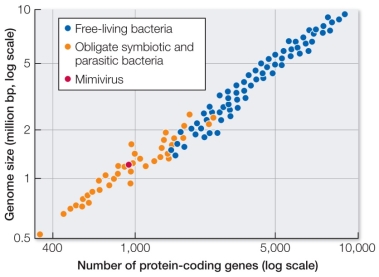 Based on these data, state and justify the most likely origin of the mimivirus, and present an alternative hypothesis for the origin of this and other viruses.
 (Essay)
4.8/5 (77)
(77) Which category of organisms depends on organic molecules as the source of both energy and carbon?
(Multiple Choice)
4.7/5 (89)
(89) Comparisons of entire genomes among prokaryotes have revealed a stable core of crucial genes that are unaffected by lateral gene transfer.Which statement concerning this discovery is false?
(Multiple Choice)
4.8/5 (82)
(82) Observable phenotypic characteristics, such as a reaction to the Gram stain, are less useful than molecular traits for understanding the evolutionary relationships of prokaryotes.Which statement about the importance of rRNA to the classification of organisms is false?
(Multiple Choice)
4.8/5 (77)
(77) Extreme halophiles absorb light to form ATP, using a molecule called microbial rhodopsin.This molecule is formed by combining a protein with _______, a pigment also found in the vertebrate eye.
(Multiple Choice)
4.9/5 (74)
(74) Match the name of the bacteria from the list below with the description that follows.
(Multiple Choice)
4.9/5 (77)
(77) The most recent identified ancestor of eukaryotes is a group of Archaea called the lokiarchaeotes.The evidence of this phylogenetic relationship is based on the presence of certain genes in the lokiarchaeote genome.These genes
(Multiple Choice)
5.0/5 (70)
(70) Refer to the figure. 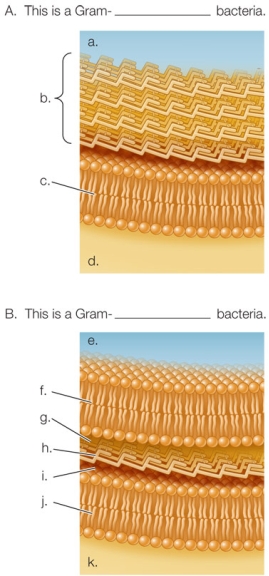 Label the cells as Gram-positive or Gram-negative, and identify each portion of the structure.
 (Short Answer)
4.8/5 (84)
(84) The Gram-staining method is useful for classifying all bacteria that
(Multiple Choice)
5.0/5 (86)
(86) An archaeal species, taken near a hydrothermal vent, survives and even multiplies at 121°C.This indicates that at least some members of this group can live under severe conditions.Which of the following does not characterize the archaea?
(Multiple Choice)
4.9/5 (69)
(69) 
Filters
- Essay(0)
- Multiple Choice(0)
- Short Answer(0)
- True False(0)
- Matching(0)