



 Chat with AI
Exam 25: Bacteria, Archaea, and Viruses

Exam 1: Studying Life246 Questions
Exam 2: Small Molecules and the Chemistry of Life246 Questions
Exam 3: Proteins, Carbohydrates, and Lipids246 Questions
Exam 4: Nucleic Acids and the Origin of Life246 Questions
Exam 5: Cells: the Working Units of Life248 Questions
Exam 6: Cell Membranes246 Questions
Exam 7: Cell Communication and Multicellularity246 Questions
Exam 8: Energy, Enzymes, and Metabolism246 Questions
Exam 9: Pathways That Harvest Chemical Energy246 Questions
Exam 10: Photosynthesis: Energy From Sunlight242 Questions
Exam 11: The Cell Cycle and Cell Division260 Questions
Exam 12: Inheritance, Genes, and Chromosomes250 Questions
Exam 13: Dna and Its Role in Heredity257 Questions
Exam 14: From Dna to Protein: Gene Expression252 Questions
Exam 15: Gene Mutation and Molecular Medicine251 Questions
Exam 16: Regulation of Gene Expression245 Questions
Exam 17: Genomes249 Questions
Exam 18: Recombinant Dna and Biotechnology243 Questions
Exam 20: Mechanisms of Evolution243 Questions
Exam 21: Reconstructing and Using Phylogenies246 Questions
Exam 22: Speciation247 Questions
Exam 23: Evolution of Genes and Genomes252 Questions
Exam 24: The History of Life on Earth246 Questions
Exam 25: Bacteria, Archaea, and Viruses262 Questions
Exam 26: The Origin and Diversification of Eukaryotes252 Questions
Exam 27: Plants Without Seeds: From Water to Land251 Questions
Exam 28: The Evolution of Seed Plants259 Questions
Exam 29: The Evolution and Diversity of Fungi261 Questions
Exam 30: Animal Origins and the Evolution of Body Plans248 Questions
Exam 31: Protostome Animals244 Questions
Exam 32: Deuterostome Animals246 Questions
Exam 33: The Plant Body243 Questions
Exam 34: Transport in Plants248 Questions
Exam 35: Plant Nutrition247 Questions
Exam 36: Regulation of Plant Growth246 Questions
Exam 37: Reproduction in Flowering Plants247 Questions
Exam 38: Plant Responses to Environmental Challenges246 Questions
Exam 39: Physiology, Homeostasis, and Temperature Regulation258 Questions
Exam 40: Animal Hormones249 Questions
Exam 41: Immunology: Animal Defense Systems265 Questions
Exam 42: Animal Reproduction261 Questions
Exam 43: Animal Development261 Questions
Exam 44: Neurons, Glia, and Nervous Systems250 Questions
Exam 45: Sensory Systems249 Questions
Exam 46: The Mammalian Nervous System: Structure and Higher Functions254 Questions
Exam 47: Musculoskeletal Systems259 Questions
Exam 48: Gas Exchange247 Questions
Exam 49: Circulatory Systems252 Questions
Exam 50: Nutrition, Digestion, and Absorption259 Questions
Exam 51: Salt and Water Balance and Nitrogen Excretion251 Questions
Exam 52: Animal Behavior249 Questions
Exam 53: The Physical Environment and Biogeography of Life248 Questions
Exam 54: Populations259 Questions
Exam 55: Species Interactions254 Questions
Exam 56: Communities247 Questions
Exam 57: Ecosystems238 Questions
Exam 58: A Changing Biosphere222 Questions
Select questions type


A patient is admitted to the hospital complaining of itchy eyes.After a few diagnostic tests, the doctors determine that the symptoms are being caused by small Gram-negative cocci that appear to have two types of cell morphology.With this information they conclude that the infection is likely caused by
(Multiple Choice)
4.9/5  (80)
(80) If a phylogenetic tree were constructed using sequences from eukaryotic mitochondrial DNA and bacterial and archaeal genomes, it would suggest a close relationship between _______ and eukaryotes (or mitochondria).
(Short Answer)
4.9/5 (82)
(82) Eukarya is evolutionarily closer to _______ than it is to Bacteria.
(Short Answer)
4.8/5 (70)
(70) Which of the following interfere(s) with the synthesis of peptidoglycan-containing cell walls?
(Multiple Choice)
4.8/5 (86)
(86) When a key nutrient such as nitrogen or carbon becomes scarce, some bacteria replicate their DNA and encapsulate one copy, along with some cytoplasm, in a tough cell wall heavily thickened with peptidoglycan and surrounded by a spore coat.The parent cell then breaks down.The result is
(Multiple Choice)
4.8/5 (84)
(84) Photoautotrophs use light as their source of energy and _______ as their source of carbon.
(Short Answer)
4.9/5 (80)
(80) In light, purple sulfur bacteria use H2S as an electron donor and release pure sulfur as a waste product.Purple sulfur bacteria are thus
(Multiple Choice)
4.7/5 (74)
(74) The genetic makeup of many viruses supports the hypothesis that they are derived from "escaped" cellular components.In contrast, which class of viruses best supports the hypothesis that certain viruses have evolved from highly reduced parasitic organisms?
(Multiple Choice)
4.7/5 (79)
(79) An electron transport system is an important feature of cellular respiratory pathways.In these pathways, humans and other aerobes obtain an electron acceptor from the atmosphere or an aqueous environment, but anaerobic prokaryotes use oxidized inorganic ions as electron acceptors.Which of the following is not an electron acceptor used by either aerobes or anaerobes?
(Multiple Choice)
4.9/5 (85)
(85) Refer to the figure, which shows the formation of a biofilm. 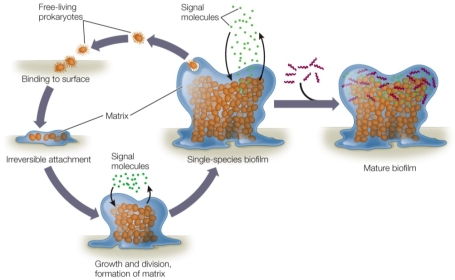 According to the figure, which statement about biofilms is true?
 (Multiple Choice)
4.8/5 (76)
(76) Refer to the figure, which shows a prokaryote. 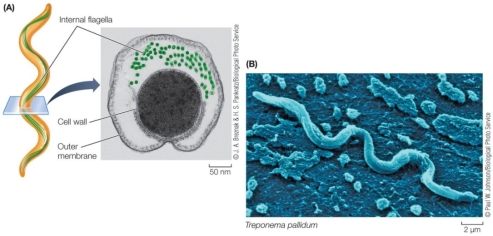 Which statement about the structures labeled "internal flagella" (which compose the axial filament) is true?
 (Multiple Choice)
4.9/5 (82)
(82) Which of the following statements concerning axial filaments is false?
(Multiple Choice)
4.9/5 (77)
(77) Your research group is studying a bacterium known to produce a medically relevant biofilm.In an effort to understand how the biofilm is induced, you mutate one of the bacterium's genes (gene X) that you believe to be involved in quorum sensing.Design an experiment to determine whether gene X is involved in biofilm formation.Be sure to include the reasoning behind your experimental design in your answer.
(Essay)
4.8/5 (83)
(83) Because of complications during delivery of identical twins, "Baby A" is born vaginally while "Baby B" is born by cesarean section.As the twins have aged, Baby B alone has begun to experience rheumatoid arthritis (RA).Which explanation most likely accounts for the autoimmune disease endured by Baby B?
(Multiple Choice)
4.8/5 (86)
(86) Escherichia coli and Salmonella typhimurium are both members of the
(Multiple Choice)
4.9/5 (68)
(68) 
Filters
- Essay(0)
- Multiple Choice(0)
- Short Answer(0)
- True False(0)
- Matching(0)