



 Chat with AI
Exam 25: Bacteria, Archaea, and Viruses

Exam 1: Studying Life246 Questions
Exam 2: Small Molecules and the Chemistry of Life246 Questions
Exam 3: Proteins, Carbohydrates, and Lipids246 Questions
Exam 4: Nucleic Acids and the Origin of Life246 Questions
Exam 5: Cells: the Working Units of Life248 Questions
Exam 6: Cell Membranes246 Questions
Exam 7: Cell Communication and Multicellularity246 Questions
Exam 8: Energy, Enzymes, and Metabolism246 Questions
Exam 9: Pathways That Harvest Chemical Energy246 Questions
Exam 10: Photosynthesis: Energy From Sunlight242 Questions
Exam 11: The Cell Cycle and Cell Division260 Questions
Exam 12: Inheritance, Genes, and Chromosomes250 Questions
Exam 13: Dna and Its Role in Heredity257 Questions
Exam 14: From Dna to Protein: Gene Expression252 Questions
Exam 15: Gene Mutation and Molecular Medicine251 Questions
Exam 16: Regulation of Gene Expression245 Questions
Exam 17: Genomes249 Questions
Exam 18: Recombinant Dna and Biotechnology243 Questions
Exam 20: Mechanisms of Evolution243 Questions
Exam 21: Reconstructing and Using Phylogenies246 Questions
Exam 22: Speciation247 Questions
Exam 23: Evolution of Genes and Genomes252 Questions
Exam 24: The History of Life on Earth246 Questions
Exam 25: Bacteria, Archaea, and Viruses262 Questions
Exam 26: The Origin and Diversification of Eukaryotes252 Questions
Exam 27: Plants Without Seeds: From Water to Land251 Questions
Exam 28: The Evolution of Seed Plants259 Questions
Exam 29: The Evolution and Diversity of Fungi261 Questions
Exam 30: Animal Origins and the Evolution of Body Plans248 Questions
Exam 31: Protostome Animals244 Questions
Exam 32: Deuterostome Animals246 Questions
Exam 33: The Plant Body243 Questions
Exam 34: Transport in Plants248 Questions
Exam 35: Plant Nutrition247 Questions
Exam 36: Regulation of Plant Growth246 Questions
Exam 37: Reproduction in Flowering Plants247 Questions
Exam 38: Plant Responses to Environmental Challenges246 Questions
Exam 39: Physiology, Homeostasis, and Temperature Regulation258 Questions
Exam 40: Animal Hormones249 Questions
Exam 41: Immunology: Animal Defense Systems265 Questions
Exam 42: Animal Reproduction261 Questions
Exam 43: Animal Development261 Questions
Exam 44: Neurons, Glia, and Nervous Systems250 Questions
Exam 45: Sensory Systems249 Questions
Exam 46: The Mammalian Nervous System: Structure and Higher Functions254 Questions
Exam 47: Musculoskeletal Systems259 Questions
Exam 48: Gas Exchange247 Questions
Exam 49: Circulatory Systems252 Questions
Exam 50: Nutrition, Digestion, and Absorption259 Questions
Exam 51: Salt and Water Balance and Nitrogen Excretion251 Questions
Exam 52: Animal Behavior249 Questions
Exam 53: The Physical Environment and Biogeography of Life248 Questions
Exam 54: Populations259 Questions
Exam 55: Species Interactions254 Questions
Exam 56: Communities247 Questions
Exam 57: Ecosystems238 Questions
Exam 58: A Changing Biosphere222 Questions
Select questions type


If cattle and rice cultivation were dramatically reduced, there would likely be a decrease in greenhouse gases due to a reduction in _______ available to produce methane.
(Short Answer)
4.9/5  (78)
(78) The sequencing of rRNA allowed scientists a clear understanding
(Multiple Choice)
4.7/5 (76)
(76) The common ancestry (monophyly) of all of life is confirmed by
(Multiple Choice)
4.8/5 (74)
(74) The group of bacteria least likely to be affected by antibiotics targeting peptidoglycan is the mycoplasma group, which belongs to the _______ class of bacteria.
(Short Answer)
4.8/5 (86)
(86) Most diseases caused by viruses are caused by _______.These diseases include polio, hepatitis C, and the common cold.In plants, these viruses kill patches of cells in the leaves or stems of plants, leaving live cells amid a patchwork of discolored dead tissue, giving them the name "mosaic" or "mottle" viruses.
(Multiple Choice)
4.8/5 (78)
(78) Antibiotics such as penicillin have little, if any, effect on the cells of eukaryotes, because they work by interfering with the synthesis of cell walls containing _______.
(Short Answer)
4.9/5 (74)
(74) A group of parasites that are among the smallest of the bacteria, called the _______, have a complex intracellular life cycle.
(Short Answer)
4.9/5 (70)
(70) Refer to the figure. 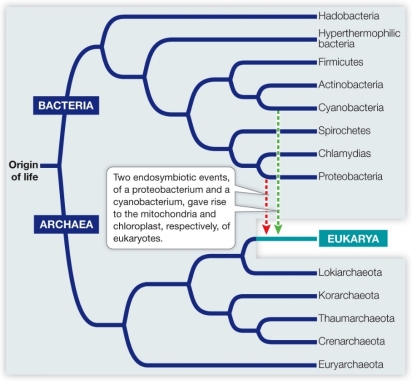 According to the depiction of the endosymbiotic origin of eukaryotic chloroplasts, which statement is correct?
 (Multiple Choice)
4.7/5 (81)
(81) If a strain of Vibrio fischeri acquired a mutation in the receptor for a signaling gene product involved in a density-dependent response, then _______ would be prevented and bioluminescence would not occur.
(Short Answer)
4.8/5 (87)
(87) Which of the following is not an ecological effect of viruses?
(Multiple Choice)
4.8/5 (83)
(83) Which statement regarding the forces that shaped the evolution of Bacteria and Archaea is false?
(Multiple Choice)
5.0/5 (80)
(80) Refer to the figure, which shows a variety of viruses. 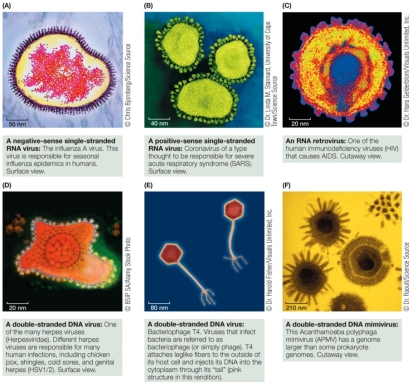 What do all of the viruses have in common?
 (Multiple Choice)
4.8/5 (93)
(93) Which of the following has been used as a bioterrorism agent, utilizing the fact that large quantities of its endospores are relatively easy to transport and spread among human populations, where they may be inhaled or ingested?
(Multiple Choice)
4.7/5 (80)
(80) Which is/are the closest monophyletic group(s) to the Bacteria?
(Multiple Choice)
4.9/5 (68)
(68) Refer to the figure. 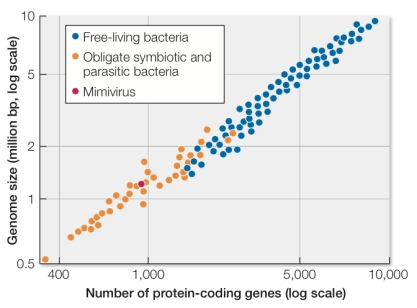 According to these data, evidence that mimiviruses are derived from reduced parasitic symbionts includes the
 (Multiple Choice)
4.8/5 (82)
(82) Which of the following is not a characteristic of prokaryotic cells?
(Multiple Choice)
4.9/5 (95)
(95) A consensus tree summarizing the evolutionary relationships among organisms consists of a phylogenetic tree
(Multiple Choice)
4.9/5 (74)
(74) 
Filters
- Essay(0)
- Multiple Choice(0)
- Short Answer(0)
- True False(0)
- Matching(0)