



 Chat with AI
Exam 25: Bacteria, Archaea, and Viruses

Exam 1: Studying Life246 Questions
Exam 2: Small Molecules and the Chemistry of Life246 Questions
Exam 3: Proteins, Carbohydrates, and Lipids246 Questions
Exam 4: Nucleic Acids and the Origin of Life246 Questions
Exam 5: Cells: the Working Units of Life248 Questions
Exam 6: Cell Membranes246 Questions
Exam 7: Cell Communication and Multicellularity246 Questions
Exam 8: Energy, Enzymes, and Metabolism246 Questions
Exam 9: Pathways That Harvest Chemical Energy246 Questions
Exam 10: Photosynthesis: Energy From Sunlight242 Questions
Exam 11: The Cell Cycle and Cell Division260 Questions
Exam 12: Inheritance, Genes, and Chromosomes250 Questions
Exam 13: Dna and Its Role in Heredity257 Questions
Exam 14: From Dna to Protein: Gene Expression252 Questions
Exam 15: Gene Mutation and Molecular Medicine251 Questions
Exam 16: Regulation of Gene Expression245 Questions
Exam 17: Genomes249 Questions
Exam 18: Recombinant Dna and Biotechnology243 Questions
Exam 20: Mechanisms of Evolution243 Questions
Exam 21: Reconstructing and Using Phylogenies246 Questions
Exam 22: Speciation247 Questions
Exam 23: Evolution of Genes and Genomes252 Questions
Exam 24: The History of Life on Earth246 Questions
Exam 25: Bacteria, Archaea, and Viruses262 Questions
Exam 26: The Origin and Diversification of Eukaryotes252 Questions
Exam 27: Plants Without Seeds: From Water to Land251 Questions
Exam 28: The Evolution of Seed Plants259 Questions
Exam 29: The Evolution and Diversity of Fungi261 Questions
Exam 30: Animal Origins and the Evolution of Body Plans248 Questions
Exam 31: Protostome Animals244 Questions
Exam 32: Deuterostome Animals246 Questions
Exam 33: The Plant Body243 Questions
Exam 34: Transport in Plants248 Questions
Exam 35: Plant Nutrition247 Questions
Exam 36: Regulation of Plant Growth246 Questions
Exam 37: Reproduction in Flowering Plants247 Questions
Exam 38: Plant Responses to Environmental Challenges246 Questions
Exam 39: Physiology, Homeostasis, and Temperature Regulation258 Questions
Exam 40: Animal Hormones249 Questions
Exam 41: Immunology: Animal Defense Systems265 Questions
Exam 42: Animal Reproduction261 Questions
Exam 43: Animal Development261 Questions
Exam 44: Neurons, Glia, and Nervous Systems250 Questions
Exam 45: Sensory Systems249 Questions
Exam 46: The Mammalian Nervous System: Structure and Higher Functions254 Questions
Exam 47: Musculoskeletal Systems259 Questions
Exam 48: Gas Exchange247 Questions
Exam 49: Circulatory Systems252 Questions
Exam 50: Nutrition, Digestion, and Absorption259 Questions
Exam 51: Salt and Water Balance and Nitrogen Excretion251 Questions
Exam 52: Animal Behavior249 Questions
Exam 53: The Physical Environment and Biogeography of Life248 Questions
Exam 54: Populations259 Questions
Exam 55: Species Interactions254 Questions
Exam 56: Communities247 Questions
Exam 57: Ecosystems238 Questions
Exam 58: A Changing Biosphere222 Questions
Select questions type


The hadobacteria are thermophilic extremophiles.They include the genus Deinococcus, which
(Multiple Choice)
4.9/5  (75)
(75) Match the name of the bacteria from the list below with the description that follows.
(Multiple Choice)
4.8/5 (75)
(75) Unknown bacteria are cultured from a scaly patch on the skin's surface.Upon further characterization, they are found to contain half the DNA of most bacteria and are not affected by the application of penicillin.Based on these two criteria, you conclude these bacteria are
(Multiple Choice)
4.8/5 (77)
(77) Gram-negative bacteria usually have a thin peptidoglycan layer and an outer _______.
(Short Answer)
4.9/5 (83)
(83) Bacteria that are unable to survive for extended periods in the absence of oxygen are called _______.
(Short Answer)
4.8/5 (89)
(89) When stained with Gram stain, Gram-positive bacteria stain blue to purple (or violet), whereas Gram-negative bacteria stain _______.
(Short Answer)
4.7/5 (80)
(80) The bacterium Escherichia coli is rod-shaped and is Gram-_______.
(Short Answer)
4.9/5 (97)
(97) Some prokaryotes are photoheterotrophs, which obtain energy from _______ and obtain carbon from _______.
(Multiple Choice)
4.8/5 (93)
(93) Your research group is interested in studying a bacterium known to associate with the roots of soybean plants.When the bacterium is present, the plants grow taller and produce higher yields.Choose the experimental setup that would provide an explanation for this observed phenomenon.
(Multiple Choice)
4.9/5 (71)
(71) Organisms require energy to carry out metabolic activities, and prokaryote species occur in all nutrition-obtaining categories.Organisms classified as _______ obtain their energy by oxidizing inorganic substances such as ammonia, nitrate, hydrogen sulfide, and sulfur.
(Multiple Choice)
4.7/5 (83)
(83) In an effort to lead a healthier lifestyle, you reduce the amount of sugar in your diet and start using a sugar substitute that tastes sweet but is not taken up by mammalian cells.After a few weeks you experience stomach cramps and lethargy.Based on what you know about microbiomes, what would be a reasonable hypothesis to explain your discomfort?
(Multiple Choice)
4.8/5 (95)
(95) Refer to the figure, which shows the formation of a biofilm. 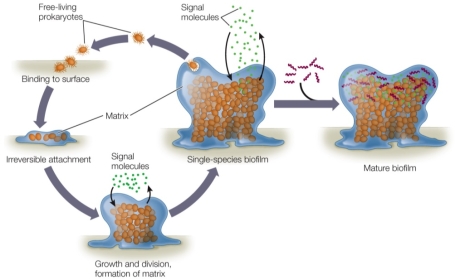 According to the figure, which statement about biofilms is false?
 (Multiple Choice)
4.8/5 (80)
(80) Match the name of the bacteria from the list below with the description that follows.
(Multiple Choice)
4.9/5 (97)
(97) Bacteria are known for the many roles they play in biological communities.Which of the following is the most rare role for this group of organisms?
(Multiple Choice)
4.8/5 (66)
(66) Clostridium and Escherichia coli are both well-known genera of rod-shaped bacteria, but they are classified into different groups based on their peptidoglycan content.If Clostridium stains purple during a Gram stain test, then we know that E.coli is
(Multiple Choice)
4.9/5 (70)
(70) Which of the following is not a potential application of biofilms?
(Multiple Choice)
4.8/5 (88)
(88) 
Filters
- Essay(0)
- Multiple Choice(0)
- Short Answer(0)
- True False(0)
- Matching(0)