



 Chat with AI
Exam 25: Bacteria, Archaea, and Viruses

Exam 1: Studying Life246 Questions
Exam 2: Small Molecules and the Chemistry of Life246 Questions
Exam 3: Proteins, Carbohydrates, and Lipids246 Questions
Exam 4: Nucleic Acids and the Origin of Life246 Questions
Exam 5: Cells: the Working Units of Life248 Questions
Exam 6: Cell Membranes246 Questions
Exam 7: Cell Communication and Multicellularity246 Questions
Exam 8: Energy, Enzymes, and Metabolism246 Questions
Exam 9: Pathways That Harvest Chemical Energy246 Questions
Exam 10: Photosynthesis: Energy From Sunlight242 Questions
Exam 11: The Cell Cycle and Cell Division260 Questions
Exam 12: Inheritance, Genes, and Chromosomes250 Questions
Exam 13: Dna and Its Role in Heredity257 Questions
Exam 14: From Dna to Protein: Gene Expression252 Questions
Exam 15: Gene Mutation and Molecular Medicine251 Questions
Exam 16: Regulation of Gene Expression245 Questions
Exam 17: Genomes249 Questions
Exam 18: Recombinant Dna and Biotechnology243 Questions
Exam 20: Mechanisms of Evolution243 Questions
Exam 21: Reconstructing and Using Phylogenies246 Questions
Exam 22: Speciation247 Questions
Exam 23: Evolution of Genes and Genomes252 Questions
Exam 24: The History of Life on Earth246 Questions
Exam 25: Bacteria, Archaea, and Viruses262 Questions
Exam 26: The Origin and Diversification of Eukaryotes252 Questions
Exam 27: Plants Without Seeds: From Water to Land251 Questions
Exam 28: The Evolution of Seed Plants259 Questions
Exam 29: The Evolution and Diversity of Fungi261 Questions
Exam 30: Animal Origins and the Evolution of Body Plans248 Questions
Exam 31: Protostome Animals244 Questions
Exam 32: Deuterostome Animals246 Questions
Exam 33: The Plant Body243 Questions
Exam 34: Transport in Plants248 Questions
Exam 35: Plant Nutrition247 Questions
Exam 36: Regulation of Plant Growth246 Questions
Exam 37: Reproduction in Flowering Plants247 Questions
Exam 38: Plant Responses to Environmental Challenges246 Questions
Exam 39: Physiology, Homeostasis, and Temperature Regulation258 Questions
Exam 40: Animal Hormones249 Questions
Exam 41: Immunology: Animal Defense Systems265 Questions
Exam 42: Animal Reproduction261 Questions
Exam 43: Animal Development261 Questions
Exam 44: Neurons, Glia, and Nervous Systems250 Questions
Exam 45: Sensory Systems249 Questions
Exam 46: The Mammalian Nervous System: Structure and Higher Functions254 Questions
Exam 47: Musculoskeletal Systems259 Questions
Exam 48: Gas Exchange247 Questions
Exam 49: Circulatory Systems252 Questions
Exam 50: Nutrition, Digestion, and Absorption259 Questions
Exam 51: Salt and Water Balance and Nitrogen Excretion251 Questions
Exam 52: Animal Behavior249 Questions
Exam 53: The Physical Environment and Biogeography of Life248 Questions
Exam 54: Populations259 Questions
Exam 55: Species Interactions254 Questions
Exam 56: Communities247 Questions
Exam 57: Ecosystems238 Questions
Exam 58: A Changing Biosphere222 Questions
Select questions type


Thermotoga maritima is a bacterium that can survive extremely high temperatures.Some of its genes most resemble those of archaea that live in similar extreme environments.This is most likely the result of
(Multiple Choice)
4.9/5  (80)
(80) Genes that are likely to undergo lateral transfer are those that
(Multiple Choice)
4.8/5 (89)
(89) A phylogenetic tree constructed using sequences from eukaryotic chloroplast DNA, bacterial genomes, and archaeal genomes would show an artificially close relationship between bacteria and _______.
(Short Answer)
4.8/5 (68)
(68) 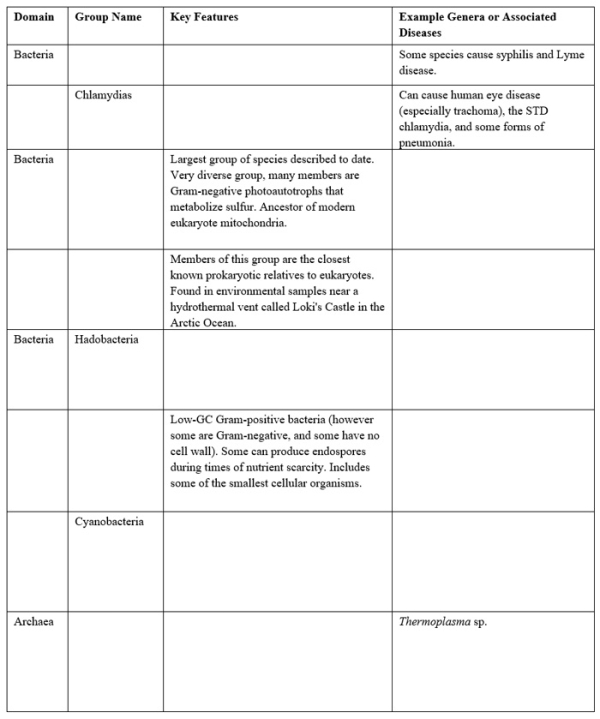
Which bacterium is abundant on the human body surface and is responsible for boils and many other skin problems?
(Multiple Choice)
4.8/5 (84)
(84) Certain bacterial photoautotrophs use bacteriochlorophyll for photosynthesis.Bacteriochlorophyll molecules absorb light of longer wavelengths than the chlorophyll a molecules of other photosynthesizing organisms.The longer wavelengths pass through other organisms.What is the ecological advantage to this?
(Multiple Choice)
4.9/5 (88)
(88) Living colonies of Clostridium botulinum produce a deadly toxin, which is lethal at about one-millionth of a gram.Smaller doses of this toxin, marketed as Botox, are used to treat muscle spasms and for temporary wrinkle reduction in the skin.Which of the following groups of terms is most applicable to this species?
(Multiple Choice)
4.8/5 (80)
(80) Of the four nutritional categories of archaea and bacteria, most are _______, as are animals, fungi, and many protists.
(Short Answer)
4.9/5 (80)
(80) Refer to the figure, which shows an organismal tree. 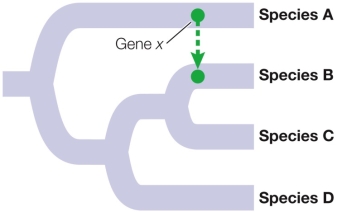 In the tree shown, Gene x has undergone a lateral transfer event.Draw the phylogenetic tree you would expect based on Gene x, as well as the phylogenetic tree you would expect based on a consensus of nontransferred genes.Explain your answer as well.
 (Essay)
4.9/5 (86)
(86) After a few weeks of using a new antibiotic, you begin to experience stomach cramps and lethargy.Based on what you know about microbiomes, what would be a reasonable hypothesis to explain your discomfort?
(Multiple Choice)
4.9/5 (86)
(86) Conditions of early Earth are believed to have been hotter than the present day.Evidence supporting this hypothesis is demonstrated by the existence of several early-branching lineages of bacteria called _______.
(Short Answer)
4.8/5 (62)
(62) Which statement concerning nitrifiers, which act in soil and seawater, is false?
(Multiple Choice)
4.8/5 (76)
(76) How is it that viruses can be thought of as the "bark" on the tree of life: an important component all across the tree, but not quite like the main branches?
(Multiple Choice)
4.7/5 (79)
(79) RNA that is the complement of the mRNA needed for protein translation occurs in
(Multiple Choice)
4.7/5 (77)
(77) Some cyanobacteria that form filamentous colonies possess heterocysts, which are
(Multiple Choice)
4.7/5 (81)
(81) Which of Koch's postulates would be especially difficult to satisfy when diagnosing an infection caused by a chlamydia?
(Multiple Choice)
4.8/5 (83)
(83) How are prokaryote phylogenies different from mammal phylogenies?
(Multiple Choice)
4.7/5 (78)
(78) 
Filters
- Essay(0)
- Multiple Choice(0)
- Short Answer(0)
- True False(0)
- Matching(0)