



 Chat with AI
Exam 25: Bacteria, Archaea, and Viruses

Exam 1: Studying Life246 Questions
Exam 2: Small Molecules and the Chemistry of Life246 Questions
Exam 3: Proteins, Carbohydrates, and Lipids246 Questions
Exam 4: Nucleic Acids and the Origin of Life246 Questions
Exam 5: Cells: the Working Units of Life248 Questions
Exam 6: Cell Membranes246 Questions
Exam 7: Cell Communication and Multicellularity246 Questions
Exam 8: Energy, Enzymes, and Metabolism246 Questions
Exam 9: Pathways That Harvest Chemical Energy246 Questions
Exam 10: Photosynthesis: Energy From Sunlight242 Questions
Exam 11: The Cell Cycle and Cell Division260 Questions
Exam 12: Inheritance, Genes, and Chromosomes250 Questions
Exam 13: Dna and Its Role in Heredity257 Questions
Exam 14: From Dna to Protein: Gene Expression252 Questions
Exam 15: Gene Mutation and Molecular Medicine251 Questions
Exam 16: Regulation of Gene Expression245 Questions
Exam 17: Genomes249 Questions
Exam 18: Recombinant Dna and Biotechnology243 Questions
Exam 20: Mechanisms of Evolution243 Questions
Exam 21: Reconstructing and Using Phylogenies246 Questions
Exam 22: Speciation247 Questions
Exam 23: Evolution of Genes and Genomes252 Questions
Exam 24: The History of Life on Earth246 Questions
Exam 25: Bacteria, Archaea, and Viruses262 Questions
Exam 26: The Origin and Diversification of Eukaryotes252 Questions
Exam 27: Plants Without Seeds: From Water to Land251 Questions
Exam 28: The Evolution of Seed Plants259 Questions
Exam 29: The Evolution and Diversity of Fungi261 Questions
Exam 30: Animal Origins and the Evolution of Body Plans248 Questions
Exam 31: Protostome Animals244 Questions
Exam 32: Deuterostome Animals246 Questions
Exam 33: The Plant Body243 Questions
Exam 34: Transport in Plants248 Questions
Exam 35: Plant Nutrition247 Questions
Exam 36: Regulation of Plant Growth246 Questions
Exam 37: Reproduction in Flowering Plants247 Questions
Exam 38: Plant Responses to Environmental Challenges246 Questions
Exam 39: Physiology, Homeostasis, and Temperature Regulation258 Questions
Exam 40: Animal Hormones249 Questions
Exam 41: Immunology: Animal Defense Systems265 Questions
Exam 42: Animal Reproduction261 Questions
Exam 43: Animal Development261 Questions
Exam 44: Neurons, Glia, and Nervous Systems250 Questions
Exam 45: Sensory Systems249 Questions
Exam 46: The Mammalian Nervous System: Structure and Higher Functions254 Questions
Exam 47: Musculoskeletal Systems259 Questions
Exam 48: Gas Exchange247 Questions
Exam 49: Circulatory Systems252 Questions
Exam 50: Nutrition, Digestion, and Absorption259 Questions
Exam 51: Salt and Water Balance and Nitrogen Excretion251 Questions
Exam 52: Animal Behavior249 Questions
Exam 53: The Physical Environment and Biogeography of Life248 Questions
Exam 54: Populations259 Questions
Exam 55: Species Interactions254 Questions
Exam 56: Communities247 Questions
Exam 57: Ecosystems238 Questions
Exam 58: A Changing Biosphere222 Questions
Select questions type


If you were on a ship and observed bioluminescence in the ocean, what is the most logical conclusion you could draw about the surrounding waters?
(Multiple Choice)
4.8/5  (79)
(79) Recessive mutations in prokaryotes exert their effects immediately because prokaryotes are effectively _______.Mutations can move quickly through populations of prokaryotes by _______ and _______ of the mutated cell.
(Multiple Choice)
4.9/5 (82)
(82) You work with the Centers for Disease Control and Prevention in Atlanta.You have been called to a remote area of Uganda to study a mysterious disease that is causing respiratory ailments in a small village.You isolate a bacterium from several patients that seems like a good candidate for the pathogen.How can you determine whether this bacterium is causing the illness?
(Essay)
5.0/5 (94)
(94) Refer to the figure. 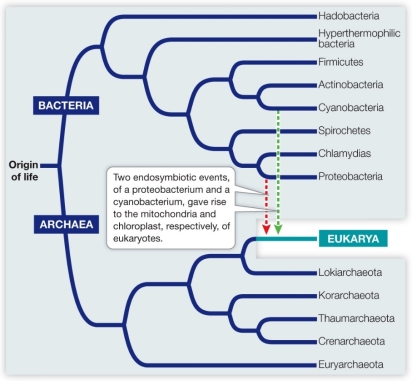 Based on the figure, which statement is true?
 (Multiple Choice)
4.8/5 (76)
(76) Dormant endospores of a species of _______ produce the disease anthrax.
(Multiple Choice)
4.8/5 (72)
(72) Why would a physician refuse to prescribe antibiotics for a cold or the flu?
(Essay)
4.9/5 (76)
(76) Before DNA sequencing became practical, taxonomists based prokaryote classification on observable phenotypic characters.Choose the character least likely to distinguish the spirochetes from other groups of prokaryotes.
(Multiple Choice)
4.8/5 (65)
(65) Treponema pallidum, the causative agent of syphilis, belongs to the group of bacteria known as the _______.
(Short Answer)
4.7/5 (87)
(87) Cattle depend on prokaryotes to perform important steps in digestion of plant material, such as producing the enzyme
(Multiple Choice)
4.9/5 (75)
(75) Which statement concerning the microbiome on the human body is false?
(Multiple Choice)
5.0/5 (81)
(81) Methanogenic euryarchaeotes are obligate anaerobes, some of which live in the intestinal tracts of mammals and other animals.From this information, one can conclude that the environment in the intestinal tracts
(Multiple Choice)
4.9/5 (70)
(70) Choose the most robust method to compellingly differentiate individuals from the two prokaryotic domains.
(Multiple Choice)
4.7/5 (83)
(83) Chemoautotrophic bacteria called _______ carry out a two-step process.Two genera, Nitrosomonas and Nitrosococcus, convert _______, and then Nitrobacter converts _______, which is most usable by plants.
(Multiple Choice)
4.7/5 (77)
(77) Which of the following characteristics is not shared by Archaea, Bacteria, and Eukarya?
(Multiple Choice)
4.9/5 (86)
(86) You discover a new prokaryotic organism.What sorts of traits will you look for in order to determine whether it is a bacterial or an archaeal organism? (Assume you cannot sequence the genome but must use other criteria for your initial classification.)
(Essay)
4.8/5 (69)
(69) 
Filters
- Essay(0)
- Multiple Choice(0)
- Short Answer(0)
- True False(0)
- Matching(0)