



 Chat with AI
Exam 55: Species Interactions

Exam 1: Studying Life246 Questions
Exam 2: Small Molecules and the Chemistry of Life246 Questions
Exam 3: Proteins, Carbohydrates, and Lipids246 Questions
Exam 4: Nucleic Acids and the Origin of Life246 Questions
Exam 5: Cells: the Working Units of Life248 Questions
Exam 6: Cell Membranes246 Questions
Exam 7: Cell Communication and Multicellularity246 Questions
Exam 8: Energy, Enzymes, and Metabolism246 Questions
Exam 9: Pathways That Harvest Chemical Energy246 Questions
Exam 10: Photosynthesis: Energy From Sunlight242 Questions
Exam 11: The Cell Cycle and Cell Division260 Questions
Exam 12: Inheritance, Genes, and Chromosomes250 Questions
Exam 13: Dna and Its Role in Heredity257 Questions
Exam 14: From Dna to Protein: Gene Expression252 Questions
Exam 15: Gene Mutation and Molecular Medicine251 Questions
Exam 16: Regulation of Gene Expression245 Questions
Exam 17: Genomes249 Questions
Exam 18: Recombinant Dna and Biotechnology243 Questions
Exam 20: Mechanisms of Evolution243 Questions
Exam 21: Reconstructing and Using Phylogenies246 Questions
Exam 22: Speciation247 Questions
Exam 23: Evolution of Genes and Genomes252 Questions
Exam 24: The History of Life on Earth246 Questions
Exam 25: Bacteria, Archaea, and Viruses262 Questions
Exam 26: The Origin and Diversification of Eukaryotes252 Questions
Exam 27: Plants Without Seeds: From Water to Land251 Questions
Exam 28: The Evolution of Seed Plants259 Questions
Exam 29: The Evolution and Diversity of Fungi261 Questions
Exam 30: Animal Origins and the Evolution of Body Plans248 Questions
Exam 31: Protostome Animals244 Questions
Exam 32: Deuterostome Animals246 Questions
Exam 33: The Plant Body243 Questions
Exam 34: Transport in Plants248 Questions
Exam 35: Plant Nutrition247 Questions
Exam 36: Regulation of Plant Growth246 Questions
Exam 37: Reproduction in Flowering Plants247 Questions
Exam 38: Plant Responses to Environmental Challenges246 Questions
Exam 39: Physiology, Homeostasis, and Temperature Regulation258 Questions
Exam 40: Animal Hormones249 Questions
Exam 41: Immunology: Animal Defense Systems265 Questions
Exam 42: Animal Reproduction261 Questions
Exam 43: Animal Development261 Questions
Exam 44: Neurons, Glia, and Nervous Systems250 Questions
Exam 45: Sensory Systems249 Questions
Exam 46: The Mammalian Nervous System: Structure and Higher Functions254 Questions
Exam 47: Musculoskeletal Systems259 Questions
Exam 48: Gas Exchange247 Questions
Exam 49: Circulatory Systems252 Questions
Exam 50: Nutrition, Digestion, and Absorption259 Questions
Exam 51: Salt and Water Balance and Nitrogen Excretion251 Questions
Exam 52: Animal Behavior249 Questions
Exam 53: The Physical Environment and Biogeography of Life248 Questions
Exam 54: Populations259 Questions
Exam 55: Species Interactions254 Questions
Exam 56: Communities247 Questions
Exam 57: Ecosystems238 Questions
Exam 58: A Changing Biosphere222 Questions
Select questions type


Black bears are most likely acting as mutualists when they eat
(Multiple Choice)
4.8/5  (71)
(71) In an experiment involving two annual plants that grow in disturbed habitats, equal numbers of seedlings of the two species were grown together.Plant A grew much larger than plant B during the same time period.Would this interaction be considered asymmetrical? Why or why not?
(Multiple Choice)
4.9/5 (77)
(77) Many interactions between plants and insects result in pollination.How does coevolution play a role in the development of these interactions?
(Essay)
4.8/5 (83)
(83) Kangaroo rats live in the desert and forage at night.When there is bright moonlight, they forage in more covered areas.This strategy of defense against predators could best be described as
(Multiple Choice)
4.8/5 (73)
(73) A forest is destroyed by fire, and then plant species begin to recolonize the burned site.Which types of species are likely to compete best in this environment?
(Multiple Choice)
4.9/5 (91)
(91) Two species compete for a shared set of limiting resources.Over time, one of them declines in population size and becomes locally extinct.All factors are at work in this community except
(Multiple Choice)
4.9/5 (86)
(86) Refer to the graph below showing one of the results from G.F.Gause's classic competition experiment on three species of Paramecium.Both of these species, P.aurelia and P.caudatum, feed on floating bacteria. 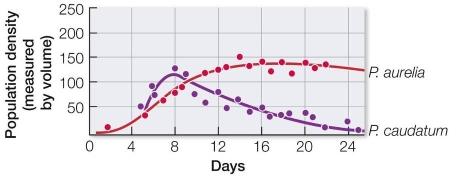 Which statement best describes the relationship between the two species?
 (Multiple Choice)
4.9/5 (78)
(78) Several lizards of the genus Anolis live on Caribbean islands.They all feed on insects, but they feed in different areas of the habitat.For example, some live in leaf litter, others in tree branches, and still others on tree trunks or in surrounding shrubs.This variation in habitat and feeding locations enables various species of Anolis to share a habitat because of
(Multiple Choice)
4.8/5 (65)
(65) A chimpanzee has a serious parasite infestation.She responds to this infestation by seeking out members of her troop and sitting with them while they groom her.She is most likely infested with
(Multiple Choice)
4.9/5 (76)
(76) Two species of barnacles, stellate and rock barnacles, occupy the rocky intertidal zone of the Scottish coast and illustrate factors that can determine species distribution in a community.Larvae of both species settle throughout the intertidal zone, but adult barnacles occupy specific zones.The smaller stellate barnacle lives only in higher zones, where the environment dries out between high tides.The larger, faster-reproducing rock barnacle lives only at lower zones.Differences in the distribution of larval and adult barnacles suggest that stellate barnacles are primarily restricted by _______ and rock barnacles are restricted by _______.
(Multiple Choice)
4.8/5 (86)
(86) A small population of Canada lynx feeds on Arctic hares.Then snowshoe hares (the lynx's favorite prey) are introduced.The snowshoe hares reproduce rapidly, and their population explodes.Based on your knowledge of predatorprey interactions, what changes would you expect in the lynx population and in the population of Arctic hares, the lynx's previous prey?
(Multiple Choice)
4.8/5 (79)
(79) The interaction in which fleas live on a dog and feed on its blood is best described as _______.
(Short Answer)
4.8/5 (71)
(71) Refer to the figures showing results of laboratory experiments that grew two species of Paramecium together. 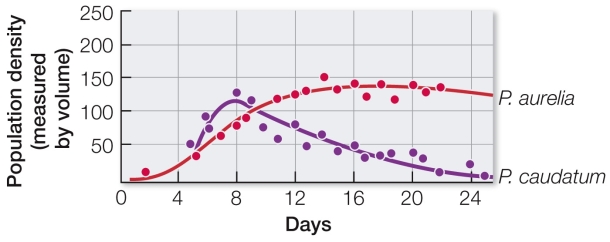
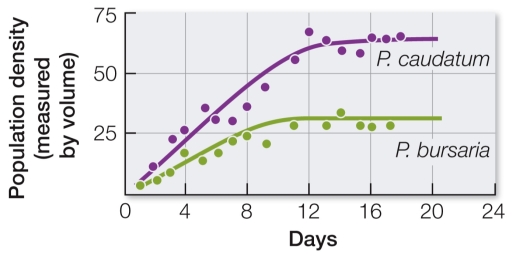 What types of competition are occurring in each of the two graphs?
 (Essay)
4.9/5 (72)
(72) Two plant species live along a gradient, from a rich temperate valley floor to halfway up a mountain slope.In the valley, the two plants are competitors, but going up the gradient their relationship changes and becomes more and more commensal.This change in their relationship is most likely the result of
(Multiple Choice)
4.8/5 (89)
(89) If the removal of a predator results in expansion of a spider's range, it is likely that the spider's _______ niche is larger than its realized niche in the presence of predators.
(Short Answer)
4.8/5 (79)
(79) The partnership between plants and mycorrhizal fungi is best described as _______ mutualism.
(Short Answer)
4.8/5 (87)
(87) When two species, such as Paramecium caudatum and P.bursaria, live in a limited environment and share resources, enabling both to coexist, their populations level off and both eventually reach their _______ for that environment.
(Short Answer)
4.9/5 (75)
(75) Competition between coexisting species can be either direct or indirect.In which of these examples is the competition indirect (exploitative)?
(Multiple Choice)
4.8/5 (72)
(72) The roots of many plants are connected to the hyphal strands of fungi.The fungi supply necessary water and minerals to the plants, and the plants supply carbohydrate nutrients to the fungi.This interaction is an example of
(Multiple Choice)
4.9/5 (79)
(79) Two similar species of lemurs exist in Madagascar.One species eats leaves from the understory of trees, and the other eats leaves from the tops of those trees.This phenomenon would be described as
(Multiple Choice)
4.7/5 (84)
(84) 
Filters
- Essay(0)
- Multiple Choice(0)
- Short Answer(0)
- True False(0)
- Matching(0)