



 Chat with AI
Exam 55: Species Interactions

Exam 1: Studying Life246 Questions
Exam 2: Small Molecules and the Chemistry of Life246 Questions
Exam 3: Proteins, Carbohydrates, and Lipids246 Questions
Exam 4: Nucleic Acids and the Origin of Life246 Questions
Exam 5: Cells: the Working Units of Life248 Questions
Exam 6: Cell Membranes246 Questions
Exam 7: Cell Communication and Multicellularity246 Questions
Exam 8: Energy, Enzymes, and Metabolism246 Questions
Exam 9: Pathways That Harvest Chemical Energy246 Questions
Exam 10: Photosynthesis: Energy From Sunlight242 Questions
Exam 11: The Cell Cycle and Cell Division260 Questions
Exam 12: Inheritance, Genes, and Chromosomes250 Questions
Exam 13: Dna and Its Role in Heredity257 Questions
Exam 14: From Dna to Protein: Gene Expression252 Questions
Exam 15: Gene Mutation and Molecular Medicine251 Questions
Exam 16: Regulation of Gene Expression245 Questions
Exam 17: Genomes249 Questions
Exam 18: Recombinant Dna and Biotechnology243 Questions
Exam 20: Mechanisms of Evolution243 Questions
Exam 21: Reconstructing and Using Phylogenies246 Questions
Exam 22: Speciation247 Questions
Exam 23: Evolution of Genes and Genomes252 Questions
Exam 24: The History of Life on Earth246 Questions
Exam 25: Bacteria, Archaea, and Viruses262 Questions
Exam 26: The Origin and Diversification of Eukaryotes252 Questions
Exam 27: Plants Without Seeds: From Water to Land251 Questions
Exam 28: The Evolution of Seed Plants259 Questions
Exam 29: The Evolution and Diversity of Fungi261 Questions
Exam 30: Animal Origins and the Evolution of Body Plans248 Questions
Exam 31: Protostome Animals244 Questions
Exam 32: Deuterostome Animals246 Questions
Exam 33: The Plant Body243 Questions
Exam 34: Transport in Plants248 Questions
Exam 35: Plant Nutrition247 Questions
Exam 36: Regulation of Plant Growth246 Questions
Exam 37: Reproduction in Flowering Plants247 Questions
Exam 38: Plant Responses to Environmental Challenges246 Questions
Exam 39: Physiology, Homeostasis, and Temperature Regulation258 Questions
Exam 40: Animal Hormones249 Questions
Exam 41: Immunology: Animal Defense Systems265 Questions
Exam 42: Animal Reproduction261 Questions
Exam 43: Animal Development261 Questions
Exam 44: Neurons, Glia, and Nervous Systems250 Questions
Exam 45: Sensory Systems249 Questions
Exam 46: The Mammalian Nervous System: Structure and Higher Functions254 Questions
Exam 47: Musculoskeletal Systems259 Questions
Exam 48: Gas Exchange247 Questions
Exam 49: Circulatory Systems252 Questions
Exam 50: Nutrition, Digestion, and Absorption259 Questions
Exam 51: Salt and Water Balance and Nitrogen Excretion251 Questions
Exam 52: Animal Behavior249 Questions
Exam 53: The Physical Environment and Biogeography of Life248 Questions
Exam 54: Populations259 Questions
Exam 55: Species Interactions254 Questions
Exam 56: Communities247 Questions
Exam 57: Ecosystems238 Questions
Exam 58: A Changing Biosphere222 Questions
Select questions type


When sap-sucking leafhoppers feed on potato plants early in the growing season, they cause potato leaves to curl and lose chlorophyll.Later in the season, potato beetles that consume these damaged leaves show reduced growth and survival rates.This interaction is best described as _______ that is _______.
(Multiple Choice)
4.9/5  (88)
(88) A Geometridae caterpillar eating leaves avoids detection by matching the leaf in color, being shaped like a leaf spine, and nibbling a pattern similar to that of the leaf.The caterpillar avoids predators by means of
(Multiple Choice)
4.8/5 (85)
(85) An herbivore species would most likely exert strong selective pressure on its host plant species if the herbivore eats
(Multiple Choice)
4.9/5 (75)
(75) Rain forest trees provide habitats for many other kinds of organisms, including epiphytes, vines, insects, birds, and arboreal animals such as monkeys.Usually, interactions between the trees and these animals can be classified as _______.
(Short Answer)
4.8/5 (94)
(94) Hummingbirds are important pollinators.They are attracted to the color red.Red flowers have evolved in many different plants that are not closely related, all of which are pollinated by hummingbirds.What does this example of coevolution suggest about the importance of color in pollination?
(Multiple Choice)
4.9/5 (87)
(87) Refer to the graph below, showing population cycles of snowshoe hares and their predator, Canada lynx.Population numbers were collected when both populations were trapped for the fur trade. 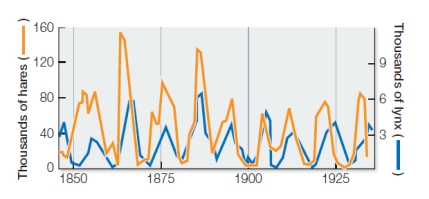 Some scientists think that the predator-prey cycles of the snowshoe hare and Canada lynx are not dependent on the interaction between the two species but instead on some outside factor, such as climate.If this is the case and if lynx were removed from the community, the hare population would likely
 (Multiple Choice)
4.9/5 (74)
(74) Three species of snails that are toxic to their bird predators have evolved similar patterns of coloration that help notify the birds of their poisonous nature.This phenomenon is known as
(Multiple Choice)
4.9/5 (74)
(74) Coral snakes are brightly striped Neotropical species with venomous fangs that dispense a neurotoxin into their prey.They also have a bright and distinctive color pattern of red, yellow, and black stripes.How would these two strategies, venom and warning color pattern, affect the coral snake as predator and prey?
(Multiple Choice)
4.9/5 (85)
(85) Some mimicry systems (e.g., those involving tropical butterflies) include several toxic species and several palatable species, all of which involve warning coloration and resemble one another closely.How would you classify these mimicry systems-Batesian, Müllerian, or both? Why might natural selection have favored the evolution of such complex mimicry systems?
(Essay)
4.8/5 (86)
(86) The H1N1 influenza virus responsible for the 2009 pandemic is an example of
(Multiple Choice)
4.7/5 (92)
(92) Refer to the table below showing the results of a greenhouse experiment.Sunflowers and corn plants are grown in 6-inch pots in treatments of varying plant densities and plant combinations.There are ten pots per treatment.All pots contain the same amount of potting soil and receive the same amount of water and sunlight.After 2 months, the heights of the plants in each pot are measured and averaged. 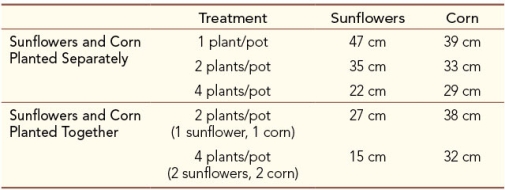 Explain how this experiment illustrates asymmetrical competition, and what this process means for plants in nature.
 (Essay)
4.8/5 (86)
(86) A wingless fly has a flat body and is capable of attaching itself to the feathers of a bird.It sucks the bird's blood without causing disease.The best description of this parasite is
(Multiple Choice)
4.8/5 (81)
(81) Some types of pine trees are attacked and fed on by pine bark beetles.As the beetles feed, they girdle the trees, destroying the phloem layer and killing the trees.Pine bark beetles are also associated with the blue stain fungus, which grows in their frass (feces).As they attack the trees, the beetles also inject the fungus.The fungal hyphae grow into the tree and follow its xylem cells, blocking the flow of xylem and causing rapid tree death.Suppose pine bark beetles that lacked the blue stain fungus attacked pine trees.How would the absence of the blue stain fungus be likely to affect the death rate of pines?
(Multiple Choice)
4.8/5 (80)
(80) Barnacles (hard-shelled marine invertebrates) live on rocks in the intertidal zone.Two species in an experiment, Semibalanus balanoides and Chthamalus stellatus, were able to coexist.S.balanoides grew rapidly and crushed the slower-growing C.stellatus.However, C.stellatus tolerated dry conditions.These species therefore existed in two distinct high and low bands in the intertidal zone, with C.stellatus living in the drier area above S.balanoides.These results suggest the two barnacle species coexist because of
(Multiple Choice)
4.8/5 (75)
(75) Refer to the tables below.The first shows the types of flowers preferred by various pollinators.The second shows the characteristics of three different flowers.Some flowers attract only one kind of pollinator; others have characteristics that attract more than one. 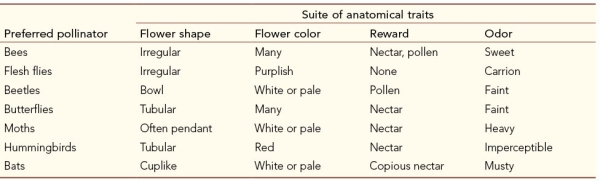
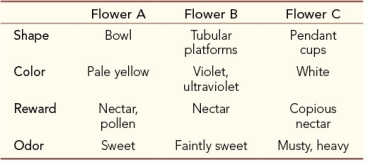 Flower B is most likely to attract
 (Multiple Choice)
4.9/5 (83)
(83) The South American tree sloth feeds on leaves and buds, which are digested by bacteria that inhabit the sloth's stomach.It is difficult for predators to see the sloth in a tree, because it is tinted green from the cyanobacteria that live in its fur.A variety of nonbiting insects also live in the fur but appear not to affect the sloth.This suggests that the sloth has mutualistic interactions with which two sets of organisms?
(Multiple Choice)
4.7/5 (82)
(82) As their name suggests, stick insects ("walking sticks") strongly resemble sticks or twigs, which their predators consider inedible.The term for this method of avoiding detection by predators is _______.
(Short Answer)
4.9/5 (84)
(84) Which type of organisms would be most likely to evolve adaptations that would enable them to grasp onto and maintain a tight grip on their hosts?
(Multiple Choice)
4.8/5 (76)
(76) 
Filters
- Essay(0)
- Multiple Choice(0)
- Short Answer(0)
- True False(0)
- Matching(0)