



 Chat with AI
Exam 55: Species Interactions

Exam 1: Studying Life246 Questions
Exam 2: Small Molecules and the Chemistry of Life246 Questions
Exam 3: Proteins, Carbohydrates, and Lipids246 Questions
Exam 4: Nucleic Acids and the Origin of Life246 Questions
Exam 5: Cells: the Working Units of Life248 Questions
Exam 6: Cell Membranes246 Questions
Exam 7: Cell Communication and Multicellularity246 Questions
Exam 8: Energy, Enzymes, and Metabolism246 Questions
Exam 9: Pathways That Harvest Chemical Energy246 Questions
Exam 10: Photosynthesis: Energy From Sunlight242 Questions
Exam 11: The Cell Cycle and Cell Division260 Questions
Exam 12: Inheritance, Genes, and Chromosomes250 Questions
Exam 13: Dna and Its Role in Heredity257 Questions
Exam 14: From Dna to Protein: Gene Expression252 Questions
Exam 15: Gene Mutation and Molecular Medicine251 Questions
Exam 16: Regulation of Gene Expression245 Questions
Exam 17: Genomes249 Questions
Exam 18: Recombinant Dna and Biotechnology243 Questions
Exam 20: Mechanisms of Evolution243 Questions
Exam 21: Reconstructing and Using Phylogenies246 Questions
Exam 22: Speciation247 Questions
Exam 23: Evolution of Genes and Genomes252 Questions
Exam 24: The History of Life on Earth246 Questions
Exam 25: Bacteria, Archaea, and Viruses262 Questions
Exam 26: The Origin and Diversification of Eukaryotes252 Questions
Exam 27: Plants Without Seeds: From Water to Land251 Questions
Exam 28: The Evolution of Seed Plants259 Questions
Exam 29: The Evolution and Diversity of Fungi261 Questions
Exam 30: Animal Origins and the Evolution of Body Plans248 Questions
Exam 31: Protostome Animals244 Questions
Exam 32: Deuterostome Animals246 Questions
Exam 33: The Plant Body243 Questions
Exam 34: Transport in Plants248 Questions
Exam 35: Plant Nutrition247 Questions
Exam 36: Regulation of Plant Growth246 Questions
Exam 37: Reproduction in Flowering Plants247 Questions
Exam 38: Plant Responses to Environmental Challenges246 Questions
Exam 39: Physiology, Homeostasis, and Temperature Regulation258 Questions
Exam 40: Animal Hormones249 Questions
Exam 41: Immunology: Animal Defense Systems265 Questions
Exam 42: Animal Reproduction261 Questions
Exam 43: Animal Development261 Questions
Exam 44: Neurons, Glia, and Nervous Systems250 Questions
Exam 45: Sensory Systems249 Questions
Exam 46: The Mammalian Nervous System: Structure and Higher Functions254 Questions
Exam 47: Musculoskeletal Systems259 Questions
Exam 48: Gas Exchange247 Questions
Exam 49: Circulatory Systems252 Questions
Exam 50: Nutrition, Digestion, and Absorption259 Questions
Exam 51: Salt and Water Balance and Nitrogen Excretion251 Questions
Exam 52: Animal Behavior249 Questions
Exam 53: The Physical Environment and Biogeography of Life248 Questions
Exam 54: Populations259 Questions
Exam 55: Species Interactions254 Questions
Exam 56: Communities247 Questions
Exam 57: Ecosystems238 Questions
Exam 58: A Changing Biosphere222 Questions
Select questions type


Using the symbols to represent positive (+), negative (-), and neutral (0), which correctly represents interactions between species one and species two, respectively?
(Multiple Choice)
4.9/5  (81)
(81) The actions of a frugivore become part of a mutualistic interaction only when the frugivore
(Multiple Choice)
4.7/5 (81)
(81) A wild mouse population has coexisted for millions of years with Toxoplasma parasites.However, during a recent year, the mouse population was almost decimated by a Toxoplasma infection.What factor most likely explains this sudden change in the pattern of coexistence?
(Multiple Choice)
4.9/5 (77)
(77) Grasshoppers feed on many different plants and will consume all parts of the plant, while apple borers feed only on apples.This difference in feeding habits suggests that the grasshopper is a generalist herbivore, while the apple borer is a(n) _______ herbivore.
(Short Answer)
4.8/5 (74)
(74) Which of these responses to predation could best be described as Batesian mimicry?
(Multiple Choice)
4.7/5 (87)
(87) A mutualistic relationship will most likely lead to reciprocal adaptations when
(Multiple Choice)
4.9/5 (87)
(87) Some nontoxic female swallowtail butterflies resemble other butterfly species that are toxic.This phenomenon is known as
(Multiple Choice)
4.9/5 (77)
(77) Which situation is most likely to result in the process of coevolution?
(Multiple Choice)
4.9/5 (77)
(77) A Nigerian coastal forest is inhabited by five species of small primates, all competing for the same limiting resources.If one primate species becomes locally extinct because of hunting, what will happen to the niches of the remaining species?
(Multiple Choice)
4.9/5 (78)
(78) Stinging bees, stinging wasps, and nonstinging hover flies all have black-and-yellow striped abdomens.Which type(s) of mimicry are these three types of insects expressing?
(Multiple Choice)
4.9/5 (86)
(86) When two species of stickleback fish each live in separate lakes, the two species are similar in shape, size, and the features of their gill rakers.When the two species inhabit the same lake, they differ in shape, size, and the number and length of their gill rakers.These morphological changes are examples of _______.
(Short Answer)
4.8/5 (86)
(86) Which statement describes an example of interference competition?
(Multiple Choice)
5.0/5 (69)
(69) Animals that use chemicals to defend themselves against predators often advertise their toxicity using
(Multiple Choice)
4.7/5 (73)
(73) In which type of environment is a positive interaction, such as a mutualism or commensalism, least likely to be found?
(Multiple Choice)
4.9/5 (70)
(70) Detrimental effects of climate change on the U.S.Southwest include increased temperatures, drought, insect outbreaks, and declining water supplies.How would you expect the number of mutualisms and commensalisms to change in the Southwest in the coming years, as these changes become established?
(Essay)
4.8/5 (65)
(65) Refer to the graph below showing one of the results from G.F.Gause's classic competition experiment on three species of Paramecium.P.caudatum feeds on floating bacteria; P.bursaria feeds on yeast cells. 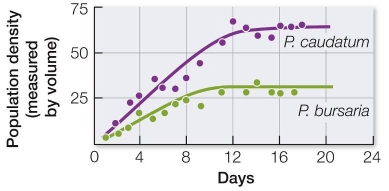 Which statement best describes the relationship between the two species?
 (Multiple Choice)
4.9/5 (84)
(84) Plant chemical defenses form an effective defense against herbivores because the chemicals
(Multiple Choice)
4.9/5 (75)
(75) The relationship between flowering plants and the caterpillars that eat them is best described as
(Multiple Choice)
4.7/5 (77)
(77) Nitrogen is absorbed by plants through their roots.It is a limiting resource, meaning that its abundance directly limits plant growth.A plant species that produces many roots can significantly reduce soil nitrogen locally, resulting in the mortality of neighboring individual plants of that species.This is an example of
(Multiple Choice)
4.9/5 (80)
(80) 
Filters
- Essay(0)
- Multiple Choice(0)
- Short Answer(0)
- True False(0)
- Matching(0)