



 Chat with AI
Exam 55: Species Interactions

Exam 1: Studying Life246 Questions
Exam 2: Small Molecules and the Chemistry of Life246 Questions
Exam 3: Proteins, Carbohydrates, and Lipids246 Questions
Exam 4: Nucleic Acids and the Origin of Life246 Questions
Exam 5: Cells: the Working Units of Life248 Questions
Exam 6: Cell Membranes246 Questions
Exam 7: Cell Communication and Multicellularity246 Questions
Exam 8: Energy, Enzymes, and Metabolism246 Questions
Exam 9: Pathways That Harvest Chemical Energy246 Questions
Exam 10: Photosynthesis: Energy From Sunlight242 Questions
Exam 11: The Cell Cycle and Cell Division260 Questions
Exam 12: Inheritance, Genes, and Chromosomes250 Questions
Exam 13: Dna and Its Role in Heredity257 Questions
Exam 14: From Dna to Protein: Gene Expression252 Questions
Exam 15: Gene Mutation and Molecular Medicine251 Questions
Exam 16: Regulation of Gene Expression245 Questions
Exam 17: Genomes249 Questions
Exam 18: Recombinant Dna and Biotechnology243 Questions
Exam 20: Mechanisms of Evolution243 Questions
Exam 21: Reconstructing and Using Phylogenies246 Questions
Exam 22: Speciation247 Questions
Exam 23: Evolution of Genes and Genomes252 Questions
Exam 24: The History of Life on Earth246 Questions
Exam 25: Bacteria, Archaea, and Viruses262 Questions
Exam 26: The Origin and Diversification of Eukaryotes252 Questions
Exam 27: Plants Without Seeds: From Water to Land251 Questions
Exam 28: The Evolution of Seed Plants259 Questions
Exam 29: The Evolution and Diversity of Fungi261 Questions
Exam 30: Animal Origins and the Evolution of Body Plans248 Questions
Exam 31: Protostome Animals244 Questions
Exam 32: Deuterostome Animals246 Questions
Exam 33: The Plant Body243 Questions
Exam 34: Transport in Plants248 Questions
Exam 35: Plant Nutrition247 Questions
Exam 36: Regulation of Plant Growth246 Questions
Exam 37: Reproduction in Flowering Plants247 Questions
Exam 38: Plant Responses to Environmental Challenges246 Questions
Exam 39: Physiology, Homeostasis, and Temperature Regulation258 Questions
Exam 40: Animal Hormones249 Questions
Exam 41: Immunology: Animal Defense Systems265 Questions
Exam 42: Animal Reproduction261 Questions
Exam 43: Animal Development261 Questions
Exam 44: Neurons, Glia, and Nervous Systems250 Questions
Exam 45: Sensory Systems249 Questions
Exam 46: The Mammalian Nervous System: Structure and Higher Functions254 Questions
Exam 47: Musculoskeletal Systems259 Questions
Exam 48: Gas Exchange247 Questions
Exam 49: Circulatory Systems252 Questions
Exam 50: Nutrition, Digestion, and Absorption259 Questions
Exam 51: Salt and Water Balance and Nitrogen Excretion251 Questions
Exam 52: Animal Behavior249 Questions
Exam 53: The Physical Environment and Biogeography of Life248 Questions
Exam 54: Populations259 Questions
Exam 55: Species Interactions254 Questions
Exam 56: Communities247 Questions
Exam 57: Ecosystems238 Questions
Exam 58: A Changing Biosphere222 Questions
Select questions type


Which of these interactions does not represent a typical parasite-host interaction?
(Multiple Choice)
4.9/5  (85)
(85) Although lichens look like single organisms, they are actually an association between a fungus and a photosynthetic partner, usually an alga.The lichen association is considered mutualistic, but the relationship also shows some features of parasitism.Which fact about lichens suggests parasitism rather than mutualism?
(Multiple Choice)
4.8/5 (75)
(75) Which type of interaction would be least likely to lead to coevolution of the interacting species?
(Multiple Choice)
4.9/5 (76)
(76) The protist that causes malaria and the various viruses that cause influenza are examples of microparasites that are also _______.
(Short Answer)
5.0/5 (90)
(90) Adult monarch butterflies contain glycosides that are toxic to predators.The glycosides originate from
(Multiple Choice)
4.7/5 (82)
(82) Sap-sucking insects called aphids often occur on alder trees.The aphids excrete sugary honeydew, which is eaten by ants.In turn, the ants protect the aphids from other insects.The aphids and alder trees have a _______ relationship; the aphids and ants have a _______ relationship.
(Multiple Choice)
4.8/5 (82)
(82) The spines of a cactus and the deadly chemicals produced by the foxglove are examples of plant defenses against _______.
(Short Answer)
4.7/5 (90)
(90) If a predator species were incapable of learning, which of the following would be the least adaptive for its prey?
(Multiple Choice)
4.9/5 (72)
(72) The type of interaction in which one partner is harmed but there is no effect on the other is called _______.
(Short Answer)
4.7/5 (84)
(84) Termites live on cellulose from dead wood.They depend on protists in their guts to provide enzymes that can digest wood.Protists would die outside the termites, and the termites would starve without the protists to aid in digestion.This is an example of
(Multiple Choice)
4.9/5 (82)
(82) Which factor would not be a benefit to members of a mutualism in a stressful environment?
(Multiple Choice)
4.8/5 (77)
(77) Refer to the table showing major types of interactions between species and the positive or negative influences of each interaction type. 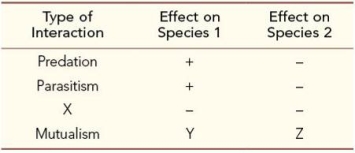 What symbols should replace the "Y" and "Z," respectively, in the table?
 (Multiple Choice)
4.8/5 (75)
(75) Refer to the figures showing results of laboratory experiments that grew two species of Paramecium together. 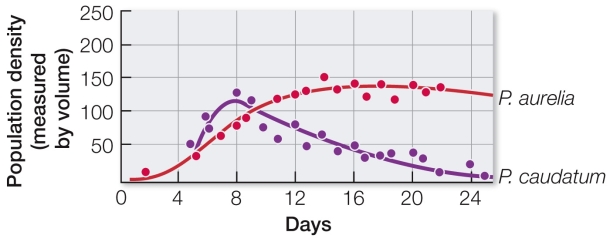
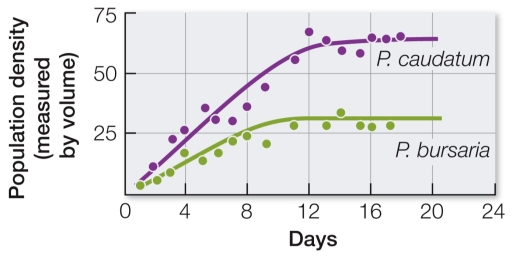 Explain the difference in the two graphs.That is, how is the interaction between P.aurelia and P.caudatum different from the interaction between P.caudatum and P.bursaria?
 (Essay)
4.9/5 (85)
(85) In New Zealand, mistletoes grow on beech tree hosts, receiving water and nutrients from the trees without harming them.Mistletoes, in turn, provide nectar and fruit to bellbirds.What benefits, if any, do bellbirds most likely provide to mistletoes?
(Multiple Choice)
4.8/5 (75)
(75) A bird eats cherry seeds but does not digest the seeds.It excretes the seeds at some distance from the cherry tree, where they then germinate.This type of interaction is _______.
(Short Answer)
4.9/5 (94)
(94) Refer to the table showing major types of interactions between species and the positive or negative influences of each interaction type. 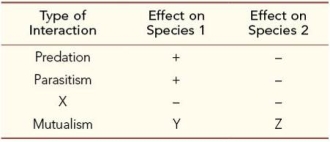 What type of interaction is represented by the "X" in the table?
 (Multiple Choice)
4.9/5 (78)
(78) Which interaction does not cause a species' realized niche to be more restricted than its fundamental niche?
(Multiple Choice)
4.9/5 (85)
(85) Which relationship has negative consequences for both species involved?
(Multiple Choice)
4.9/5 (75)
(75) The microscopic roundworm Caenorhabditis elegans is a host for the pathogenic bacterium Serratia marcescens.Researchers genetically manipulated the mating system of C.elegans, producing populations that mated either sexually or asexually (by self-fertilization).When exposed to the S.marcescens parasite, self-fertilizing populations of C.elegans rapidly became extinct.Sexually reproducing populations survived.This suggests that, to maintain healthy populations, C.elegans requires
(Multiple Choice)
4.8/5 (74)
(74) 
Filters
- Essay(0)
- Multiple Choice(0)
- Short Answer(0)
- True False(0)
- Matching(0)