



 Chat with AI
Exam 55: Species Interactions

Exam 1: Studying Life246 Questions
Exam 2: Small Molecules and the Chemistry of Life246 Questions
Exam 3: Proteins, Carbohydrates, and Lipids246 Questions
Exam 4: Nucleic Acids and the Origin of Life246 Questions
Exam 5: Cells: the Working Units of Life248 Questions
Exam 6: Cell Membranes246 Questions
Exam 7: Cell Communication and Multicellularity246 Questions
Exam 8: Energy, Enzymes, and Metabolism246 Questions
Exam 9: Pathways That Harvest Chemical Energy246 Questions
Exam 10: Photosynthesis: Energy From Sunlight242 Questions
Exam 11: The Cell Cycle and Cell Division260 Questions
Exam 12: Inheritance, Genes, and Chromosomes250 Questions
Exam 13: Dna and Its Role in Heredity257 Questions
Exam 14: From Dna to Protein: Gene Expression252 Questions
Exam 15: Gene Mutation and Molecular Medicine251 Questions
Exam 16: Regulation of Gene Expression245 Questions
Exam 17: Genomes249 Questions
Exam 18: Recombinant Dna and Biotechnology243 Questions
Exam 20: Mechanisms of Evolution243 Questions
Exam 21: Reconstructing and Using Phylogenies246 Questions
Exam 22: Speciation247 Questions
Exam 23: Evolution of Genes and Genomes252 Questions
Exam 24: The History of Life on Earth246 Questions
Exam 25: Bacteria, Archaea, and Viruses262 Questions
Exam 26: The Origin and Diversification of Eukaryotes252 Questions
Exam 27: Plants Without Seeds: From Water to Land251 Questions
Exam 28: The Evolution of Seed Plants259 Questions
Exam 29: The Evolution and Diversity of Fungi261 Questions
Exam 30: Animal Origins and the Evolution of Body Plans248 Questions
Exam 31: Protostome Animals244 Questions
Exam 32: Deuterostome Animals246 Questions
Exam 33: The Plant Body243 Questions
Exam 34: Transport in Plants248 Questions
Exam 35: Plant Nutrition247 Questions
Exam 36: Regulation of Plant Growth246 Questions
Exam 37: Reproduction in Flowering Plants247 Questions
Exam 38: Plant Responses to Environmental Challenges246 Questions
Exam 39: Physiology, Homeostasis, and Temperature Regulation258 Questions
Exam 40: Animal Hormones249 Questions
Exam 41: Immunology: Animal Defense Systems265 Questions
Exam 42: Animal Reproduction261 Questions
Exam 43: Animal Development261 Questions
Exam 44: Neurons, Glia, and Nervous Systems250 Questions
Exam 45: Sensory Systems249 Questions
Exam 46: The Mammalian Nervous System: Structure and Higher Functions254 Questions
Exam 47: Musculoskeletal Systems259 Questions
Exam 48: Gas Exchange247 Questions
Exam 49: Circulatory Systems252 Questions
Exam 50: Nutrition, Digestion, and Absorption259 Questions
Exam 51: Salt and Water Balance and Nitrogen Excretion251 Questions
Exam 52: Animal Behavior249 Questions
Exam 53: The Physical Environment and Biogeography of Life248 Questions
Exam 54: Populations259 Questions
Exam 55: Species Interactions254 Questions
Exam 56: Communities247 Questions
Exam 57: Ecosystems238 Questions
Exam 58: A Changing Biosphere222 Questions
Select questions type


Refer to the tables below.The first shows the types of flowers preferred by various pollinators.The second shows the characteristics of three different flowers.Some flowers attract only one kind of pollinator; others have characteristics that attract more than one. 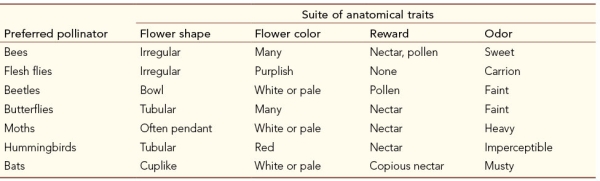
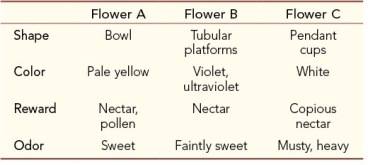 Flower A is most likely to attract
 (Multiple Choice)
4.9/5  (69)
(69) Oxpeckers, birds that ride on the backs of grazing mammals, have long been thought to provide benefits to African mammal hosts because they remove and feed on ticks (parasites that embed themselves in the skin of the grazers).However, an experimental study in 2000 suggested that the oxpeckers actually drink the blood from the mammals, with the result that the wounds heal less quickly than if the tick were simply removed.This suggests that oxpeckers may in fact be
(Multiple Choice)
4.9/5 (84)
(84) In pollination, which characteristic of the plant being pollinated is necessary to attract all pollinators?
(Multiple Choice)
4.9/5 (78)
(78) Eastern tent caterpillars are social nesters that spin weblike nests, or tents, to which they keep adding layers as they molt and grow.The caterpillars leave the tent several times each day to feed on the leaves of their host tree.The large, conspicuous caterpillar tents attract some predators and provide protection from others.Based on features of the tents, which animal would be most able to attack caterpillars inside their tents?
(Multiple Choice)
4.8/5 (85)
(85) Refer to the graph below showing the average number of parasite species per host, separated by host types. 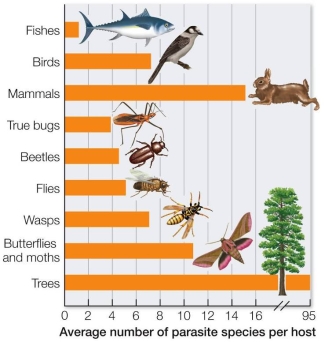 Which factor most likely accounts for the great specialization of parasites on trees, as compared with the various animal groups?
 (Multiple Choice)
4.8/5 (93)
(93) Many species of algae, seaweed, and sea grasses live on and around coral reefs.Herbivores, including most fish, sea urchins, and gastropods (snails and sea slugs), graze on them.In this environment, are herbivores more likely to be generalists or specialists?
(Multiple Choice)
4.9/5 (86)
(86) Two species of lionfish have recently invaded the Caribbean, the Gulf of Mexico, and the Western Atlantic region.Comparing these predatory fishes with their native competitors, the activity of the lionfish could best be classified as
(Multiple Choice)
4.8/5 (89)
(89) Scarlet gilia, a common Rocky Mountain wildflower, produces red flowers early in the season and transitions to producing white flowers late in the season.Pollination by hummingbirds is replaced by pollination by moths.This adaptation would most likely benefit the pollination interaction because it would
(Multiple Choice)
4.7/5 (81)
(81) All of these mechanisms are examples of a plant defense against herbivory except
(Multiple Choice)
4.8/5 (96)
(96) Both the great biochemical diversity of flowering plants and the tremendous diversity of herbivorous insects can be explained by their _______ adaptations.
(Short Answer)
4.8/5 (89)
(89) Leafcutter ants cut large amounts of leaf material and carry it back to their nests, where they use it in "fungal gardens" to feed and grow a fungus.The fungus depends on the ants for its food and is also the primary food for the ants, themselves.This interaction between ants and fungi is best described as
(Multiple Choice)
4.8/5 (68)
(68) A frugivore can be said to be acting as a successful mutualist with a plant if it
(Multiple Choice)
4.9/5 (69)
(69) Nitrogen is an essential nutrient for plant growth, but it must be available in a form plants can use.They can use ammonia (NH3), but not atmospheric nitrogen gas (N2).Legumes such as peas and beans have nodules on their roots that contain Rhizobium, a nitrogen-fixing bacterium that can trap N2 and transform it into NH3.Suppose two similar fields are planted, one with corn alone, and one with corn and soybeans combined.How would the growth of corn alone be likely to compare with the growth of corn combined with soybeans?
(Multiple Choice)
4.8/5 (73)
(73) If two organisms use the same resources, and those resources are insufficient to supply their combined needs, the organisms' interactions constitute
(Multiple Choice)
4.8/5 (80)
(80) 
Filters
- Essay(0)
- Multiple Choice(0)
- Short Answer(0)
- True False(0)
- Matching(0)