



 Chat with AI
Exam 55: Species Interactions

Exam 1: Studying Life246 Questions
Exam 2: Small Molecules and the Chemistry of Life246 Questions
Exam 3: Proteins, Carbohydrates, and Lipids246 Questions
Exam 4: Nucleic Acids and the Origin of Life246 Questions
Exam 5: Cells: the Working Units of Life248 Questions
Exam 6: Cell Membranes246 Questions
Exam 7: Cell Communication and Multicellularity246 Questions
Exam 8: Energy, Enzymes, and Metabolism246 Questions
Exam 9: Pathways That Harvest Chemical Energy246 Questions
Exam 10: Photosynthesis: Energy From Sunlight242 Questions
Exam 11: The Cell Cycle and Cell Division260 Questions
Exam 12: Inheritance, Genes, and Chromosomes250 Questions
Exam 13: Dna and Its Role in Heredity257 Questions
Exam 14: From Dna to Protein: Gene Expression252 Questions
Exam 15: Gene Mutation and Molecular Medicine251 Questions
Exam 16: Regulation of Gene Expression245 Questions
Exam 17: Genomes249 Questions
Exam 18: Recombinant Dna and Biotechnology243 Questions
Exam 20: Mechanisms of Evolution243 Questions
Exam 21: Reconstructing and Using Phylogenies246 Questions
Exam 22: Speciation247 Questions
Exam 23: Evolution of Genes and Genomes252 Questions
Exam 24: The History of Life on Earth246 Questions
Exam 25: Bacteria, Archaea, and Viruses262 Questions
Exam 26: The Origin and Diversification of Eukaryotes252 Questions
Exam 27: Plants Without Seeds: From Water to Land251 Questions
Exam 28: The Evolution of Seed Plants259 Questions
Exam 29: The Evolution and Diversity of Fungi261 Questions
Exam 30: Animal Origins and the Evolution of Body Plans248 Questions
Exam 31: Protostome Animals244 Questions
Exam 32: Deuterostome Animals246 Questions
Exam 33: The Plant Body243 Questions
Exam 34: Transport in Plants248 Questions
Exam 35: Plant Nutrition247 Questions
Exam 36: Regulation of Plant Growth246 Questions
Exam 37: Reproduction in Flowering Plants247 Questions
Exam 38: Plant Responses to Environmental Challenges246 Questions
Exam 39: Physiology, Homeostasis, and Temperature Regulation258 Questions
Exam 40: Animal Hormones249 Questions
Exam 41: Immunology: Animal Defense Systems265 Questions
Exam 42: Animal Reproduction261 Questions
Exam 43: Animal Development261 Questions
Exam 44: Neurons, Glia, and Nervous Systems250 Questions
Exam 45: Sensory Systems249 Questions
Exam 46: The Mammalian Nervous System: Structure and Higher Functions254 Questions
Exam 47: Musculoskeletal Systems259 Questions
Exam 48: Gas Exchange247 Questions
Exam 49: Circulatory Systems252 Questions
Exam 50: Nutrition, Digestion, and Absorption259 Questions
Exam 51: Salt and Water Balance and Nitrogen Excretion251 Questions
Exam 52: Animal Behavior249 Questions
Exam 53: The Physical Environment and Biogeography of Life248 Questions
Exam 54: Populations259 Questions
Exam 55: Species Interactions254 Questions
Exam 56: Communities247 Questions
Exam 57: Ecosystems238 Questions
Exam 58: A Changing Biosphere222 Questions
Select questions type


At first, a dog walks away from its bed whenever the new cat approaches.The cat then stretches out on the bed by itself.This is an example of _______.After a few weeks, the dog stays on the bed and curls up tighter, and the cat curls up in the unused part of the bed.This is an example of _______.
(Multiple Choice)
4.8/5  (77)
(77) In the coral reef environment, the ivory bush coral competes for space with surrounding seaweed.The red-ridged clinging crab feeds on seaweed but is also preyed on by surrounding fish.The crab hides in the coral branches and feeds only on the seaweed closest to the coral.Would the crab-coral interaction be best classified as mutualism or commensalism?
(Multiple Choice)
4.9/5 (72)
(72) In nature, predator-prey cycles can continue for many years.In laboratory cultures, both populations quickly die off unless new individuals are periodically introduced (i.e., immigration occurs).Based on this information, cycles in nature might be maintained by any of these factors (or some combination of them) except
(Multiple Choice)
4.8/5 (78)
(78) Which feature of head lice is least likely to be an adaptation for their lifestyle as ectoparasites on humans?
(Multiple Choice)
5.0/5 (76)
(76) Many animals, particularly insects, have a strong mutualism with flowering plants.The animal benefits by receiving food (pollen or nectar), while the plant benefits from _______.
(Short Answer)
4.8/5 (70)
(70) Some bats use sonar to detect and catch their prey.Some species of moth have developed the behavior of diving down to avoid being caught.Bats, in turn, have responded by learning to catch moths over water because the moths get stuck on the water surface if they try to get away.This is an example of
(Multiple Choice)
4.7/5 (73)
(73) Which type of organism is most likely to kill the organism it feeds on?
(Multiple Choice)
4.7/5 (68)
(68) Climate change leads to much drier climates in some areas.Over time, some plant species will likely show genetic changes related to their ability to withstand drought.In this situation, the precipitation level is acting as
(Multiple Choice)
4.9/5 (82)
(82) In the rain forest, many plants are prevented from growing on the forest floor because sunlight does not reach to the ground.For these plants, sunlight is a _______.
(Short Answer)
4.7/5 (71)
(71) All of these factors would contribute to making microparasites efficient pathogens except
(Multiple Choice)
4.9/5 (68)
(68) Suppose the fecal matter from dogs helps fertilize a species of grass, thus increasing the grass's ability to grow in a particular area.The relationship between the dogs and the grass would be described as
(Multiple Choice)
4.9/5 (72)
(72) When you eat a seedless navel orange, your interaction with the orange best fits into the category of
(Multiple Choice)
4.9/5 (74)
(74) In a classroom full of hungry students, there is a bowl of grapes.One of the students grabs the whole bowl and won't let the other students have any.This is a form of resource competition known as _______.
(Short Answer)
4.8/5 (75)
(75) An insect and a flower have a highly specific pollination interaction; that is, the two species depend closely on each other.The insect feeds almost exclusively on nectar and pollen from this flower, and the flower is only pollinated by this insect species or its close relatives.A severe and long-lasting drought greatly depletes the population of this flower species.What will most likely happen to the population of the insect species?
(Multiple Choice)
5.0/5 (85)
(85) In the antacacia studies by Thomas Belt and Daniel Janzen, how does the relationship between ants and acacias affect the population of acacia trees?
(Multiple Choice)
4.9/5 (82)
(82) A robin is feeding at a bird feeder.A second robin arrives, and the first robin chases the second one away.While the first robin is distracted by the chase, a blue jay arrives at the feeder and starts feeding.The interaction between the first and second robins is _______ competition, and that between the blue jay and the first robin is _______ competition.
(Multiple Choice)
4.9/5 (77)
(77) Orchids, a type of plant, require tree limbs for support but do not harm the trees.This interaction demonstrates
(Multiple Choice)
4.8/5 (82)
(82) In pregnant women, the Zika virus causes serious birth defects.It is spread by the bite of the Aedes aegypti mosquito, which contracts it from an infected human.It must replicate and spread within the mosquito before it can infect a human.Infected humans can spread the virus through sex and from mother to unborn child.In this relationship, how can the Zika virus be characterized?
(Multiple Choice)
4.8/5 (81)
(81) Refer to the table below showing the results of a greenhouse experiment.Sunflowers and corn plants are grown in 6-inch pots in treatments of varying plant densities and plant combinations.There are ten pots per treatment.All pots contain the same amount of potting soil and receive the same amount of water and sunlight.After 2 months, the heights of the plants in each pot are measured and averaged. 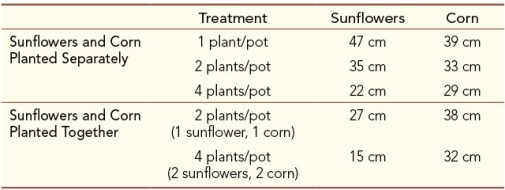 Describe the effects of intraspecific competition in the two species.
 (Essay)
4.8/5 (85)
(85) 
Filters
- Essay(0)
- Multiple Choice(0)
- Short Answer(0)
- True False(0)
- Matching(0)