



 Chat with AI
Exam 55: Species Interactions

Exam 1: Studying Life246 Questions
Exam 2: Small Molecules and the Chemistry of Life246 Questions
Exam 3: Proteins, Carbohydrates, and Lipids246 Questions
Exam 4: Nucleic Acids and the Origin of Life246 Questions
Exam 5: Cells: the Working Units of Life248 Questions
Exam 6: Cell Membranes246 Questions
Exam 7: Cell Communication and Multicellularity246 Questions
Exam 8: Energy, Enzymes, and Metabolism246 Questions
Exam 9: Pathways That Harvest Chemical Energy246 Questions
Exam 10: Photosynthesis: Energy From Sunlight242 Questions
Exam 11: The Cell Cycle and Cell Division260 Questions
Exam 12: Inheritance, Genes, and Chromosomes250 Questions
Exam 13: Dna and Its Role in Heredity257 Questions
Exam 14: From Dna to Protein: Gene Expression252 Questions
Exam 15: Gene Mutation and Molecular Medicine251 Questions
Exam 16: Regulation of Gene Expression245 Questions
Exam 17: Genomes249 Questions
Exam 18: Recombinant Dna and Biotechnology243 Questions
Exam 20: Mechanisms of Evolution243 Questions
Exam 21: Reconstructing and Using Phylogenies246 Questions
Exam 22: Speciation247 Questions
Exam 23: Evolution of Genes and Genomes252 Questions
Exam 24: The History of Life on Earth246 Questions
Exam 25: Bacteria, Archaea, and Viruses262 Questions
Exam 26: The Origin and Diversification of Eukaryotes252 Questions
Exam 27: Plants Without Seeds: From Water to Land251 Questions
Exam 28: The Evolution of Seed Plants259 Questions
Exam 29: The Evolution and Diversity of Fungi261 Questions
Exam 30: Animal Origins and the Evolution of Body Plans248 Questions
Exam 31: Protostome Animals244 Questions
Exam 32: Deuterostome Animals246 Questions
Exam 33: The Plant Body243 Questions
Exam 34: Transport in Plants248 Questions
Exam 35: Plant Nutrition247 Questions
Exam 36: Regulation of Plant Growth246 Questions
Exam 37: Reproduction in Flowering Plants247 Questions
Exam 38: Plant Responses to Environmental Challenges246 Questions
Exam 39: Physiology, Homeostasis, and Temperature Regulation258 Questions
Exam 40: Animal Hormones249 Questions
Exam 41: Immunology: Animal Defense Systems265 Questions
Exam 42: Animal Reproduction261 Questions
Exam 43: Animal Development261 Questions
Exam 44: Neurons, Glia, and Nervous Systems250 Questions
Exam 45: Sensory Systems249 Questions
Exam 46: The Mammalian Nervous System: Structure and Higher Functions254 Questions
Exam 47: Musculoskeletal Systems259 Questions
Exam 48: Gas Exchange247 Questions
Exam 49: Circulatory Systems252 Questions
Exam 50: Nutrition, Digestion, and Absorption259 Questions
Exam 51: Salt and Water Balance and Nitrogen Excretion251 Questions
Exam 52: Animal Behavior249 Questions
Exam 53: The Physical Environment and Biogeography of Life248 Questions
Exam 54: Populations259 Questions
Exam 55: Species Interactions254 Questions
Exam 56: Communities247 Questions
Exam 57: Ecosystems238 Questions
Exam 58: A Changing Biosphere222 Questions
Select questions type


Hyenas can obtain as much as three-fourths of their prey by hunting, but they also scavenge the kills of other carnivores.A group of hyenas can displace any carnivore except lions from a kill.Which characteristic would be most useful to hyenas in both hunting their own prey and scavenging kills from other predators?
(Multiple Choice)
4.7/5  (85)
(85) In many areas of the Rocky Mountains, both squirrel and bird species extract and eat the pine seeds from cones of lodgepole pines.In a few areas, however, birds called red crossbills are the only consumers of the pine seeds.Where this one-on-one relationship occurs, both the birds and the pine trees have changed over generations.The crossbills have developed deeper, shorter, and straighter bills that are more efficient at extracting pine seeds, and the pines have developed larger, thicker scales on the cones that defend the seeds from extraction.This bird-tree interaction is an example of _______ due to _______.
(Multiple Choice)
4.9/5 (79)
(79) At some water bird breeding colonies, the large quantities of excrement from the birds may result in the death of vegetation underneath the trees in which their nests are built.Which characteristic of the bird population would have the greatest effect on the amount of damage caused to the understory plants?
(Multiple Choice)
4.9/5 (83)
(83) Most trees are dispersed by means of frugivores.If frugivore populations in an area declined because of disease, what would most likely happen to the tree species previously dispersed in this way?
(Multiple Choice)
4.9/5 (81)
(81) In what way did the sea star, Pisaster ochraceus, act as a keystone species in the Robert Paine study of rocky shore communities in the Pacific Northwest?
(Multiple Choice)
4.9/5 (76)
(76) Termites live on cellulose, mostly derived from the dead wood they chew.Protists in the gut provide enzymes that allow digestion of the wood.The termite gut provides a habitat for the protists.Classify this interaction in terms of the direction of its effect on both species.
(Multiple Choice)
4.9/5 (89)
(89) Suggest conditions under which an animal might respond to competition by becoming a fugitive species.
(Short Answer)
4.9/5 (74)
(74) The yucca and the yucca moth have an exclusive plant‒pollinator relationship.Which would represent a cost, rather than a benefit, of this relationship?
(Multiple Choice)
4.8/5 (74)
(74) An herbivorous insect feeds on a plant, which produces a toxic chemical to protect itself.The insect develops a resistance to the chemical and continues to feed on the plant.The two species are undergoing _______.
(Short Answer)
4.8/5 (82)
(82) According to studies, when ant colonies are removed from acacia trees, the acacias show decreased growth and increased mortality, due to repeated removal of their growing tips by herbivores.This suggests that the primary benefit that acacia trees receive from their association with ants is
(Multiple Choice)
4.7/5 (85)
(85) When a soccer player guards her opponent and prevents her from receiving the ball, this is an example of _______ competition.When players from both teams rush toward a loose ball and the fastest player gains control of the ball, this is an example of _______ competition.
(Multiple Choice)
4.8/5 (93)
(93) The three species of bees that feed on the shin dagger agave in the American Southwest can be said to exhibit competitive coexistence because they
(Multiple Choice)
4.8/5 (82)
(82) When a parasite first invades a host, it may be very damaging, even causing the host's death.Over many generations, the host-parasite relationship may evolve so that the parasite's effect on the host is much weaker.How would this evolution most likely affect the size of the parasite population?
(Multiple Choice)
5.0/5 (69)
(69) Because they live outside their hosts, ticks are not only macroparasites but also _______.
(Short Answer)
4.8/5 (63)
(63) In the following situations, which organism would be considered a microparasite?
(Multiple Choice)
4.8/5 (72)
(72) When two populations of flour beetles, the red flour beetle and the confused flour beetle, occur together in the same bag of flour, the red flour beetle population usually increases and the confused flour beetle population dwindles to extinction.This type of outcome between species that use the same limited resource is called _______.
(Short Answer)
4.9/5 (81)
(81) You find a series of related plants with chewed leaves growing in a defined area.You determine that this is the work of an herbivore specialist that feeds on a few closely related species and removes only a small percentage of the plant tissue without killing the plant.This herbivore is most likely
(Multiple Choice)
4.8/5 (78)
(78) Refer to the graph below, showing population cycles of snowshoe hares and their predator, Canada lynx.Population numbers were collected when both populations were trapped for the fur trade. 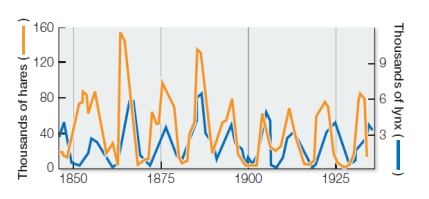 In the study of snowshoe hares and Canada lynx, this predator-prey interaction showed tightly controlled population cycles of approximately 10 years.The hares' numbers peaked, followed by peaks in lynx numbers approximately 2 to 3 years later.Assuming a cause-and-effect relationship between the two species, if lynx were removed from the community, the hare population would likely
 (Multiple Choice)
4.8/5 (81)
(81) Refer to the table below. 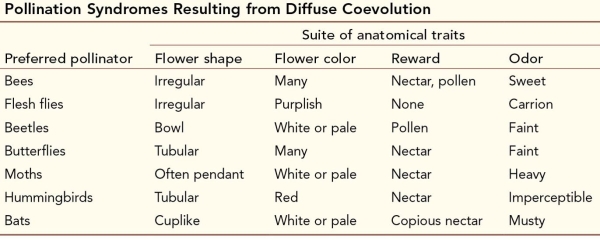 Many flowers have characteristics that are attractive to more than one type of pollinator.Which of the flower types shown would be most likely to attract both beetles and butterflies as pollinators?
 (Multiple Choice)
4.9/5 (87)
(87) 
Filters
- Essay(0)
- Multiple Choice(0)
- Short Answer(0)
- True False(0)
- Matching(0)