



 Chat with AI
Exam 55: Species Interactions

Exam 1: Studying Life246 Questions
Exam 2: Small Molecules and the Chemistry of Life246 Questions
Exam 3: Proteins, Carbohydrates, and Lipids246 Questions
Exam 4: Nucleic Acids and the Origin of Life246 Questions
Exam 5: Cells: the Working Units of Life248 Questions
Exam 6: Cell Membranes246 Questions
Exam 7: Cell Communication and Multicellularity246 Questions
Exam 8: Energy, Enzymes, and Metabolism246 Questions
Exam 9: Pathways That Harvest Chemical Energy246 Questions
Exam 10: Photosynthesis: Energy From Sunlight242 Questions
Exam 11: The Cell Cycle and Cell Division260 Questions
Exam 12: Inheritance, Genes, and Chromosomes250 Questions
Exam 13: Dna and Its Role in Heredity257 Questions
Exam 14: From Dna to Protein: Gene Expression252 Questions
Exam 15: Gene Mutation and Molecular Medicine251 Questions
Exam 16: Regulation of Gene Expression245 Questions
Exam 17: Genomes249 Questions
Exam 18: Recombinant Dna and Biotechnology243 Questions
Exam 20: Mechanisms of Evolution243 Questions
Exam 21: Reconstructing and Using Phylogenies246 Questions
Exam 22: Speciation247 Questions
Exam 23: Evolution of Genes and Genomes252 Questions
Exam 24: The History of Life on Earth246 Questions
Exam 25: Bacteria, Archaea, and Viruses262 Questions
Exam 26: The Origin and Diversification of Eukaryotes252 Questions
Exam 27: Plants Without Seeds: From Water to Land251 Questions
Exam 28: The Evolution of Seed Plants259 Questions
Exam 29: The Evolution and Diversity of Fungi261 Questions
Exam 30: Animal Origins and the Evolution of Body Plans248 Questions
Exam 31: Protostome Animals244 Questions
Exam 32: Deuterostome Animals246 Questions
Exam 33: The Plant Body243 Questions
Exam 34: Transport in Plants248 Questions
Exam 35: Plant Nutrition247 Questions
Exam 36: Regulation of Plant Growth246 Questions
Exam 37: Reproduction in Flowering Plants247 Questions
Exam 38: Plant Responses to Environmental Challenges246 Questions
Exam 39: Physiology, Homeostasis, and Temperature Regulation258 Questions
Exam 40: Animal Hormones249 Questions
Exam 41: Immunology: Animal Defense Systems265 Questions
Exam 42: Animal Reproduction261 Questions
Exam 43: Animal Development261 Questions
Exam 44: Neurons, Glia, and Nervous Systems250 Questions
Exam 45: Sensory Systems249 Questions
Exam 46: The Mammalian Nervous System: Structure and Higher Functions254 Questions
Exam 47: Musculoskeletal Systems259 Questions
Exam 48: Gas Exchange247 Questions
Exam 49: Circulatory Systems252 Questions
Exam 50: Nutrition, Digestion, and Absorption259 Questions
Exam 51: Salt and Water Balance and Nitrogen Excretion251 Questions
Exam 52: Animal Behavior249 Questions
Exam 53: The Physical Environment and Biogeography of Life248 Questions
Exam 54: Populations259 Questions
Exam 55: Species Interactions254 Questions
Exam 56: Communities247 Questions
Exam 57: Ecosystems238 Questions
Exam 58: A Changing Biosphere222 Questions
Select questions type


A fallen western hemlock becomes a "nurse log" on the forest floor, providing a raised substrate that keeps seedlings off the ground.Seedlings growing in the log survive better than those growing on the forest floor.Which of the following statements does not describe a mutualism or benefit that likely contributes to the tree seedlings' improved survival?
(Multiple Choice)
4.9/5  (83)
(83) A cow's rumen, or first stomach, provides the ideal environment for a variety of microbes.When a cow consumes grass, these microbes digest the grass, releasing nutrients, which both they and the cow use.While most of the microbes remain in the rumen, some are killed during digestion and provide additional nutrition for the cow.This complex relationship between the cow and its microbes has features of which two categories of interactions?
(Multiple Choice)
4.9/5 (75)
(75) Explain the concept of symbiosis, and give examples of both positive and negative symbioses.
(Essay)
4.9/5 (88)
(88) Two species of yeast can persist indefinitely on agar in the lab, but when they are grown together under similar conditions, only a single species remains after a few days.This interaction is an illustration of
(Multiple Choice)
4.9/5 (78)
(78) After the introduction of the American mink into Belarus, the native European mink became larger, and the American mink gradually decreased in size.These changes most likely occurred because of
(Multiple Choice)
4.8/5 (70)
(70) A species of brightly colored herbivorous insect enters a new environment.Which factor found in the new environment is most likely to lead over time to a situation involving coevolution?
(Multiple Choice)
4.9/5 (85)
(85) Anemonefish live inside sea anemones and acclimate, so they are unaffected by anemone stings.They avoid predators and may steal food brought in by the anemone's tentacles.Their feces may provide nitrogen to the anemone, but this effect is not clear.Why might this interaction be hard to classify, and what classifications might it fit into?
(Essay)
4.9/5 (80)
(80) Refer to the table below showing the results of a greenhouse experiment.Sunflowers and corn plants are grown in 6-inch pots in treatments of varying plant densities and plant combinations.There are ten pots per treatment.All pots contain the same amount of potting soil and receive the same amount of water and sunlight.After 2 months, the heights of the plants in each pot are measured and averaged. 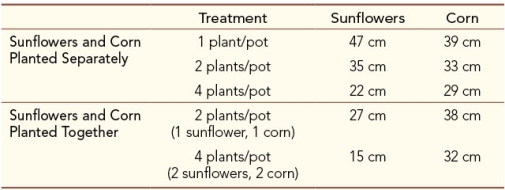 Describe the effects of interspecific competition in the two species.
 (Essay)
4.8/5 (84)
(84) Two species of beetles are herbivores on the same host plant, and the presence of either species reduces the population growth of the other.The relationship between the beetles is therefore best described as
(Multiple Choice)
4.8/5 (63)
(63) Eastern tent caterpillars are social nesters that spin weblike nests, or tents, to which they keep adding layers as they molt and grow.The caterpillars leave the tent several times each day to feed on the leaves of their host tree.Many potential predators will attack one tent caterpillar and then refrain from attacking or eating others.Two possible deterrents to predation are the stiff hairs present on caterpillars (but not pupae) and toxic cyanide compounds, which caterpillars absorb from cherry trees where they nest and feed.Researchers wish to determine whether either of these actually deters predators.Which study design would most clearly distinguish between the two possible deterrents?
(Multiple Choice)
4.8/5 (76)
(76) Which prey defense represents a chemical defense but not a warning signal?
(Multiple Choice)
4.9/5 (78)
(78) Butterfly caterpillars and adults are herbivores, and they exhibit many adaptations to this lifestyle.Which characteristic of butterflies is least likely to be an adaptation to herbivory?
(Multiple Choice)
4.9/5 (67)
(67) Refer to the graph below showing the result of sea star removal on community structure. 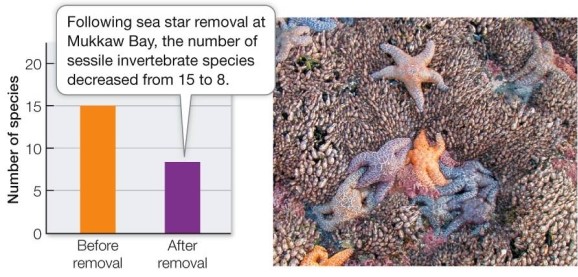 The graph suggests that the predatory sea star acts as a _______ species in this community.
 (Short Answer)
4.8/5 (75)
(75) Which statement is a correct comparison of predators and parasites?
(Multiple Choice)
5.0/5 (80)
(80) Microscopic study of the contact lens fluid of a person with an eye infection revealed a series of four nested parasites: an amoeba, which contained a giant virus, which contained a smaller virus, which contained chunks of parasitic DNA.How could these four parasites best be characterized?
(Multiple Choice)
5.0/5 (91)
(91) Caterpillars feed on plant leaves.Some plants contain compounds that, when mixed with the saliva of particular caterpillar species, create an odor that attracts parasitoid wasps.Unlike true parasites, parasitoids like these wasps kill their hosts (caterpillars), often laying their eggs within the caterpillar carcasses.The relationship between plant and wasp could be considered _______; the relationship between wasp and caterpillar is _______.
(Multiple Choice)
4.9/5 (75)
(75) A bird is infested with the bloodsucking larvae of blowflies.The blowfly larvae fall off the bird and are themselves infested with parasitic wasps.The wasps contain a parasitic bacterium, which in turn is infested with bacteriophages, or parasitic viruses.This multitiered system could be considered evidence for
(Multiple Choice)
4.9/5 (88)
(88) The geographic distributions of wolves and coyotes often do not overlap.A study of wolves and coyotes in an area where they do overlap found that the two species minimized competition by differential use of food resources.Wolves preyed primarily on elk and a few deer, whereas coyotes preyed mostly on deer and rarely on young elk.Coyotes also scavenged abandoned wolf kills.Wolf and coyote behavior illustrates which type of competition?
(Multiple Choice)
4.9/5 (79)
(79) Which feature is not an adaptation usually associated with predators?
(Multiple Choice)
4.8/5 (81)
(81) 
Filters
- Essay(0)
- Multiple Choice(0)
- Short Answer(0)
- True False(0)
- Matching(0)