



 Chat with AI
Exam 55: Species Interactions

Exam 1: Studying Life246 Questions
Exam 2: Small Molecules and the Chemistry of Life246 Questions
Exam 3: Proteins, Carbohydrates, and Lipids246 Questions
Exam 4: Nucleic Acids and the Origin of Life246 Questions
Exam 5: Cells: the Working Units of Life248 Questions
Exam 6: Cell Membranes246 Questions
Exam 7: Cell Communication and Multicellularity246 Questions
Exam 8: Energy, Enzymes, and Metabolism246 Questions
Exam 9: Pathways That Harvest Chemical Energy246 Questions
Exam 10: Photosynthesis: Energy From Sunlight242 Questions
Exam 11: The Cell Cycle and Cell Division260 Questions
Exam 12: Inheritance, Genes, and Chromosomes250 Questions
Exam 13: Dna and Its Role in Heredity257 Questions
Exam 14: From Dna to Protein: Gene Expression252 Questions
Exam 15: Gene Mutation and Molecular Medicine251 Questions
Exam 16: Regulation of Gene Expression245 Questions
Exam 17: Genomes249 Questions
Exam 18: Recombinant Dna and Biotechnology243 Questions
Exam 20: Mechanisms of Evolution243 Questions
Exam 21: Reconstructing and Using Phylogenies246 Questions
Exam 22: Speciation247 Questions
Exam 23: Evolution of Genes and Genomes252 Questions
Exam 24: The History of Life on Earth246 Questions
Exam 25: Bacteria, Archaea, and Viruses262 Questions
Exam 26: The Origin and Diversification of Eukaryotes252 Questions
Exam 27: Plants Without Seeds: From Water to Land251 Questions
Exam 28: The Evolution of Seed Plants259 Questions
Exam 29: The Evolution and Diversity of Fungi261 Questions
Exam 30: Animal Origins and the Evolution of Body Plans248 Questions
Exam 31: Protostome Animals244 Questions
Exam 32: Deuterostome Animals246 Questions
Exam 33: The Plant Body243 Questions
Exam 34: Transport in Plants248 Questions
Exam 35: Plant Nutrition247 Questions
Exam 36: Regulation of Plant Growth246 Questions
Exam 37: Reproduction in Flowering Plants247 Questions
Exam 38: Plant Responses to Environmental Challenges246 Questions
Exam 39: Physiology, Homeostasis, and Temperature Regulation258 Questions
Exam 40: Animal Hormones249 Questions
Exam 41: Immunology: Animal Defense Systems265 Questions
Exam 42: Animal Reproduction261 Questions
Exam 43: Animal Development261 Questions
Exam 44: Neurons, Glia, and Nervous Systems250 Questions
Exam 45: Sensory Systems249 Questions
Exam 46: The Mammalian Nervous System: Structure and Higher Functions254 Questions
Exam 47: Musculoskeletal Systems259 Questions
Exam 48: Gas Exchange247 Questions
Exam 49: Circulatory Systems252 Questions
Exam 50: Nutrition, Digestion, and Absorption259 Questions
Exam 51: Salt and Water Balance and Nitrogen Excretion251 Questions
Exam 52: Animal Behavior249 Questions
Exam 53: The Physical Environment and Biogeography of Life248 Questions
Exam 54: Populations259 Questions
Exam 55: Species Interactions254 Questions
Exam 56: Communities247 Questions
Exam 57: Ecosystems238 Questions
Exam 58: A Changing Biosphere222 Questions
Select questions type


At a swim meet, all the swimmers in a race want to place first, but only the fastest swimmer can do so.The is an example of
(Multiple Choice)
4.7/5  (92)
(92) Which prey animal is using a morphological form of defense against predators?
(Multiple Choice)
4.8/5 (85)
(85) Two snake species move into a new habitat.Both feed predominantly on crickets and grasshoppers.One species is able to feed both day and night, while the other is strictly diurnal.Over time, one of the species becomes locally extinct.This form of competition is known as _______.
(Short Answer)
4.7/5 (76)
(76) African wild dogs avoid competition with lions by living in areas lions are unlikely to inhabit.A species might also be a fugitive species if it
(Multiple Choice)
4.7/5 (88)
(88) The Rhode Island salt marsh experiments on the rush Juncus gerardii and the shrub Iva frutescens showed that Iva dominates and Juncus has a low biomass in the high intertidal zone.However, in the low intertidal, where salinity and waterlogging are greater, Iva depends on Juncus for survival.Which general statement best describes the cause of the change in this relationship?
(Multiple Choice)
4.7/5 (94)
(94) Which relationship is least likely to result in coevolution?
(Multiple Choice)
4.8/5 (88)
(88) Many relatively large ectoparasites, such as leeches and mosquitoes, are only casually associated with their hosts; that is, they feed and then leave.However, whale lice spend their entire lives on one whale.A difference in _______ has most likely caused the evolution of this difference in ectoparasite life style.
(Multiple Choice)
4.9/5 (74)
(74) In coral reefs, the cells of the cylindrical coral polyp contain single-celled photosynthetic algae, or zooxanthellae.Coral polyps filter organic material from water and metabolize it, forming carbon dioxide and nitrogenous wastes that zooxanthellae use in photosynthesis.The oxygen and sugars they form in turn are used by coral polyps and dinoflagellates for metabolism.Many corals cannot feed successfully when they lose their zooxanthellae, but zooxanthellae can usually grow and reproduce outside of the corals.For zooxanthellae, this interaction is _______; for corals, it is _______.
(Multiple Choice)
4.9/5 (73)
(73) The interaction of the ant and the acacia tree, in which the ant builds nests in the acacia's thorns and feeds on its nectar while also defending the acacia from herbivores, is most likely a product of
(Multiple Choice)
4.8/5 (74)
(74) The desert-dwelling yucca moth lays its eggs in the blossoms of the yucca plant and yucca seeds provide food for its larvae.The yucca plant depends on this moth for pollination.The two organisms are completely dependent on each other.In Great Britain, there are no yucca moths, and the yucca flowers produce no seeds.This highly specialized interaction likely evolved only in the desert environment because the two species
(Multiple Choice)
4.7/5 (73)
(73) While pursuing its prey, a bear destroys a shrub.The relationship between the bear and the shrub would be described as
(Multiple Choice)
4.9/5 (72)
(72) In Paine's classic study of sea star predation on mussel populations, he showed that in the absence of sea stars, experimental plots lost approximately half of the sessile invertebrate species usually present.This result suggests that
(Multiple Choice)
4.8/5 (79)
(79) An "active pursuit" predator, such as a cheetah, is adapted to catching prey by having excellent eyesight and being extremely fast.The most effective type of defense a prey animal might use to avoid capture by this predator is likely
(Multiple Choice)
4.8/5 (81)
(81) Two species of barnacles, stellate and rock barnacles, occupy the rocky intertidal zone of the Scottish coast and illustrate factors that can determine species distribution in a community.Larvae of both species settle throughout the intertidal zone, but adult barnacles occupy specific zones.The smaller stellate barnacle lives only in higher zones, where the environment dries out between high tides.The larger, faster-reproducing rock barnacle lives only at lower zones.If rock barnacles were entirely removed from this community, what would most likely happen to the population of stellate barnacles?
(Multiple Choice)
4.9/5 (78)
(78) Cheetahs are active-pursuit predators; they capture prey by chasing them down.Leopards, in contrast, are stealth or ambush predators; they watch their prey from a concealed location, and when the prey gets close, they execute a rapid surprise attack.What differences in body type, physiology, or behavior would you expect these two types of predators to have?
(Essay)
4.8/5 (80)
(80) Photosynthetic single-celled dinoflagellates, called zooxanthellae, live within coral polyps.Zooxanthellae use CO2 and nitrogenous wastes from the polyps to form oxygen and sugars, which in turn are used by both polyps and zooxanthellae for metabolism.As water temperatures warm, polyps eject their zooxanthellae, causing the coral to turn a bleached white.Corals slowly starve without zooxanthellae.As climate change causes warmer waters, we may expect to see a(n) _______ in corals as the number of zooxanthellae _______.
(Multiple Choice)
4.7/5 (78)
(78) In a mutualistic interaction between a sessile species and a motile species, the sessile partner often receives benefits that are only available because of the motile species.In a pollination interaction, the plant would be least likely to receive which benefit as a result of the interaction?
(Multiple Choice)
4.9/5 (79)
(79) Refer to the graph below, showing population cycles of snowshoe hares and their predator, Canada lynx.Population numbers were collected when both populations were trapped for the fur trade. 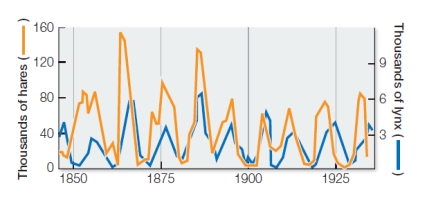 Assuming minimal variations in environment over the period of the study, which statement best represents the interaction of the hare and lynx?
 (Multiple Choice)
4.8/5 (71)
(71) 
Filters
- Essay(0)
- Multiple Choice(0)
- Short Answer(0)
- True False(0)
- Matching(0)