



 Chat with AI
Exam 55: Species Interactions

Exam 1: Studying Life246 Questions
Exam 2: Small Molecules and the Chemistry of Life246 Questions
Exam 3: Proteins, Carbohydrates, and Lipids246 Questions
Exam 4: Nucleic Acids and the Origin of Life246 Questions
Exam 5: Cells: the Working Units of Life248 Questions
Exam 6: Cell Membranes246 Questions
Exam 7: Cell Communication and Multicellularity246 Questions
Exam 8: Energy, Enzymes, and Metabolism246 Questions
Exam 9: Pathways That Harvest Chemical Energy246 Questions
Exam 10: Photosynthesis: Energy From Sunlight242 Questions
Exam 11: The Cell Cycle and Cell Division260 Questions
Exam 12: Inheritance, Genes, and Chromosomes250 Questions
Exam 13: Dna and Its Role in Heredity257 Questions
Exam 14: From Dna to Protein: Gene Expression252 Questions
Exam 15: Gene Mutation and Molecular Medicine251 Questions
Exam 16: Regulation of Gene Expression245 Questions
Exam 17: Genomes249 Questions
Exam 18: Recombinant Dna and Biotechnology243 Questions
Exam 20: Mechanisms of Evolution243 Questions
Exam 21: Reconstructing and Using Phylogenies246 Questions
Exam 22: Speciation247 Questions
Exam 23: Evolution of Genes and Genomes252 Questions
Exam 24: The History of Life on Earth246 Questions
Exam 25: Bacteria, Archaea, and Viruses262 Questions
Exam 26: The Origin and Diversification of Eukaryotes252 Questions
Exam 27: Plants Without Seeds: From Water to Land251 Questions
Exam 28: The Evolution of Seed Plants259 Questions
Exam 29: The Evolution and Diversity of Fungi261 Questions
Exam 30: Animal Origins and the Evolution of Body Plans248 Questions
Exam 31: Protostome Animals244 Questions
Exam 32: Deuterostome Animals246 Questions
Exam 33: The Plant Body243 Questions
Exam 34: Transport in Plants248 Questions
Exam 35: Plant Nutrition247 Questions
Exam 36: Regulation of Plant Growth246 Questions
Exam 37: Reproduction in Flowering Plants247 Questions
Exam 38: Plant Responses to Environmental Challenges246 Questions
Exam 39: Physiology, Homeostasis, and Temperature Regulation258 Questions
Exam 40: Animal Hormones249 Questions
Exam 41: Immunology: Animal Defense Systems265 Questions
Exam 42: Animal Reproduction261 Questions
Exam 43: Animal Development261 Questions
Exam 44: Neurons, Glia, and Nervous Systems250 Questions
Exam 45: Sensory Systems249 Questions
Exam 46: The Mammalian Nervous System: Structure and Higher Functions254 Questions
Exam 47: Musculoskeletal Systems259 Questions
Exam 48: Gas Exchange247 Questions
Exam 49: Circulatory Systems252 Questions
Exam 50: Nutrition, Digestion, and Absorption259 Questions
Exam 51: Salt and Water Balance and Nitrogen Excretion251 Questions
Exam 52: Animal Behavior249 Questions
Exam 53: The Physical Environment and Biogeography of Life248 Questions
Exam 54: Populations259 Questions
Exam 55: Species Interactions254 Questions
Exam 56: Communities247 Questions
Exam 57: Ecosystems238 Questions
Exam 58: A Changing Biosphere222 Questions
Select questions type


Evidence suggests that some grasses benefit from being grazed.In an asymmetrical grazing interaction, which action of grazers would likely provide the most benefit to a grass species in this ecosystem?
(Multiple Choice)
5.0/5  (75)
(75) Various types of aphids feed on the leaves of cottonwood trees.The larger aphids defend feeding sites on the most preferred leaves by kicking or shoving smaller aphids off the leaves.This is an example of
(Multiple Choice)
4.9/5 (83)
(83) Which feature of a fruit would be least likely to attract or reward a frugivore?
(Multiple Choice)
4.8/5 (68)
(68) The graph below shows cycles of predators (lynx) and prey (snowshoe hares) over nearly a century.During this time, people were trapping both lynx and hares, thus limiting their populations. 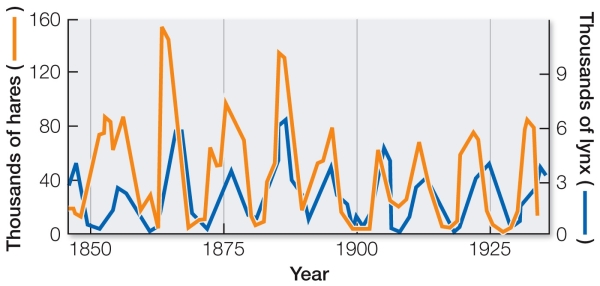 If trapping of both species declined, what changes would be expected to occur in the hare and lynx populations?
 (Multiple Choice)
4.8/5 (83)
(83) A stressful environment, such as a desert, will likely have a high proportion of ecological interactions that are _______ (positive/negative/neutral).
(Short Answer)
4.8/5 (88)
(88) Many stinging wasps that are not closely related have black-and-yellow striped abdomens and display similar behaviors.This example of Müllerian mimicry includes which type or types of prey defenses?
(Multiple Choice)
4.8/5 (93)
(93) Which type of interaction best characterizes a disease-causing bacterium?
(Multiple Choice)
4.7/5 (88)
(88) Which type of study would likely provide scientists with the best information on why lionfish are successfully invading the Western Atlantic and Caribbean?
(Multiple Choice)
4.7/5 (65)
(65) An "honest" mimic that is genuinely unpalatable and mimics the coloration of another species that is also unpalatable is called a(n) _______ mimic.
(Short Answer)
4.8/5 (71)
(71) Some types of pine trees are attacked and fed on by pine bark beetles.As the beetles feed, they girdle the trees, destroying the phloem layer and killing the trees.Pine bark beetles are also associated with the blue stain fungus, which grows in their frass (feces).As they attack the trees, the beetles also inject the fungus.The fungal hyphae grow into the tree and follow its xylem cells, blocking the flow of xylem and causing rapid tree death.This information suggests that the relationship between the pine bark beetle and fungus is _______, while the relationship between the beetle and the pine tree is _______.
(Multiple Choice)
4.8/5 (82)
(82) Many scientists think the great number of parasite species on Earth can be explained by the specialization parasites have undergone and continue to undergo.Which factor is likely most responsible for the continued evolution of new forms of parasites?
(Multiple Choice)
4.8/5 (86)
(86) In Robert Paine's study of sea star-mussel interactions in rocky shore communities of the Pacific Northwest, which species would be considered a keystone species and why?
(Multiple Choice)
4.9/5 (88)
(88) Many species of parrotfishes inhabit coral reefs.These species have different feeding habits, swimming in and around the corals.Many large species, such as steephead parrotfish, feed by scraping algae from the substrate of the coral reef, exposing bare areas where new coral larvae can settle.Others, such as bumphead parrotfish, actually eat the coral, taking large bites from the coral skeleton and damaging its integrity, so it takes years to repair.How can these interactions best be characterized?
(Multiple Choice)
4.9/5 (94)
(94) Why would it be particularly beneficial for sessile species, such as plants or corals, to develop positive interactions such as mutualisms or commensalisms?
(Essay)
4.9/5 (74)
(74) Leaf cutter ants cannot survive without the fungus that they cultivate in their gardens, and the fungus in turn cannot survive without the ants.Which statement best describes this interaction?
(Multiple Choice)
4.9/5 (86)
(86) A newly discovered frog species secretes toxic chemicals.Compared with closely related species without chemical defenses, members of this new frog species will most likely
(Multiple Choice)
4.8/5 (80)
(80) The African savanna is flat and has few hiding places.In this environment, which characteristic is likely to be the greatest asset for a predator?
(Multiple Choice)
4.8/5 (84)
(84) Anemonefishes can tolerate the stings of anemone tentacles, whereas most fish species cannot.An anemonefish lives among an anemone's tentacles, where the anemone protects it from its predators, butterfly fishes.This is an example of
(Multiple Choice)
5.0/5 (84)
(84) Describe an experiment that would enable you to assess the degree of interspecific competition that exists between two rodent species living in the same habitat.How would you interpret the results?
(Essay)
4.8/5 (77)
(77) 
Filters
- Essay(0)
- Multiple Choice(0)
- Short Answer(0)
- True False(0)
- Matching(0)